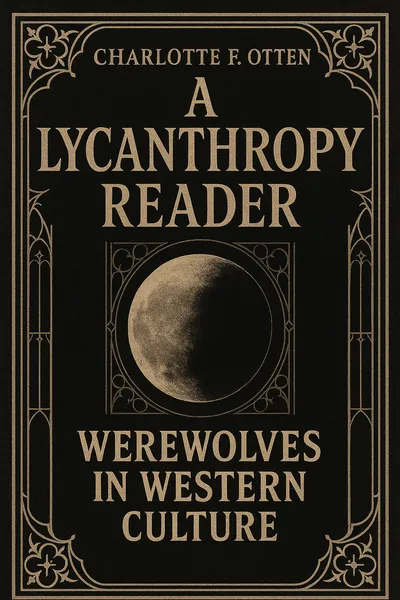
A Lycanthropy Reader
Werewolves in western culture
Description
Charlotte F. Otten presents a comprehensive interdisciplinary examination of lycanthropy as a cultural phenomenon spanning medical, legal, literary, and philosophical domains across Western civilization. Drawing upon her expertise in comparative literature and medieval studies, Otten constructs a multifaceted analysis that transcends traditional academic boundaries. The work emerges within contemporary scholarly discourse on cultural mythology and collective psychological manifestations, positioning itself as both historical survey and cultural criticism. This ambitious undertaking seeks to demonstrate how the werewolf figure functions as a revelatory lens through which Western society has consistently negotiated fundamental questions about human nature and social order.
The central research question driving this work asks: How has the werewolf figure evolved across Western cultural institutions to embody society's deepest anxieties about human nature and social boundaries? Otten's defended thesis maintains that the persistence of lycanthropy narratives across diverse cultural domains reveals a fundamental Western preoccupation with the fragility of civilization and the perpetual threat of regression to primitive states. The main stake of this analysis is to establish lycanthropy as a crucial interpretive framework for understanding Western civilization's ongoing negotiation with questions of identity, control, and the limits of human rationality.
Otten successfully demonstrates that lycanthropy functions as a persistent cultural construct that reveals Western civilization's deepest anxieties about human nature and social order. Through interdisciplinary analysis spanning medical, legal, literary, and philosophical domains, the work establishes the werewolf as a crucial interpretive lens for understanding cultural psychology. The author's comprehensive approach illuminates how transformation narratives serve multiple social functions, from reinforcing boundaries to providing outlets for suppressed desires. The work's strength lies in its demonstration of continuity across historical periods, revealing how fundamental concerns about civilization and savagery persist despite changing cultural contexts. This analysis contributes significantly to cultural studies by establishing mythology as a legitimate framework for understanding collective psychology and social organization.
Table of contents
01 Medical Perspectives: Pathological Transformation and Scientific Rationalization
Otten's analysis of medical perspectives on lycanthropy reveals how scientific discourse has consistently attempted to rationalize transformation narratives through pathological frameworks. The medical documentation of alleged werewolf cases demonstrates society's need to contain supernatural explanations within empirical structures. This medicalization reflects deeper epistemological tensions between emerging scientific rationality and persistent folkloric beliefs. The author illuminates how medical authorities constructed lycanthropy as a form of madness, thereby preserving social order while acknowledging the phenomenon's cultural persistence. This medicalization process reveals Western culture's characteristic strategy of domesticating threatening concepts through institutional categorization. The medical approach ultimately exposes society's discomfort with liminal states that challenge established taxonomies of human experience.

02 Legal Frameworks and Social Control: Werewolf Trials as Cultural Theater
The examination of historical werewolf trials unveils the juridical mechanisms through which societies have attempted to maintain boundaries between acceptable and transgressive behavior. Otten demonstrates how legal proceedings against alleged lycanthropes served multiple social functions beyond simple punishment. These trials functioned as theatrical performances of social cohesion, reinforcing community boundaries while providing cathartic outlets for collective anxieties. The legal treatment of lycanthropy cases reveals the intersection of superstition and emerging rational legal frameworks, illustrating how societies negotiate transitions between belief systems. The author's analysis suggests that werewolf trials served as early forms of social control, targeting individuals who threatened established hierarchies or community stability. This legal dimension exposes how transformation narratives became instruments of political and social regulation.
03 Literary Evolution and Cultural Memory: From Medieval Morality to Modern Psychology
The literary trajectory of werewolf narratives demonstrates how cultural anxieties evolve while maintaining core symbolic functions. Otten traces the transformation of lycanthropy from medieval cautionary tales to contemporary psychological horror, revealing shifting concerns about human nature and social organization. Medieval texts emphasize moral corruption and divine punishment, reflecting theocentric worldviews and hierarchical social structures. Modern literary treatments increasingly focus on psychological fragmentation and loss of civilized identity, mirroring contemporary anxieties about urban alienation and social atomization. This evolution illustrates how the werewolf figure adapts to historical contexts while preserving its essential function as a repository for cultural fears. The literary analysis reveals how transformation narratives serve as vehicles for exploring forbidden desires and suppressed aspects of human experience.
04 Philosophical Implications and Existential Questions: Challenging Western Humanism
The philosophical dimensions of lycanthropy engage fundamental questions about human essence and the nature of identity. Otten explores how werewolf narratives challenge Western philosophical traditions that privilege reason over instinct and culture over nature. The transformation motif confronts essentialist concepts of human nature, suggesting instead a more fluid and precarious understanding of identity. These narratives implicitly critique Cartesian dualism by proposing permeable boundaries between mind and body, human and animal. The philosophical implications extend to questions of moral responsibility and the relationship between individual agency and natural determinism. The werewolf figure thus emerges as a philosophical thought experiment that interrogates the foundations of Western humanism and rational discourse.
05 Critical Assessment and Future Directions
Despite its interdisciplinary ambition, Otten's analysis occasionally suffers from insufficient engagement with contemporary anthropological theories of ritual and symbolism. The work's Western-centric focus limits its comparative potential, missing opportunities to explore how other cultures handle similar transformation narratives. Additionally, the analysis could benefit from deeper engagement with feminist and postcolonial perspectives that might illuminate how werewolf narratives reinforce or challenge existing power structures.
Related books