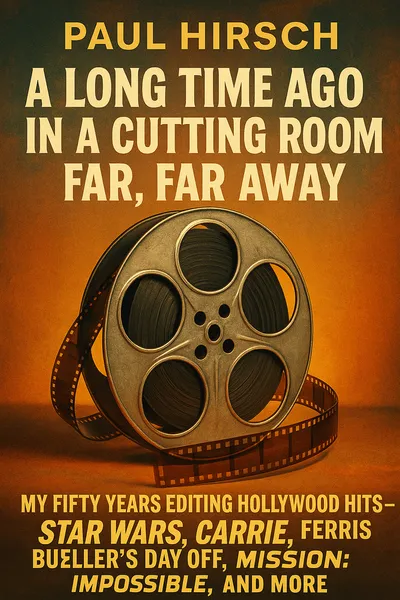
A Long Time Ago in a Cutting Room Far, Far Away
My Fifty Years Editing Hollywood Hits―Star Wars, Carrie, Ferris Bueller's Day Off, Mission: Impossible, and More
Description
Paul Hirsch's memoir "A Long Time Ago in a Cutting Room Far, Far Away" emerges as a significant contribution to cinema studies, offering unprecedented access to the creative processes behind some of Hollywood's most influential films. Drawing from his extensive experience as a film editor, Hirsch provides both technical insights into the craft of editing and cultural analysis of the film industry's evolution during the blockbuster era. The work situates itself within the broader discourse of cinematic craftsmanship while interrogating the relationship between artistic vision and commercial imperatives.
The central research question examined throughout the memoir is: How does the invisible craft of film editing function as both technical process and cultural mediation in shaping cinematic meaning? Hirsch's defended thesis argues that film editing operates as the fundamental yet underrecognized force that transforms raw footage into culturally resonant narratives. The main stake of the work is to illuminate editing as a creative practice that transcends mere technical execution to become a form of cultural authorship.
This thesis constitutes the art of film editing as the invisible architecture of cinema, where technical mastery and creative intuition converge to shape cultural narratives that define generational consciousness.
Table of contents
01 The Invisible Craft as Cultural Production
Hirsch's analysis reveals film editing as a form of cultural labor that operates beneath the threshold of popular consciousness while fundamentally determining audience experience. The memoir demonstrates how editorial decisions function as interpretive acts, where the editor serves simultaneously as technician, artist, and cultural mediator. This positioning challenges traditional auteur theory by suggesting that cinematic meaning emerges through collaborative processes rather than singular directorial vision.

02 Industry Dynamics and Creative Autonomy
The memoir interrogates the tension between artistic integrity and commercial pressures within Hollywood's studio system. Hirsch's experiences across different production contexts reveal how editorial creativity operates within complex networks of power relations, budget constraints, and market demands. His collaborations with directors like De Palma demonstrate how the editor-director relationship functions as a creative partnership where aesthetic decisions emerge through negotiation rather than hierarchy.
03 Technology and Aesthetic Transformation
Hirsch's career trajectory coincides with fundamental technological transitions in film editing, from mechanical cutting to digital systems. His analysis of these changes reveals technology not as neutral tool but as cultural force that reshapes creative possibilities and aesthetic sensibilities. The transition from physical film cutting to digital editing represents a paradigmatic shift that alters not only technical processes but fundamental relationships between editor, material, and creative outcome.
04 Cultural Memory and Generational Impact
The films edited by Hirsch have achieved canonical status within popular culture, raising questions about how editorial choices contribute to cultural longevity and generational transmission. His work on Star Wars and other blockbusters demonstrates how editorial decisions participate in creating cultural touchstones that transcend their immediate entertainment function to become shared reference points for collective memory. This analysis reveals editing as a form of cultural curation, where editorial choices determine which elements of performance, dialogue, and visual content survive into cultural circulation.
05 Critical Assessment and Future Directions
Hirsch's memoir successfully demonstrates that film editing constitutes a distinct form of cultural authorship that operates through technical mastery, aesthetic sensitivity, and cultural intuition. The work establishes editing as creative practice that transcends mere technical execution to become a form of interpretive artistry. His account reveals how editorial decisions function as cultural interventions that shape not only individual films but broader patterns of popular meaning-making.
The memoir's intellectual contribution lies in its successful integration of technical expertise with cultural analysis, offering insights valuable both to film studies scholarship and broader discussions of cultural production. Hirsch's perspective illuminates the collaborative nature of cinematic creation while asserting the editor's distinctive creative contribution to the filmmaking process. However, the memoir's primary limitation lies in its tendency toward nostalgic idealization of Hollywood's classical period, potentially obscuring contemporary challenges facing film editors in an increasingly fragmented media landscape.
Related books