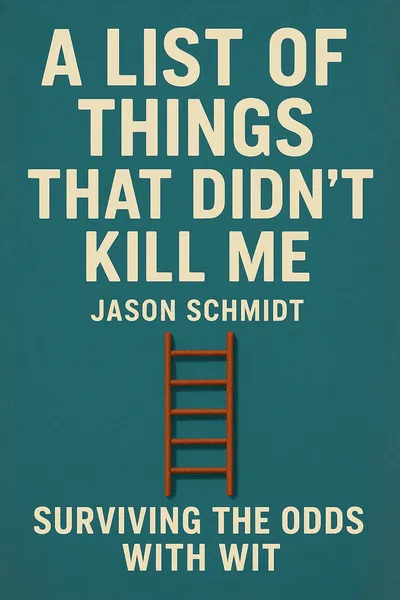
A List of Things That Didn't Kill Me
Surviving the odds with wit
Description
Jason Schmidt's debut memoir "A List of Things That Didn't Kill Me" positions itself within the contemporary landscape of trauma literature, where personal catastrophe becomes the raw material for literary transformation. The author, drawing from his background in creative writing, constructs a narrative that interrogates the relationship between childhood adversity and adult resilience. The work emerges from a tradition established by writers such as Jeannette Walls, yet distinguishes itself through its particular attention to the mechanisms by which young people navigate systemic familial dysfunction while maintaining agency and hope.
The central research question driving the memoir is: How does an individual maintain psychological integrity and moral clarity when raised within fundamentally dysfunctional family systems? Schmidt defends the thesis that survival and growth are possible through the cultivation of narrative distance, dark humor, and the strategic preservation of selfhood against chaotic environments. The main stake of the work is to demonstrate that resilience is not passive endurance but active creative resistance to destructive circumstances.
"A List of Things That Didn't Kill Me" demonstrates that resilience emerges not from the absence of trauma but from the creative transformation of adverse experiences into meaningful narrative and identity formation. This memoir presents a sophisticated analysis of how individuals navigate and transcend adverse circumstances through the cultivation of narrative capacity, ethical reasoning, and creative resilience. Schmidt's memoir contributes to contemporary understanding of trauma and recovery by demonstrating that survival requires active engagement with experience rather than passive endurance. The work's intellectual coherence emerges from its consistent attention to agency within constraint, revealing how ordinary human capacities for meaning-making and connection provide resources for extraordinary challenges.
Table of contents
01The Architecture of Dysfunction
Schmidt's exploration reveals dysfunction not as aberration but as systematic structure requiring sophisticated navigation strategies. The memoir illuminates how children develop parallel cognitive frameworks—one for managing immediate survival within toxic environments, another for preserving future possibilities. This dual consciousness represents a fundamental adaptation mechanism wherein the child learns to simultaneously participate in and resist familial pathology.

02Narrative as Survival Technology
The memoir's central innovation lies in its demonstration of storytelling as survival mechanism. Schmidt reveals how the capacity to narrate experience—to transform lived chaos into coherent sequence—becomes a fundamental tool for psychological preservation. This process involves neither denial nor romanticization but rather the development of critical distance that allows for both acknowledgment of harm and maintenance of hope.
03The Ethics of Survival
The memoir confronts complex ethical questions surrounding loyalty, responsibility, and self-preservation within family systems. Schmidt navigates the tension between protecting oneself and abandoning others, revealing how young people develop sophisticated moral reasoning when confronted with impossible choices. The work demonstrates that ethical development can occur even within—or perhaps especially within—morally compromised environments.
04Resilience as Creative Act
The work's final analytical axis concerns the nature of resilience itself, repositioning it from passive endurance to active creation. Schmidt demonstrates that overcoming adversity requires not merely surviving but transforming experience into new possibilities for self and meaning. This transformation involves developing capacities for joy, humor, and connection despite—and partly because of—early exposure to their opposites.
05Critical Assessment and Future Implications
The memoir's primary limitation lies in its potential universalization of highly individual strategies, risking the suggestion that all trauma can be overcome through narrative and humor. Schmidt's particular circumstances—including his intelligence, verbal capacity, and eventual access to supportive relationships—may not be generalizable to all situations of childhood adversity. The work also demonstrates some tension between its literary ambitions and its therapeutic implications, occasionally privileging aesthetic coherence over psychological complexity.
Related books