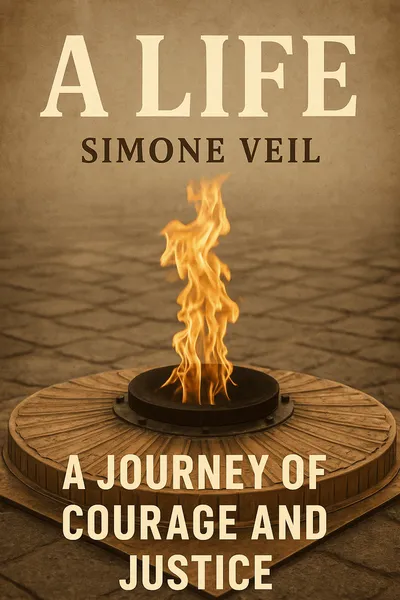
A Life
A journey of courage and justice
Description
Simone Veil's autobiographical work emerges as a singular testimony that transcends the conventional boundaries between personal memoir and political manifesto. Positioned at the intersection of Holocaust studies, feminist theory, and European political history, this text constitutes both an intimate confession and a programmatic declaration. The author's unique trajectory—from deportation survivor to architect of reproductive rights legislation—provides an exceptional vantage point for examining the mechanisms through which individual suffering can be alchemized into collective emancipation. The work situates itself within the broader corpus of testimonial literature while asserting its specificity through the author's subsequent political engagement.
At its core, the work addresses the central research question: How does the experience of extreme dehumanization generate an ethical imperative toward universal dignity and institutional transformation? Veil defends the thesis that personal trauma, when channeled through institutional engagement, becomes a transformative force capable of reshaping legal frameworks and social consciousness. The main stake of her argument lies in demonstrating that historical memory serves not as paralyzing burden but as generative foundation for progressive political action.
Veil's intellectual contribution lies in her demonstration that traumatic experience, rather than inevitably producing cynicism or withdrawal, can generate renewed commitment to universal human dignity. Her synthesis reveals how personal suffering, institutional engagement, and historical consciousness can be woven together into a coherent political philosophy that remains relevant beyond its specific historical context. The work's coherence stems from its consistent emphasis on agency within constraint, showing how individuals can shape institutional development even while acknowledging structural limitations. Her argument suggests that effective political action requires both intimate understanding of human vulnerability and strategic awareness of institutional possibilities. The text ultimately proposes that democratic societies must continuously recommit to their foundational values through ongoing political engagement rather than assuming their automatic perpetuation.
Table of contents
01 The Dialectics of Memory and Action
Veil's theoretical framework rests upon a sophisticated understanding of trauma as simultaneously destructive and constructive force. Rather than conceiving Holocaust experience as purely victimizing, she articulates a phenomenology of survival that emphasizes agency within constraint. This conceptual move challenges traditional narratives of historical determinism by positioning the survivor as active interpreter rather than passive recipient of meaning.

02 Institutional Transformation and Gender Politics
The author's examination of reproductive rights legislation reveals the complex mechanisms through which personal conviction translates into institutional change. Veil's analysis exposes the gendered dimensions of political resistance, particularly the ways in which women's bodies become battlegrounds for competing ideological frameworks. Her deconstruction of parliamentary opposition demonstrates how appeals to tradition and morality function as rhetorical strategies for maintaining existing power structures.
03 European Integration and Transnational Governance
Veil's perspective on European construction reveals tensions between national sovereignty and supranational coordination that remain relevant to contemporary political debates. Her analysis of institutional development demonstrates how traumatic historical memory can motivate integrative projects while simultaneously generating resistance to power-sharing arrangements. The author's examination of gender dynamics within European institutions exposes the persistence of masculine codes despite formal commitments to equality.
04 Ethics of Testimony and Historical Responsibility
The text's final analytical axis addresses the moral obligations that accompany survival and subsequent privilege. Veil articulates a sophisticated ethics of testimony that goes beyond simple bearing witness to encompass active intervention in contemporary debates. Her framework demonstrates how historical consciousness can inform present-day political judgment without falling into deterministic thinking.
05 Critical Assessment and Contemporary Relevance
Despite its compelling narrative arc, Veil's framework occasionally lapses into exceptionalist thinking that may limit its broader applicability. Her emphasis on Holocaust experience as foundational sometimes obscures other forms of historical trauma that might generate similar political commitments. The text's focus on institutional politics, while strategically important, potentially underestimates grassroots movements and alternative forms of political organization. Additionally, her analysis of gender dynamics, though pioneering for its time, would benefit from more intersectional perspectives that account for race, class, and sexuality as intersecting systems of oppression.
Related books