
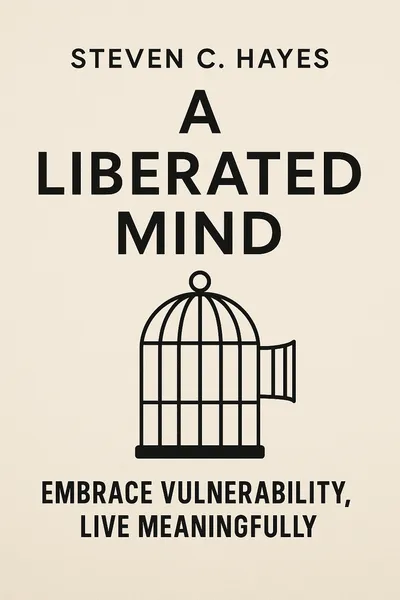
A Liberated Mind
Embrace vulnerability, live meaningfully
Description
Hayes presents a comprehensive exposition of Acceptance and Commitment Therapy principles within the broader context of contemporary mental health paradigms. Drawing from decades of clinical research and philosophical inquiry, the work challenges dominant therapeutic models that prioritize symptom reduction, proposing instead a radical reorientation toward psychological flexibility. The author situates his approach within ongoing debates about human suffering, meaning-making, and the fundamental nature of psychological well-being in modern society.
The central research question explores how individuals can achieve psychological liberation through acceptance-based approaches rather than traditional control-oriented strategies. Hayes defends the thesis that psychological flexibility, characterized by mindful awareness, value-driven action, and acceptance of difficult experiences, constitutes the foundation of human flourishing. The main stake involves demonstrating that attempts to eliminate psychological pain perpetuate suffering while embracing vulnerability enables authentic living.
Hayes constructs a compelling argument for fundamental transformation in understanding human psychology and therapeutic practice. The work successfully integrates scientific rigor with philosophical depth, demonstrating how acceptance-based approaches address root causes of suffering rather than merely managing symptoms. The theoretical coherence emerges from consistent application of contextual behavioral principles across individual, relational, and societal levels of analysis. The intellectual contribution lies in providing practical alternatives to dominant cultural narratives about happiness, success, and mental health. Hayes offers evidence-based methods for cultivating psychological flexibility while maintaining accessibility for general audiences. The work's coherence stems from its systematic deconstruction of problematic assumptions followed by constructive rebuilding around workable principles. This represents significant advancement in both theoretical understanding and practical application of acceptance-based interventions.
Table of contents
01 The Paradigmatic Shift from Control to Acceptance
Hayes fundamentally challenges the mechanistic worldview underlying traditional psychotherapy by proposing a contextual behavioral science framework. This theoretical reorientation dismantles the medical model's emphasis on symptom elimination, reconceptualizing psychological distress as natural human experiences rather than pathological conditions requiring eradication. The author draws from evolutionary psychology to argue that human cognitive abilities, particularly language and symbolic thinking, create unique vulnerabilities to psychological suffering through rumination, worry, and experiential avoidance.

02 Social Implications of Psychological Flexibility
The societal ramifications of widespread psychological inflexibility manifest in contemporary culture's obsession with happiness, success, and control. Hayes examines how modern institutions perpetuate experiential avoidance through promises of pain elimination and perfect solutions. Consumer culture capitalizes on psychological inflexibility by marketing products and experiences as antidotes to natural human discomfort, creating cycles of dependency and disappointment.
03 Deconstructing the Self and Reconstructing Identity
Hayes presents a radical deconstruction of conventional notions of selfhood, arguing that rigid self-concepts constitute primary sources of psychological suffering. The conceptualized self, built through language and social conditioning, creates artificial boundaries between self and others, generating defensive strategies that limit growth and connection. This analysis reveals how identity attachments prevent individuals from responding flexibly to changing circumstances and relationships.
04 Ethical Dimensions of Values-Based Living
The ethical framework emerging from acceptance-based approaches emphasizes chosen values over prescribed moral codes. Hayes argues that psychological flexibility enables individuals to act from intrinsic motivation rather than external compliance, creating more sustainable and meaningful behavioral patterns. This values-based orientation transcends traditional approaches to behavioral change by connecting actions to deeper purposes rather than immediate consequences.
05 Critical Analysis and Future Directions
Despite its strengths, the work exhibits potential limitations in addressing structural inequalities and systemic oppression that contribute to psychological suffering. The emphasis on individual psychological flexibility may inadvertently minimize the importance of social justice and collective action in addressing mental health disparities. Additionally, the approach risks cultural imperialism by privileging Western individualistic values over collectivistic worldviews that emphasize community interdependence.
Related books