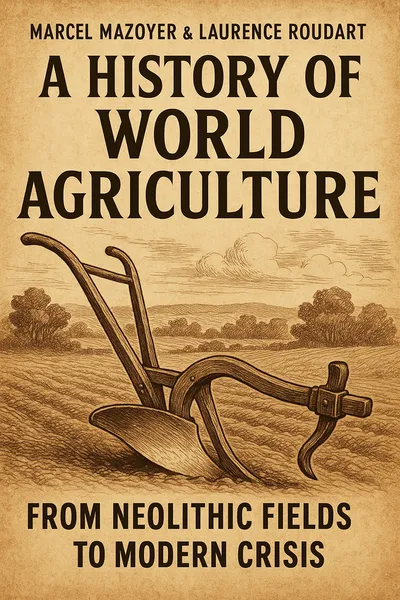
A History of World Agriculture
From neolithic fields to modern crisis
Description
Marcel Mazoyer and Laurence Roudart present a comprehensive historical synthesis that traces agricultural development across civilizations and continents. Drawing upon their expertise in comparative agricultural systems, the authors construct a panoramic view of human agricultural endeavors, positioning their work within both agricultural economics and environmental history. This ambitious undertaking seeks to illuminate contemporary food crises through historical perspective, challenging conventional narratives about agricultural progress and modernization.
The central research question that drives their work is: How have agricultural systems evolved throughout human history, and what does this evolution reveal about current global food security challenges? Their defended thesis argues that contemporary agricultural crises stem from historical patterns of agricultural development that created systemic inequalities and unsustainable practices, requiring understanding of long-term agricultural evolution for effective solutions. The main stake of their work involves demonstrating that current food insecurity and rural exodus represent culminations of historical processes rather than isolated contemporary phenomena.
The current agricultural crisis facing humanity can only be understood through a comprehensive historical analysis of agricultural systems and their continuous evolution from Neolithic times to the present. This perspective challenges purely contemporary approaches to food security by revealing the deep historical roots of modern agricultural contradictions and crises.
Table of contents
01 Historical Determinism and Agricultural Evolution
The authors construct a deterministic framework linking agricultural techniques to civilizational development, presenting agriculture as the fundamental driver of social transformation. Their analysis reveals how technological innovations in cultivation, irrigation, and animal domestication generated surplus production, enabling social stratification and urban development. This perspective emphasizes the dialectical relationship between environmental constraints and human innovation, where agricultural solutions emerge from specific ecological contexts.

02 Power Structures and Agricultural Control
The work illuminates how agricultural surplus concentration facilitated the emergence of hierarchical societies, where land ownership became synonymous with political power. Mazoyer and Roudart demonstrate how agricultural productivity increases enabled ruling classes to extract resources from rural populations, establishing patterns of exploitation that persist in contemporary global agriculture.
03 Environmental Degradation and Agricultural Intensification
The historical trajectory mapped by the authors reveals recurring patterns of environmental destruction accompanying agricultural intensification. From ancient Mesopotamian soil salinization to contemporary industrial agriculture's ecological impact, they document how short-term productivity gains often generated long-term environmental costs. This analysis exposes the fallacy of treating environmental problems as recent phenomena, demonstrating their deep historical roots.
04 Contemporary Crisis and Historical Continuity
Mazoyer and Roudart position current global food crises within historical continuity, arguing that contemporary hunger and rural displacement represent intensifications of long-standing structural contradictions rather than aberrant contemporary developments. Their analysis reveals how agricultural modernization, while increasing aggregate production, simultaneously marginalized small-scale producers and concentrated land ownership.
05 Critical Analysis and Future Directions
Mazoyer and Roudart construct a compelling narrative linking agricultural history to contemporary global challenges, demonstrating remarkable scholarly synthesis across vast temporal and geographical scales. Their work successfully challenges ahistorical approaches to food security, revealing how current crises reflect accumulated historical contradictions rather than isolated contemporary problems. Their historical perspective offers valuable insights into alternative agricultural possibilities, suggesting that sustainable solutions must draw upon traditional knowledge systems while addressing contemporary challenges.
The authors' approach suffers from occasional technological determinism that underestimates human agency in agricultural choices. Their emphasis on crisis and contradiction, while analytically powerful, may overlook successful adaptations and innovations that offer hope for sustainable transformation. The work's vast scope sometimes sacrifices analytical depth for comprehensive coverage, potentially missing nuanced local variations in agricultural development. Furthermore, the authors' critique of industrial agriculture, while justified, occasionally idealizes traditional systems without fully acknowledging their limitations or internal contradictions. Their analysis would benefit from greater attention to gender relations in agricultural systems and the differential impacts of agricultural transformation on various social groups.
Related books