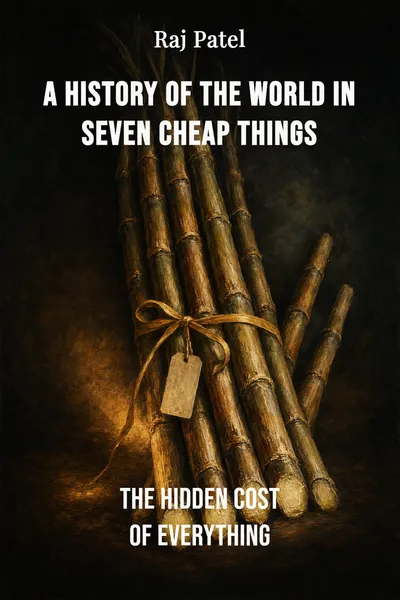
A History of the World in Seven Cheap Things
The hidden cost of everything
Description
Raj Patel, collaborating with environmental historian Jason W. Moore, constructs a sweeping reinterpretation of capitalist development through the lens of cheapness as both strategy and ideology. Positioning themselves within world-ecology theory and critical political economy, the authors challenge conventional economic historiography by demonstrating how capitalism's expansion has systematically depended upon rendering nature, money, work, care, food, energy, and lives artificially cheap. This interdisciplinary synthesis emerges from urgent contemporary crises—climate change, inequality, and social reproduction—demanding historical understanding of their structural origins.
The central research question driving this work asks: How has capitalism historically constructed and maintained artificial cheapness across seven fundamental domains to enable accumulation while externalizing social and ecological costs? The authors defend the thesis that the apparent cheapness of nature, money, work, care, food, energy, and lives constitutes capitalism's foundational strategy, systematically obscuring exploitation and environmental destruction through commodity fetishism and unequal exchange. The main stake of their argument lies in revealing the hidden architecture of capitalist cheapness to enable alternative economic imaginaries prioritizing social and ecological justice over profit maximization.
Patel and Moore construct a compelling historical narrative demonstrating capitalism's systematic dependence on artificially cheap inputs across multiple domains. Their world-ecological approach successfully integrates environmental and social justice concerns within coherent theoretical framework, revealing how seemingly separate crises share common structural origins. The seven cheap things concept provides analytical tools for understanding contemporary problems while historical perspective illuminates both constraints and possibilities for systemic transformation. Their argument's strength lies in connecting abstract economic theory with concrete historical processes, demonstrating how capitalism's global expansion required specific strategies for rendering diverse forms of work and nature cheap. This analysis enables readers to recognize current events—supply chain disruptions, care crises, climate chaos—as predictable outcomes of systemic logic rather than unfortunate accidents requiring minor adjustments.
Table of contents
01 The Commodification Matrix and Ecological Relations
The authors' theoretical framework fundamentally reconceptualizes capitalism as a world-ecological system rather than merely an economic arrangement. Their analysis reveals how the production of cheapness requires constant boundary-making between valued and devalued entities, demonstrating that capitalism's growth imperative necessitates the continuous incorporation of unpaid or underpaid work and resources. This perspective transcends traditional Marxist focus on labor exploitation by incorporating feminist critiques of social reproduction and ecological economics' attention to natural limits.

02 Imperial Strategies and Global Peripheralization
Patel and Moore's historical analysis demonstrates how European colonial expansion pioneered cheapness strategies that remain central to contemporary global capitalism. The plantation system exemplifies their argument, revealing how seemingly separate categories—cheap nature, work, and lives—intersect systematically. Colonial extraction required rendering Indigenous lands as empty nature available for appropriation, Indigenous and enslaved peoples as cheap labor power, and entire ecosystems as resource warehouses serving metropolitan accumulation.
03 Crisis Tendencies and Systemic Contradictions
The text illuminates capitalism's inherent tendency toward crisis through cheapness strategies' internal contradictions. As exploitation intensifies, resistance emerges from affected communities, forcing capital to seek new frontiers or technological fixes that ultimately reproduce problems at larger scales. Climate change exemplifies this dynamic, representing capitalism's incapacity to internalize ecological costs without undermining accumulation imperatives.
04 Alternative Imaginaries and Transformative Possibilities
Beyond critique, Patel and Moore gesture toward post-capitalist possibilities emerging from current crisis moments. They highlight diverse resistance movements challenging cheapness logic through food sovereignty initiatives, commons restoration, and care ethics prioritizing social reproduction over accumulation. These alternatives demonstrate practical possibilities for organizing economic activity around use-value rather than exchange-value, emphasizing reciprocity and ecological integration.
05 Critical Assessment and Future Directions
Despite their synthetic ambition, the authors occasionally sacrifice analytical precision for sweeping generalization, particularly regarding non-Western economic systems' historical diversity. Their emphasis on capitalism's totalizing logic sometimes understates actually-existing alternatives and hybrid arrangements that complicate binary opposition between capitalist and post-capitalist futures. Additionally, while identifying cheapness strategies' contradictions, they provide limited concrete analysis of transition pathways beyond gestural references to grassroots movements.
Related books