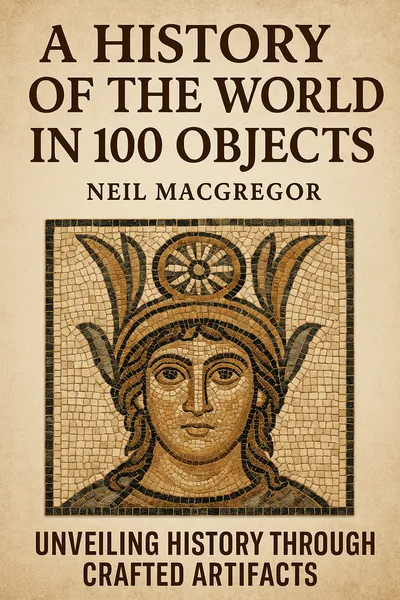
A History of the World in 100 Objects
Unveiling history through crafted artifacts
Description
Macgregor's ambitious project emerges from contemporary debates surrounding global history and cultural representation within museum spaces. Drawing upon his extensive curatorial expertise, the author challenges traditional chronological narratives by proposing material culture as the fundamental lens through which human development can be decoded. This methodological shift reflects broader academic movements toward decolonizing historical discourse while simultaneously asserting the museum's role as a democratizing institution capable of transcending cultural boundaries.
The book's central research question asks: How can material objects serve as universal languages for understanding human civilization across cultural and temporal divides? Macgregor defends the thesis that objects function as primary historical texts that reveal shared human experiences while simultaneously preserving cultural specificity. The main stake is to establish material culture as a legitimate and superior methodology for global historical analysis.
Macgregor's intellectual contribution lies in demonstrating material culture's capacity to generate historical knowledge while simultaneously making that knowledge accessible to diverse audiences. The work succeeds in creating a coherent global narrative without imposing homogenizing interpretations, maintaining tension between universal and particular dimensions of human experience. The author's curatorial expertise enables sophisticated object analysis while his communicative skills ensure broad accessibility, achieving a rare synthesis of scholarly rigor and public engagement.
The argument's coherence derives from consistent application of material culture methodology across diverse cultural contexts, creating cumulative evidence for objects' capacity to reveal human patterns while respecting cultural specificity. This methodological consistency allows readers to develop interpretive confidence while engaging with unfamiliar cultural contexts, effectively training audiences in visual literacy and cross-cultural analysis.
Table of contents
01 Materiality as Historical Epistemology
Macgregor's fundamental theoretical innovation lies in repositioning objects from mere illustrations of historical processes to primary sources of knowledge production. This epistemological shift challenges traditional textual hierarchies within historical scholarship, suggesting that material culture possesses inherent narrative capacities often superior to written documentation. The author employs a phenomenological approach, treating each artifact as a condensation of human intention, technological capability, and social structure.

02 Democracy and Cultural Authority
The work's most radical political dimension emerges through its implicit critique of traditional cultural hierarchies. By selecting objects ranging from prehistoric tools to contemporary manufactured goods, Macgregor challenges established distinctions between high and low culture, effectively democratizing historical significance. This curatorial strategy functions as a subtle but persistent argument against Eurocentric historical narratives that privilege written records and monumental architecture.
03 Temporality and Cultural Translation
Macgregor's handling of temporal relationships reveals sophisticated engagement with postcolonial theory, particularly regarding the politics of cultural translation. Rather than imposing linear developmental narratives, the author creates dialogues between objects separated by millennia, suggesting that human concerns remain fundamentally consistent despite technological and social transformations. This approach destabilizes progress narratives while maintaining appreciation for human creativity and adaptation.
04 Global Citizenship and Cultural Responsibility
The ethical dimensions of Macgregor's project emerge most clearly through its implicit argument for cultural stewardship and global citizenship. By presenting human creativity as a shared heritage transcending national boundaries, the work constructs a cosmopolitan vision of cultural belonging that challenges nationalist appropriations of historical legacy. Objects become ambassadors of human achievement, suggesting that cultural treasures belong ultimately to humanity rather than particular nations or communities.
05 Critical Evaluation and Future Directions
The work's primary limitation lies in its insufficient engagement with power relations embedded within both historical processes and contemporary museum practices. While celebrating human creativity, Macgregor tends to minimize the violence and exploitation that frequently accompanied object production and circulation. The analysis remains largely depoliticized, focusing on cultural achievement rather than the social conditions enabling such achievement.
Additionally, the selection criteria remain opaque, potentially reproducing curatorial biases despite democratic intentions. The emphasis on objects within British Museum collections inevitably privileges particular cultural traditions while marginalizing others, creating systematic blind spots that undermine the project's universalizing aspirations.
Related books