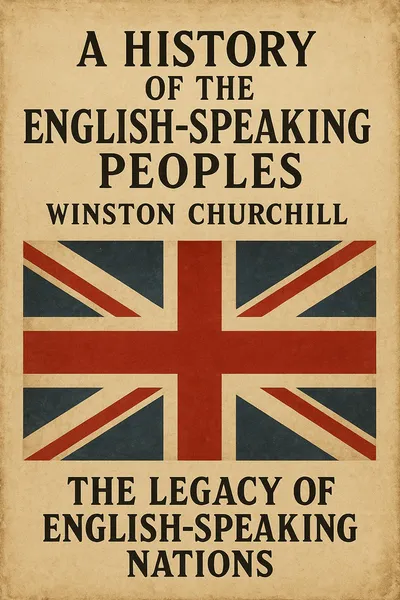
A History of the English-Speaking Peoples
The legacy of English-speaking nations
Description
Churchill's magnum opus represents a sweeping interpretation of Anglo-Saxon civilization from its medieval origins through the twentieth century. Written during the Cold War era, this work reflects Churchill's conviction that English-speaking nations possess unique historical bonds transcending political divisions. The author leverages his dual expertise as statesman and historian to construct a narrative that positions these peoples as the primary architects of modern democratic governance, constitutional monarchy, and liberal capitalism. This civilizational history emerges from Churchill's broader political philosophy, emphasizing cultural continuity and shared institutional heritage as foundations for international cooperation.
Churchill argues that the English-speaking peoples constitute a distinctive civilization united by shared language, democratic institutions, and common law traditions that have collectively shaped the trajectory of modern world history. The central research question driving the work examines what historical forces and shared characteristics have enabled English-speaking peoples to exercise disproportionate influence on global political, economic, and cultural development. The defended thesis maintains that English-speaking nations form a coherent civilizational bloc whose common linguistic, legal, and political traditions have positioned them as the principal agents of democratic modernization worldwide. The main stake of the work is to demonstrate that Anglo-Saxon institutional frameworks and cultural values represent the most successful model for organizing human societies and international relations.
Churchill's monumental work constructs a comprehensive interpretive framework positioning English-speaking peoples as history's primary progressive force, united by language, institutions, and cultural values that have shaped global development. The author weaves together linguistic analysis, constitutional history, imperial expansion, and civilizational comparison to demonstrate the coherence and continuity of Anglo-Saxon influence across centuries of political transformation. The work's intellectual contribution lies in its systematic articulation of cultural nationalism transcending political boundaries, providing historical foundation for twentieth-century Anglo-American alliance while celebrating shared democratic traditions. Churchill's narrative skill and political insight create compelling account of institutional development and international cooperation among English-speaking nations.
Table of contents
01 Linguistic Imperialism and Cultural Hegemony
Churchill's analysis reveals language as the fundamental organizing principle of his historical framework, yet this approach conceals profound ideological assumptions about cultural superiority. The author treats English linguistic expansion as a natural evolutionary process, obscuring the violent mechanisms of colonial conquest that facilitated this dominance. His narrative constructs language not merely as communication tool but as carrier of supposedly superior rationality, pragmatism, and democratic instincts inherent to Anglo-Saxon peoples.
The theoretical framework underlying this linguistic determinism draws heavily from nineteenth-century racial theories and cultural evolutionism, positioning English as the inevitable vehicle of human progress. Churchill's treatment of indigenous languages and cultures reveals paternalistic assumptions about civilizational hierarchy, systematically marginalizing non-English speaking contributions to political and intellectual development. This linguistic imperialism operates through historical narrative itself, reinforcing contemporary Anglo-American dominance by naturalizing past conquests as progressive transformation.

02 Democratic Exceptionalism and Constitutional Mythology
Churchill constructs an elaborate mythology surrounding Anglo-Saxon democratic traditions, tracing contemporary parliamentary systems to supposedly ancient Germanic assemblies and medieval English councils. This genealogical approach obscures the revolutionary ruptures and social conflicts that actually produced modern democratic institutions, instead presenting gradual evolution as natural expression of inherent cultural characteristics.
The author's constitutional interpretation emphasizes procedural continuity over substantive transformation, minimizing the radical democratization struggles that expanded political participation beyond aristocratic elites. His narrative privileges institutional forms over social movements, systematically underplaying popular resistance, working-class organization, and feminist activism in achieving democratic reforms. This elite-centered perspective reinforces conservative interpretations of political change while marginalizing revolutionary traditions within English-speaking societies.
03 Imperial Networks and Global Hegemony
The work's treatment of imperial expansion reveals Churchill's fundamental ambivalence toward colonial violence while celebrating the civilizational benefits allegedly flowing from English dominance. His narrative transforms conquest into partnership, presenting indigenous displacement and cultural destruction as necessary costs of historical progress. This imperial apologetics operates through strategic omissions and euphemistic language that obscures systematic brutality underlying Anglo-Saxon expansion.
04 Civilizational Mission and Cultural Supremacy
Churchill's civilizational framework ultimately rests on assumptions about Anglo-Saxon cultural superiority that justify historical dominance while obscuring alternative development paths. His emphasis on English-speaking contributions to science, philosophy, and literature systematically minimizes non-Western intellectual traditions, presenting European knowledge systems as universal human achievements rather than particular cultural products.
05 Critical Analysis and Contemporary Relevance
Churchill's analysis suffers from fundamental methodological limitations rooted in cultural chauvinism and imperial nostalgia. His selective use of evidence systematically marginalizes non-English perspectives while constructing teleological narratives that present contingent historical outcomes as inevitable results of cultural superiority. The work's Eurocentric framework obscures alternative modernization paths while naturalizing colonial domination as civilizational progress.
The author's failure to engage seriously with indigenous knowledge systems, non-Western political traditions, or systematic critique of imperial violence undermines claims about democratic exceptionalism and moral leadership. His constitutional mythology ignores revolutionary social movements while privileging elite institutional continuity over popular democratization struggles.
Related books