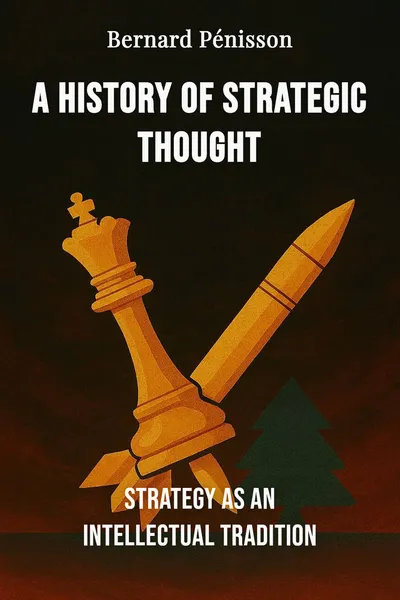
A History of Strategic Thought
Strategy as an intellectual tradition
Description
Somewhere in the fifth century before our era, a Chinese writer we call Sun Tzu set down a line that still gets quoted in sales meetings: the best victory is the one won without fighting. Around the same stretch of history, Greek city-states were learning the same thing the hard way, on the plains of the Peloponnese and the decks of their triremes. Neither tradition knew the other existed. Both were circling the same strange object — the idea that war is not only a matter of courage and numbers, but of thinking. That somewhere above the clash of bodies sits a layer of calculation, deception, timing and will, and that this layer can be studied, taught, and written down.
That intuition is what Bernard Pénisson follows across more than two thousand years in A History of Strategic Thought. His subject is not battles but the words people used to make sense of them: the treatises, the maxims, the quarrels between those who believed war obeyed rules and those who insisted it never would. Strategy, in his telling, is less a toolbox than a conversation — one that runs from Thucydides to the nuclear theorists, each generation inheriting the vocabulary of the last and bending it to a world the last could not have imagined.
The curious part is where that conversation ends up. The language forged to move armies and sink fleets did not stay on the battlefield. It drifted into offices, onto whiteboards, into the titles of books stacked by airport checkout counters. We talk now about market positioning, competitive advantage and the long game as if these were natural phrases, forgetting they were born under fire. Pénisson's book lets us watch that long migration happen in slow motion.
The question we’re asking : How did strategy become a tradition of thought in its own right — and where did that tradition eventually travel?What we’ll see : A lineage of thinkers who kept trying, and failing, to turn the chaos of conflict into something that could be reasoned about.
Table of contents
01Chapter 1 — The Greeks who separated cunning from force
Pénisson begins where the European tradition likes to begin, with the Greeks, but he is careful about what they actually bequeathed. The word strategy comes from strategos, the elected general of Athens, and for a long time the thing itself was inseparable from the man — his judgment, his nerve, his luck. There was no abstract science of command yet. What there was, and what the Greeks prized above almost everything, was metis: the cunning intelligence of Odysseus, the ability to read a situation, improvise, and turn an opponent's strength against him. Force was for Achilles. Metis was for the man who came home.
Thucydides is Pénisson's first real strategist, though he never wrote a treatise. In narrating the long war between Athens and Sparta, he produced something closer to a laboratory: here is a sea power, here is a land power, here is what happens when each tries to fight on the other's terrain, and here is how fear, honor and interest drive states toward catastrophe. The history is also an argument. Athens loses not because it is weaker but because it overreaches, gambling an army on Sicily against its own best reasoning. The lesson that resources must be matched to aims is older than any manual.

02Chapter 2 — Clausewitz and the search for a theory
The someone, in Pénisson's account, arrives with the upheaval of the French Revolution and Napoleon. Mass conscription, national passion and an emperor who treated battle as the solvent of all political problems forced a generation of observers to rethink everything. Two men dominate the response. Antoine-Henri Jomini, Swiss by birth, tried to extract from Napoleon's campaigns a set of principles — lines of operation, the concentration of force at the decisive point — that a diligent officer could learn and apply. His work read like geometry, and armies loved it precisely because it promised that war could be mastered like an engineering problem.
Carl von Clausewitz, a Prussian who had watched his own state collapse before Napoleon, pushed in the opposite direction. His unfinished On War, published by his widow in the early 1830s, is the hinge of the whole tradition. Strategy, for him, could not be reduced to maxims, because war is permeated by what he called friction — the fog, the fatigue, the small accidents that make the simplest thing difficult — and by chance and passion. Yet it was not senseless. His most famous formula, that war is the continuation of policy by other means, subordinates the whole bloody business to political purpose. The general does not fight for victory in the abstract; he fights for an end set outside the battlefield.
03Chapter 3 — The sea, the air, and the collapse of the decisive battle
Land war had its theorists; the sea got its own. Pénisson gives real weight to Alfred Thayer Mahan, the American naval officer whose lectures in the 1890s argued that history turned on control of the oceans. Command of the sea, concentrated battle fleets, the chain of bases and trade routes — Mahan's ideas were devoured by the admiralties of Britain, Germany, Japan and the United States, and helped drive the naval arms race that preceded the First World War. Here strategy shows its political force: a book can help build a fleet, and a fleet can help start a war.
Then the twentieth century broke the models. The slaughter of 1914 to 1918 made a mockery of the decisive battle; millions died to move trenches a few miles. Out of that trauma came the airpower prophets, Giulio Douhet foremost among them, who insisted the next war would be won from above, by bombing an enemy's cities and will into submission, bypassing the stalemate on the ground entirely. Alongside them, theorists of mechanized war like Basil Liddell Hart revived the older Greek preference for the indirect approach — win by dislocation and maneuver, not by frontal attrition.
04Chapter 4 — From the general staff to the boardroom
The most revealing stretch of Pénisson's book is the last, where the tradition leaves the battlefield almost entirely. After the Second World War, the vocabulary of strategy began colonizing the corporation. The reasons were partly literal: the men running American firms in the 1950s had often run logistics and planning in uniform, and the techniques of operational research born in wartime moved easily into management. By the 1960s business schools were teaching corporate strategy, and the generals' language — objectives, campaigns, fronts, the concentration of effort — had quietly become the language of markets.
What made the migration more than a metaphor was that the deep structure transferred too. Clausewitz's insistence that military means serve political ends reappears as the rule that tactics must serve a company's purpose rather than the reverse. The ancient preference for metis over brute force returns as the cult of the clever maneuver, the flanking product, the market a rival never thought to defend. Michael Porter's frameworks for competitive advantage, Pénisson notes, are recognizably descendants of the planners' habit of mapping terrain and seeking the decisive point. Even Sun Tzu, in translation, became a fixture on executive bookshelves.
05Conclusion
Pénisson ends roughly where he began, with the intuition that lit up Athens and the Chinese warring states: that between the raw collision of forces and the goals people pursue, there is a space for thought, and that this space can be cultivated. What his history shows is how durable that intuition proved, and how often it had to be rebuilt from scratch — after Napoleon, after the trenches, after Hiroshima — because each transformation of war threatened to render the old wisdom useless.
Related books