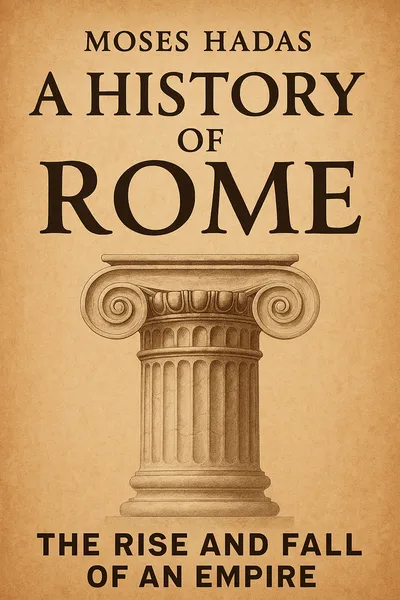
A History of Rome
The rise and fall of an empire
Description
Moses Hadas approaches Roman history through the lens of cultural synthesis and institutional evolution, drawing upon his extensive background in classical studies to present Rome not merely as a military or political entity, but as a civilization capable of unprecedented cultural assimilation. His expertise in Hellenistic studies particularly informs his analysis of Rome's encounter with Greek culture and Eastern influences. The work situates itself within mid-twentieth century historiographical debates about the nature of imperial expansion and cultural transformation.
Hadas's central thesis posits that Rome's greatness emerged from its unique capacity to synthesize diverse cultural elements while maintaining institutional continuity across centuries of expansion and transformation. The author addresses the fundamental research question: How did Rome achieve and maintain its imperial dominance through cultural adaptation rather than mere military conquest? His defended thesis maintains that Roman civilization's distinctiveness lay in its pragmatic ability to absorb and transform diverse cultural influences while preserving core institutional structures.
The work demonstrates that Roman success stemmed from cultural flexibility rather than rigid adherence to traditional forms. Hadas presents Rome as a civilization whose greatness emerged from its unprecedented capacity for cultural synthesis rather than mere military or administrative efficiency. The analysis reveals how Roman institutional flexibility enabled successful integration of diverse cultural elements while maintaining essential continuity, creating a model of imperial development that differed fundamentally from purely coercive approaches.
The author's argument demonstrates coherent progression from institutional analysis through economic, religious, and intellectual dimensions, revealing how cultural synthesis operated across multiple spheres of Roman life. This comprehensive approach illuminates Rome's distinctive contribution to Western civilization while avoiding both romantic glorification and dismissive reduction.
Table of contents
01 Institutional Pragmatism and Cultural Absorption
Hadas illuminates how Roman institutional genius manifested through adaptive pragmatism rather than rigid constitutional theory. The author demonstrates how Roman legal and governmental structures evolved organically, incorporating elements from conquered peoples while maintaining essential Roman characteristics. This synthesis created a unique governmental framework that could accommodate vast territorial expansion without losing coherence.
The theoretical framework employed draws heavily from anthropological perspectives on cultural diffusion, examining how Rome functioned as both conqueror and receiver of cultural influences. Hadas reveals how Roman flexibility in religious, legal, and administrative matters enabled successful integration of diverse populations, contrasting sharply with more rigid imperial models that relied solely on military dominance.

02 Economic Integration and Social Transformation
The second analytical axis explores how Roman expansion created unprecedented economic networks that fundamentally altered Mediterranean civilization. Hadas examines how Roman commercial practices, urban planning, and infrastructure development facilitated cultural exchange on an unprecedented scale. The author demonstrates how economic integration served as a vehicle for cultural synthesis, creating hybrid forms that were neither purely Roman nor entirely foreign.
This economic dimension reveals Rome's revolutionary approach to imperial administration, where material prosperity became intertwined with cultural assimilation. Hadas analyzes how Roman engineering achievements, from roads to aqueducts, served not merely practical functions but became instruments of cultural transformation, enabling the spread of Roman values while accommodating local traditions.
03 Religious Syncretism and Identity Formation
Hadas explores the complex dynamics of religious transformation within the Roman sphere, revealing how Rome's traditionally pragmatic approach to religious matters enabled unprecedented religious syncretism. The author examines how Roman religious practices evolved through contact with Greek, Eastern, and eventually Christian influences, creating new forms of spiritual expression that maintained Roman institutional frameworks while incorporating foreign elements.
This religious dimension illuminates broader patterns of cultural negotiation, where Roman identity proved remarkably elastic while maintaining essential characteristics. Hadas demonstrates how religious transformation both reflected and reinforced Rome's broader cultural synthesis, creating new forms of civic identity that transcended traditional ethnic boundaries while preserving Roman institutional continuity.
04 Literary and Intellectual Legacy
The final analytical axis addresses how Roman cultural synthesis produced distinctive intellectual achievements that transformed Mediterranean civilization. Hadas examines how Roman writers, philosophers, and historians created new forms of expression that synthesized Greek theoretical sophistication with Roman practical concerns, producing works that influenced subsequent Western development.
The author reveals how Roman intellectual culture embodied the broader pattern of cultural synthesis, creating literary and philosophical traditions that were simultaneously derivative and original. This intellectual dimension demonstrates how cultural absorption could produce genuine innovation, challenging simplistic notions of cultural borrowing and revealing the creative potential inherent in cultural synthesis.
05 Critical Assessment and Contemporary Relevance
Hadas's emphasis on cultural synthesis, while illuminating, occasionally understates the coercive dimensions of Roman expansion and the resistance encountered by subject populations. The work's mid-century perspective reflects certain limitations in addressing questions of cultural imperialism and power dynamics that contemporary scholarship has more fully explored. Additionally, the author's focus on elite cultural production sometimes obscures popular experiences of Roman rule and cultural transformation.
Despite these limitations, the work maintains significant relevance for contemporary understanding of cultural interaction and imperial development. Hadas's analysis provides valuable insights into how dominant civilizations can navigate cultural diversity while maintaining institutional coherence, offering historical perspective on enduring questions about cultural assimilation and imperial administration.
Related books