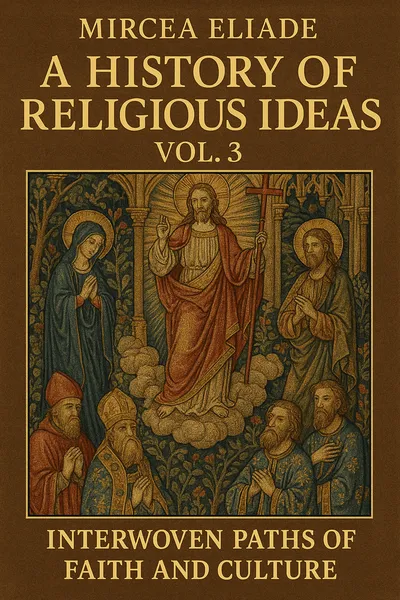
A History of Religious Ideas, Vol. 3
Interwoven paths of faith and culture
Description
This third volume of Eliade's magisterial trilogy represents the culmination of his ambitious project to trace the evolution of religious consciousness from prehistoric times to the early modern period. Drawing upon his decades of scholarship in comparative religion and his phenomenological methodology, Eliade tackles the formative centuries during which Judaism, Christianity, and Islam established their definitive theological and institutional forms. The work positions itself as both historical synthesis and interpretive framework, seeking to illuminate the complex web of interactions that shaped these three traditions during their most dynamic period of development and expansion.
The central research question driving this volume asks: How did the three Abrahamic religions evolve and interact during their crucial formative centuries, and what patterns of mutual influence can be discerned in their theological and institutional development? Eliade's defended thesis argues that the period from the sixth to seventeenth centuries witnessed the emergence of Judaism, Christianity, and Islam as distinct yet interconnected religious systems whose development cannot be adequately understood in isolation from one another. The main stake of this argument is to demonstrate that traditional approaches treating these religions as separate entities obscure fundamental patterns of cross-pollination and shared religious experience that shaped their historical trajectories.
Eliade's synthetic vision presents the three Abrahamic religions as manifestations of a broader monotheistic revolution in human religious consciousness. His phenomenological approach reveals structural patterns and experiential similarities that traditional historical methods often obscure. The period from the sixth to seventeenth centuries emerges as crucial for understanding how these traditions achieved their classical forms while maintaining dynamic interaction with one another. The work's intellectual contribution lies in demonstrating how comparative methodology can illuminate historical development without reducing religious traditions to mere historical phenomena. Eliade maintains sensitivity to each tradition's distinctive claims while identifying common patterns that suggest universal dimensions of religious experience.
Table of contents
01 Historical Dynamics and Transformation Processes
The temporal scope of Eliade's analysis encompasses periods of profound transformation within each tradition. Judaism's evolution from Second Temple religion to rabbinic Judaism, Christianity's expansion from Jewish sect to imperial religion, and Islam's rapid growth from Arabian movement to global civilization demonstrate parallel processes of institutionalization and theological elaboration. These transformations occurred within overlapping geographical and cultural contexts that facilitated extensive interaction and mutual influence.

02 Dialectical Tensions and Mystical Innovations
The interplay between unity and diversity within each tradition generates creative tensions that drive theological and institutional innovation. Eliade identifies recurring patterns of dialectical development: prophetic versus priestly emphases, mystical versus rational approaches, and universalist versus particularist orientations. These tensions manifest differently within each tradition but follow recognizable patterns that suggest underlying structural similarities.
03 Civilizational Impact and Cultural Synthesis
Eliade's analysis extends beyond internal religious development to examine how these traditions shaped broader civilizational patterns. The transformation of the Mediterranean world and Europe through Christian influence, the Islamic synthesis of Greek philosophy and Arabian culture, and Judaism's role in preserving and transmitting ancient wisdom traditions demonstrate religion's capacity to generate comprehensive worldviews that integrate spiritual, intellectual, and social dimensions.
04 Critical Assessment and Contemporary Relevance
Despite its synthetic achievements, Eliade's approach exhibits certain limitations that reflect broader tensions within phenomenological method. His emphasis on religious experience as sui generis sometimes minimizes the role of social, economic, and political factors in shaping religious development. The focus on elite theological traditions may obscure popular religious practices and their influence on official doctrines.
Contemporary scholarship increasingly emphasizes the constructed nature of religious boundaries and the fluidity of religious identity in historical contexts. Future research might productively examine how ordinary believers navigated multiple religious influences in pluralistic societies, challenging neat categorical distinctions between traditions. Additionally, postcolonial perspectives could illuminate how power dynamics shaped interfaith encounters, revealing dimensions of conflict and accommodation that Eliade's phenomenological framework tends to minimize.
Related books