A History of Religious Ideas, Vol. 2
Exploring ancient and classical faiths
Description
Mircea Eliade's second volume represents a continuation of his ambitious project to map the evolution of religious consciousness across human civilizations. Building upon the methodological foundations established in his previous works, Eliade extends his phenomenological approach to encompass the religious traditions that emerged and flourished between antiquity and the early Christian era. This volume demonstrates his commitment to understanding religion as a fundamental dimension of human experience, one that reveals itself through recurring patterns and universal structures regardless of cultural specificity. The work positions itself within the broader context of comparative religious studies, challenging conventional historical narratives by privileging morphological analysis over chronological sequence.
The central research question driving this work asks: How do diverse religious traditions across different civilizations reveal universal patterns of sacred experience and meaning-making? Eliade's defended thesis argues that religious phenomena exhibit archetypal structures that transcend cultural particularities, demonstrating humanity's consistent orientation toward transcendence and the sacred. The main stake of this scholarly endeavor is to establish a comprehensive morphology of religious experience that illuminates the underlying unity of human spiritual consciousness across historical and cultural divisions.
Eliade's monumental survey succeeds in demonstrating the coherence of human religious consciousness across diverse cultural and historical contexts. His morphological approach reveals underlying patterns and structures that connect apparently disparate traditions, supporting his thesis regarding the universal dimensions of religious experience. The work establishes a comprehensive framework for understanding religious phenomena that transcends the limitations of purely historical or sociological approaches while remaining sensitive to cultural specificity and historical development. The synthetic achievement of this volume lies in its successful integration of detailed scholarly research with broad theoretical vision. Eliade demonstrates how careful attention to the internal logic of particular religious traditions can illuminate universal patterns of human spiritual experience. His approach offers a middle path between reductionist explanations that deny the specificity of religious phenomena and particularist approaches that obscure underlying commonalities across traditions.
Table of contents
01 The Archetypal Structure of Religious Experience
The analysis of Chinese religious consciousness demonstrates how cosmological thinking permeates every aspect of spiritual practice, from ancestor veneration to imperial rituals. Eliade identifies the underlying structure of correspondence between celestial and terrestrial orders as a universal pattern that manifests differently across cultures but maintains consistent morphological features. This approach allows him to connect seemingly disparate phenomena such as Brahmanical sacrifice and Chinese imperial ceremonies under the broader category of sacred kingship and cosmic renewal.

02 The Dialectics of Sacred and Profane in Historical Context
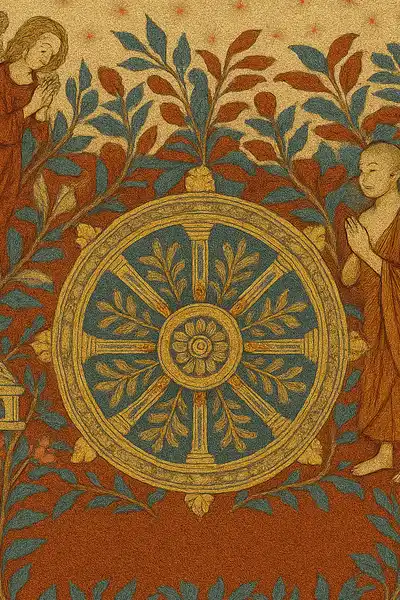
The examination of Buddhist origins and Roman religious practices reveals Eliade's sophisticated understanding of how universal religious structures adapt to specific historical circumstances without losing their essential characteristics. His analysis of Buddha's spiritual revolution demonstrates how radical innovations in religious thought emerge from tensions inherent within existing traditions while simultaneously opening new possibilities for sacred experience.
Roman religion receives particular attention as an example of how political and religious authority intersect within a coherent cosmological framework. Eliade's interpretation emphasizes the ritualistic dimension of Roman religious practice, showing how ceremonial precision and institutional continuity served to maintain cosmic order and social stability. The transformation of Roman religious consciousness through contact with Greek philosophy and Eastern mystery religions illustrates the dynamic nature of religious traditions and their capacity for creative synthesis.
03 The Emergence of Monotheistic Consciousness
Eliade's approach to Judaism represents one of the most challenging aspects of his synthetic project, requiring him to account for the apparent uniqueness of Hebrew religious consciousness while maintaining his commitment to universal patterns. His analysis emphasizes the revolutionary character of Hebrew monotheism while simultaneously identifying structural continuities with earlier religious forms. The concept of covenant receives interpretation as a particular manifestation of the universal pattern of relationship between human communities and sacred power.
The treatment of the Hellenistic period reveals the complex dynamics through which religious traditions interact, compete, and synthesize. Eliade's analysis of mystery religions, Gnostic movements, and philosophical schools demonstrates his understanding of religious creativity as emerging from the encounter between different symbolic systems and practices. The proliferation of salvific religions during this period receives interpretation as evidence of humanity's fundamental orientation toward transcendence and liberation from temporal constraints.
04 The Crystallization of Christian Consciousness
The emergence of Christianity receives treatment as both the culmination of previous religious developments and the opening of new possibilities for religious experience. Eliade's analysis emphasizes the archetypal dimensions of Christian symbolism while acknowledging the historical specificity of the Christian revelation. The figure of Christ receives interpretation through the broader category of divine mediator and cosmic renewer, connecting Christian beliefs with universal patterns of religious thought and practice.
The transformation of Greco-Roman religious consciousness through Christian influence demonstrates Eliade's understanding of religious change as involving both continuity and rupture. His analysis reveals how Christian theology and practice both fulfilled and transformed the religious aspirations of the ancient world, creating new forms of sacred experience while drawing upon established archetypal patterns. The development of Christian institutions and practices receives attention as examples of how religious consciousness adapts to changing historical circumstances while maintaining essential structural features.
05 Critical Assessment and Contemporary Implications
Despite its impressive scope and synthetic ambition, Eliade's approach exhibits significant theoretical limitations that compromise its explanatory power. His commitment to archetypal thinking tends to minimize the genuine innovations and ruptures that characterize religious history, leading to interpretations that privilege continuity over transformation. The phenomenological method, while valuable for understanding religious consciousness from within, provides insufficient tools for analyzing the social, political, and economic factors that shape religious development.
The work's treatment of historical context remains superficial, subordinating social and political analysis to morphological concerns. This approach obscures the ways in which religious ideas both reflect and influence broader cultural transformations, limiting our understanding of how religious consciousness emerges from and responds to changing historical circumstances. Additionally, Eliade's emphasis on universal patterns risks imposing Western intellectual categories upon non-Western traditions, potentially distorting their distinctive characteristics and internal development.
Related books