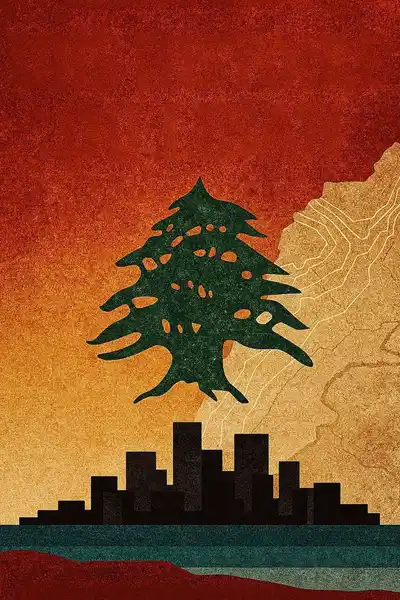
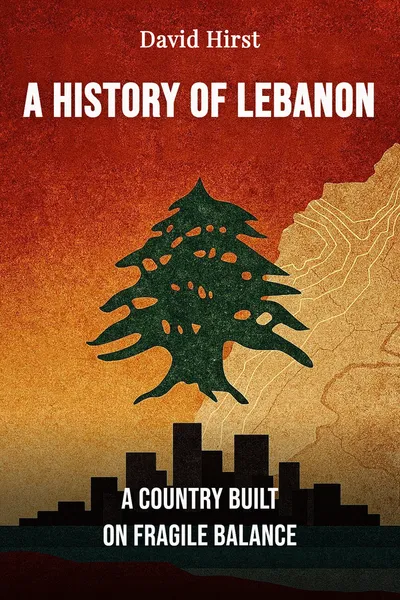
A History of Lebanon
A country built on fragile balance
Description
On September 1, 1920, a French general named Henri Gouraud stood in Beirut and proclaimed the State of Greater Lebanon. He had just carved it out of the collapsed Ottoman Empire, stretching the old Christian heartland of Mount Lebanon to take in Sunni coastal cities, Shia valleys in the south and the Bekaa plain to the east. On paper it was a gift to Lebanon's Maronite Christians, who had lobbied Paris for a country of their own. In practice, Gouraud had drawn borders around a population that did not agree on what the country was for, or even whether it should exist. The lines held. The agreement never came.
That founding tension is the thread David Hirst pulls through the whole story. Lebanon was built as an arrangement between religious communities — a formula that shared out power by sect rather than by vote — and the formula worked only as long as nobody looked too hard at whether it was fair. It gave the country a golden age: Beirut as the banking and pleasure capital of the Arab world, a place cosmopolitan enough to be called the Switzerland of the Middle East. Then it gave the country fifteen years of some of the ugliest fighting the region had seen.
Hirst, a correspondent who covered the Middle East for decades, is not interested in Lebanon as an exotic tragedy. He reads it as a case study in what happens when a small state's internal balance becomes something its powerful neighbors want to control. The wars that tore Beirut apart were Lebanese, but they were rarely only Lebanese. Understanding how that came to be means going back to the formula — and to the people who signed it without ever quite believing in it.
The question we’re asking : How did a country designed around a delicate balance between religious communities become a battlefield for everyone else's wars?What we’ll see : How Lebanon's confessional formula was built, why it broke, and who kept a hand on it from outside.
Table of contents
01Chapter 1 — A country invented around a formula
Greater Lebanon was a Maronite dream underwritten by a French mandate. For centuries the Maronites, an Eastern Christian church in communion with Rome, had lived clustered in the mountains, protected by geography and by a long relationship with France. When the Ottoman Empire fell apart after the First World War, their leaders wanted more than the old autonomous province of Mount Lebanon. They wanted a real state with ports, farmland and a capital. France obliged in 1920, and in doing so handed the Maronites a country in which they were no longer the comfortable majority they had been on the mountain.
This is the paradox Hirst places at the foundation. By enlarging Lebanon to make it viable, France diluted the very community it was built for. The new territory brought in large numbers of Sunni Muslims, who had wanted to stay part of a greater Syrian or Arab entity and resented being locked into a Christian-tilted statelet, and Shia Muslims in the south and east who had almost no voice in how any of it was decided. From the first day, a sizeable share of the population regarded the country's existence as an imposition rather than a homeland.

02Chapter 2 — The compromise that split the country
The formula was written down in 1943, as Lebanon slipped free of French control. Its leaders struck an unwritten understanding known as the National Pact, a bargain between the Maronite Christian and Sunni Muslim elites. The Christians agreed to stop looking to France and the West for protection; the Muslims agreed to stop seeking union with Syria or a wider Arab state. In exchange, the top jobs were locked in: a Maronite president, a Sunni prime minister, a Shia speaker of parliament, and a legislature seated six Christians to every five Muslims.
That six-to-five ratio was the heart of it, and its weakness. It rested on a 1932 census — the last one Lebanon ever dared to hold — that gave Christians a slim majority. Hirst underlines the trap. Demographics do not stand still. Muslim communities, and the Shia in particular, grew faster over the following decades, while Christian emigration thinned the other side. Within a generation the numbers no longer matched the arrangement, but the arrangement could not be changed without someone giving up power they had been promised.
03Chapter 3 — Fifteen years of neighbors' war
The war began in April 1975, when gunmen ambushed a bus carrying Palestinians through a Christian district of Beirut, killing more than two dozen people. Hirst treats the incident less as a cause than as a detonator. The pressures had been building for years; what followed was the collapse of the whole confessional edifice into open fighting. Militias formed along sectarian lines, the army fractured, and the capital split down a demarcation line that became known as the Green Line, cutting Christian east Beirut from the Muslim west.
What makes Hirst's account distinctive is his refusal to keep the war Lebanese. Within a year, Syria had sent its army in — first, remarkably, on the side of the Christians it would later fight, then settling into an occupation that would last nearly three decades. Israel intervened repeatedly against the Palestinian presence, culminating in a full invasion in 1982 that drove all the way to Beirut and besieged the city. Every outside power that had an interest in the region found a Lebanese faction to arm, fund or use, until the country's internal quarrel became a stage for other people's confrontations.
04Chapter 4 — The state that never got to be one
Step back from the timeline and Hirst's larger argument comes into focus. Lebanon's tragedy, in his telling, is not that it was too divided to govern itself, but that its divisions made it uniquely easy for others to govern from outside. A country whose power is parcelled out among communities is a country with a door held open to any neighbor willing to sponsor one of them. The confessional system did not merely fail to prevent foreign interference; it practically invited it, by ensuring that there was always a faction whose grievance a foreign power could exploit.
This is why Hirst keeps returning to the neighbors. Syria treated Lebanon for decades as an extension of its own security, occupying it after the war and shaping its politics until popular protest and the 2005 assassination of former prime minister Rafik Hariri finally forced its troops out. Israel occupied a strip of the south for years and shaped Lebanese affairs through its interventions. Iran built Hezbollah into a force more capable than the Lebanese army itself. Saudi Arabia, France and the United States all kept their own channels open. Lebanon's sovereignty was, in practice, always shared with people who did not live there.
05Conclusion
Return to Gouraud in Beirut in 1920, drawing borders around communities that had not asked to share a country. Everything that followed was contained in that first act: a state defined by the balance among its parts rather than by anything that bound them together. The confessional formula gave Lebanon a way to exist without agreeing on what it was, and for a while that was enough to build a glittering, improbable capital. It was never enough to build a nation that could stand on its own.
Related books