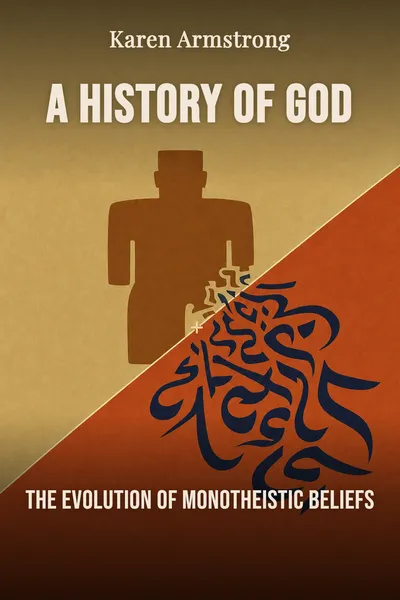
A History of God
The evolution of monotheistic beliefs
Description
Armstrong's ambitious undertaking emerges from the contemporary crisis of religious belief in Western societies, where traditional faith confronts modern skepticism and scientific rationality. The work positions itself within the broader academic discourse on religious studies, challenging conventional theological narratives through a historical-anthropological lens. Written during the late twentieth century's renewed interest in comparative religion, the book responds to growing interfaith dialogue and the need for understanding religious diversity in an increasingly globalized world.
The central research question driving Armstrong's analysis is: How have human conceptions of the divine evolved within Judaism, Christianity, and Islam from their origins to the contemporary era? Her defended thesis argues that the idea of God represents a human construct that has continuously adapted to meet changing psychological, social, and intellectual needs across different historical periods. The main stake is to demonstrate that religious belief systems are dynamic cultural phenomena rather than static divine revelations, thereby fostering greater tolerance and understanding among different faith traditions.
Armstrong's magisterial survey successfully demonstrates the historical mutability of divine concepts within monotheistic traditions. Her synthesis reveals consistent patterns of theological development responding to changing cultural contexts while maintaining continuity of spiritual concern. The work's strength lies in its comprehensive scope and accessible presentation of complex theological history. By treating religious ideas as cultural phenomena subject to historical analysis, Armstrong provides valuable insights into the relationship between human consciousness and divine conceptualization. Her argument effectively challenges both naive literalism and dismissive atheism by revealing the sophisticated symbolic dimensions of religious discourse.
Table of contents
01 The Anthropological Construction of the Divine
Armstrong's fundamental contribution lies in her anthropological approach to theological history, treating religious concepts as cultural artifacts rather than transcendent truths. Her analysis reveals how early monotheistic communities projected their social structures, psychological needs, and existential anxieties onto divine representations. The patriarchal imagery of God in ancient Judaism, for instance, reflects the tribal societies that produced these narratives rather than inherent divine characteristics. This perspective challenges traditional theological assumptions about divine revelation, suggesting instead that humans create gods in their own image according to their historical circumstances.

02 Philosophical Rationalization and Its Discontents
The encounter between monotheistic faith and Greek philosophical rationality represents a crucial transformation in divine conceptualization. Armstrong meticulously traces how thinkers like Maimonides, Aquinas, and Averroes attempted to reconcile faith with reason, fundamentally altering religious discourse. This philosophical turn introduced abstract metaphysical categories that distanced God from immediate human experience, creating what she identifies as a more intellectualized but potentially alienating religious framework.
03 Modernity's Theological Upheaval
The Enlightenment emerges in Armstrong's analysis as both culmination and crisis point for traditional theism. She examines how scientific revolution, historical criticism, and philosophical skepticism systematically undermined conventional religious authority. The mechanical universe of Newton and the critical philosophy of Kant left little space for the anthropomorphic deity of popular religion. Yet rather than viewing this as simple decline, Armstrong identifies creative theological responses that attempted to salvage religious meaning within new intellectual frameworks.
04 Contemporary Implications and Future Trajectories
Armstrong's historical survey culminates in reflection on religion's role in contemporary society. She argues that understanding God's conceptual evolution can liberate believers from rigid literalism while preserving authentic spiritual insight. Her vision suggests that mature religious consciousness must acknowledge the symbolic nature of theological language while maintaining its transformative power. This perspective offers potential resolution to conflicts between scientific and religious worldviews by relocating religious truth from factual claims to existential meaning.
05 Critical Assessment and Scholarly Impact
Despite its considerable merits, Armstrong's approach exhibits certain limitations that warrant critical examination. Her emphasis on cultural construction risks undermining the transcendent dimension that believers consider essential to religious experience. The work occasionally displays a liberal Protestant bias that may not adequately represent Catholic, Orthodox, or Islamic perspectives on tradition and authority. Furthermore, her historical narrative sometimes oversimplifies complex theological debates, presenting evolutionary progression where discontinuity and conflict might better characterize religious development.
Related books