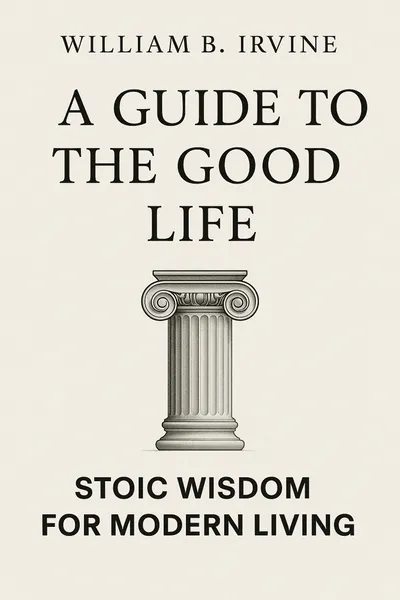
A Guide to the Good Life
Stoic wisdom for modern living
Description
William B. Irvine's "A Guide to the Good Life: The Ancient Art of Stoic Joy" is widely recognized as a "highly readable introduction to the ancient philosophy of Stoicism" that demonstrates how "you too can apply Stoic principles in everyday life" (Five Books Expert Reviews). The book is structured around the history of Stoicism, Stoic psychological techniques, Stoic advice, and applying Stoicism to modern lives.
Irvine's central thesis is that "Stoic philosophy provides a comprehensive and practically applicable framework for achieving psychological tranquility and meaningful existence in contemporary life." He aims to demonstrate that philosophical practice, rather than material achievement or emotional gratification, constitutes the most reliable path to human flourishing.
A cornerstone of Irvine's adaptation of Stoicism is the emphasis on tranquility (defined as "a psychological state marked by the absences of negative emotions, such as grief, anger, and anxiety, and the presence of positive emotions, such as joy") as the ultimate aim. This is a significant departure from traditional Stoicism, which primarily valued virtue. As Irvine himself states, his version of Stoicism is "unlike the Stoicism advocated by any particular Stoic" and "unlike the Stoicism one would have been taught to practice in an ancient Stoic school."
Irvine explicitly aims to make Stoicism accessible and relevant to a modern audience, acknowledging that his interpretation "departs significantly from any existing form of Stoicism." He removes elements like the reliance on Zeus or ancient cosmology, making it suitable for those without specific religious beliefs, stating "one need not share Epictetus' belief in God to employ Stoic strategies for attaining tranquility." The book effectively introduces ancient Stoic philosophy to a modern audience, offering practical techniques for achieving psychological tranquility. Its strength lies in its "resolutely practical" approach and systematic framework for self-improvement, creating a coherent framework for addressing modern existential anxieties through ancient wisdom.
Table of contents
01 Core Stoic Psychological Techniques for Modern Living
Irvine distills several practical techniques from ancient Stoicism to help modern readers cultivate tranquility:
Negative Visualization (praemeditatio malorum): This involves imagining the loss of things one values – "life, possessions, friends, family" – to appreciate them more deeply and prepare for potential misfortune. This counteracts "hedonistic adaptation," the tendency for humans to quickly adapt to good circumstances and take them for granted. Roy Lotz describes this as a way to fight "hedonistic adaptation," which "forever enchains us to desire." The Dygest prompt notes this practice as a "systematic approach to emotional regulation that preemptively address attachment and loss."
The Dichotomy/Trichotomy of Control: A central Stoic idea is to focus one's efforts only on what is within one's control. Irvine expands the traditional Stoic dichotomy (things under our control vs. not) into a "trichotomy," distinguishing between things one has "absolutely no control," "some control," and "complete control" over. For example, in tennis, one's goal should be "not to win, but to compete as hard as [one] can" (BMCR review). This allows one to internalize goals, focusing on effort rather than outcome. Donald Robertson criticizes this modification, arguing that it "introduces many problems" and that the traditional dichotomy is more accurate and integral to Stoic ethics.

02 Stoic Advice for Contemporary Challenges
Irvine applies Stoic principles to various contemporary situations:
Dealing with Insults: Stoics are advised to respond with humor, indifference, or silence, as "what upsets people is not things themselves but their judgments about these things" (Goodreads, Amir Tesla). Patrick Sherriff notes that "it's OK, in fact desirable, to deflect anger and insults with humour." Irvine also controversially suggests becoming a "stealth Stoic" rather than openly proclaiming one's philosophy to avoid others' disapproval (JeffreyDebris.Com).
03 Critical Analysis: Modernization and Its Philosophical Controversies
However, these adaptations draw considerable critique:
Tranquility vs. Virtue: As noted, the shift from virtue to tranquility is the most debated change. Reviewers, such as Donald Robertson, highlight this as a "fundamental departure from Stoic philosophy in general." Robertson argues that the Stoic concept of virtue, understood as practical wisdom, is the "core doctrine" distinguishing Stoicism from rival schools like Epicureanism, which did prioritize tranquility (ataraxia). Critics argue this dilutes the core of Stoicism, which sees tranquility as a consequence of virtue, not its primary goal. Robertson states, "Virtue leads to tranquility, but tranquility alone does not necessarily lead to virtue." He suggests this makes Irvine's "Stoicism" more akin to Epicureanism.
Related books