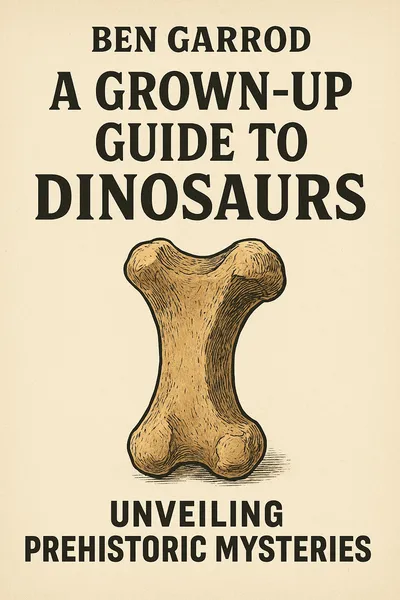
A Grown-Up Guide to Dinosaurs
Unveiling prehistoric mysteries
Description
Ben Garrod's contribution to paleontological discourse emerges within a contemporary context where scientific literacy demands sophisticated engagement with evolutionary narratives. The work positions itself as an adult-oriented examination of dinosaurian biology, departing from juvenile popularizations to engage seriously with paleontological methodology and evolutionary theory. Garrod leverages his expertise in evolutionary biology to construct a narrative that transcends simple descriptive paleontology, instead proposing dinosaurs as analytical tools for understanding broader biological principles.
The central research question driving this work is: How can dinosaurian studies inform contemporary understanding of evolutionary processes and scientific methodology? Garrod defends the thesis that dinosaurs constitute exemplary subjects for examining evolution, extinction, and the epistemological foundations of paleobiological science. The main stake of his argument is demonstrating that paleontology offers crucial insights into current biological questions and scientific practice. Dinosaurs represent not merely extinct curiosities but rather foundational evolutionary case studies that illuminate contemporary biological principles and demonstrate the dynamic nature of scientific knowledge construction.
Garrod constructs a sophisticated argument for dinosaurian studies as paradigmatic examples of evolutionary science and scientific methodology more generally. The work successfully demonstrates how paleontological research contributes to contemporary biological understanding while revealing the social and cultural dimensions of scientific knowledge production. By positioning dinosaurs as analytical tools rather than mere objects of curiosity, the author advocates for paleontology's central role in biological education and public scientific literacy.
The intellectual contribution lies in bridging specialist paleontological research with broader questions about evolutionary theory, scientific methodology, and democratic science education. Garrod's analysis reveals how historical biological sciences inform contemporary environmental and evolutionary challenges while maintaining sophisticated attention to epistemological questions about evidence, interpretation, and scientific authority.
Table of contents
01 Epistemological Frameworks in Paleobiological Knowledge
Garrod's approach fundamentally challenges the traditional separation between historical and experimental biology by positioning dinosaurs as active subjects of scientific inquiry rather than passive objects of description. The work employs neo-Darwinian synthesis frameworks while integrating contemporary developments in phylogenetic systematics and molecular paleontology. This theoretical positioning reveals tensions between morphological evidence and genetic inference, highlighting how paleontological knowledge construction necessarily involves interpretative processes that extend beyond empirical observation.

02 Evolutionary Narratives and Temporal Imagination
The work's engagement with deep time reveals fundamental challenges in conceptualizing evolutionary processes across geological scales. Garrod's analysis demonstrates how dinosaurian studies require distinctive temporal imagination that transcends human experiential frameworks, necessitating new forms of scientific reasoning. This temporal displacement generates specific methodological problems regarding causation, evidence interpretation, and theoretical validation in paleobiological contexts.
03 Technology, Evidence, and Scientific Authority
Garrod's examination of technological developments in paleontological research reveals how instrumental innovations transform scientific practice and knowledge claims. The integration of computed tomography, isotopic analysis, and digital reconstruction techniques demonstrates how technological mediation shapes paleobiological evidence and theoretical possibilities. This technological dimension highlights tensions between traditional morphological approaches and emerging digital methodologies in paleontological practice.
04 Pedagogical Implications and Scientific Citizenship
The author's emphasis on adult scientific education addresses broader questions regarding democratic participation in scientific decision-making and policy formation. By positioning dinosaurs as vehicles for scientific literacy, Garrod advocates for sophisticated public engagement with evolutionary concepts and methodological principles. This pedagogical dimension reveals assumptions about citizenship, education, and the social functions of scientific knowledge in contemporary democratic societies.
05 Critical Assessment and Future Directions
The work's strength in epistemological sophistication occasionally obscures practical implications for paleontological research and education. While Garrod successfully demonstrates theoretical connections between dinosaurian studies and contemporary biology, the analysis sometimes lacks concrete specification of how these insights translate into modified research practices or educational approaches. The emphasis on adult education may inadvertently reinforce existing educational hierarchies rather than democratizing scientific knowledge.
Related books