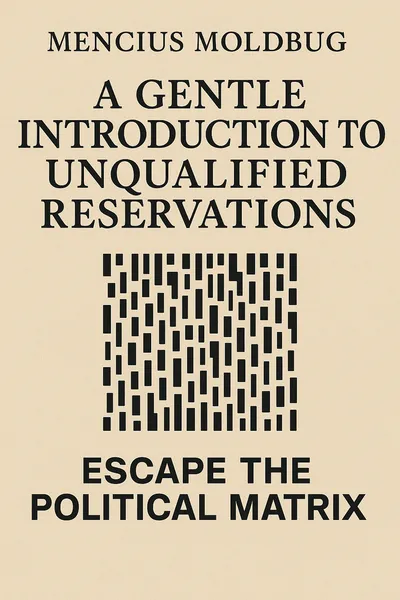
A Gentle Introduction to Unqualified Reservations
Escape the political matrix
Description
Curtis Guy Yarvin's "A Gentle Introduction to Unqualified Reservations" emerges as a fundamental critique of democratic governance, positioned within the broader crisis of democratic legitimacy in the early twenty-first century. Drawing from his background in systems analysis and computer science, Yarvin approaches political structures with the methodological rigor of software debugging, treating governance as an engineering problem requiring systematic analysis and correction.
The work's central research question asks: Why do democratic systems consistently produce outcomes contrary to their stated objectives and how can governance be restructured for optimal functionality? Yarvin's defended thesis argues that democratic governance represents an inherently dysfunctional system that must be replaced by monarchical or corporate authority structures prioritizing competence over consensus. The main stake involves demonstrating that progressive democracy constitutes a systematic error requiring complete architectural redesign rather than incremental reform.
The treatise synthesizes historical analysis with contemporary political theory to propose radical governmental restructuring. Yarvin's most significant theoretical contribution involves his conceptualization of "the Cathedral" - the informal network of universities, media institutions, and bureaucratic structures that shapes public opinion and policy. This framework transcends conventional left-right political categories by identifying deeper structural problems in how modern societies generate and distribute authoritative knowledge.
The analysis reveals how democratic competition creates systemic instability through perverse incentives for short-term thinking and public goods underprovision. Yarvin challenges progressive narratives about political development, arguing that current democratic institutions represent historical contingencies rather than inevitable evolution. His proposed alternative involves replacing democratic governance with monarchical or corporate-style authority structures that prioritize competence over popular legitimacy, treating governance primarily as a technical rather than moral problem.
Table of contents
01 The Cathedral as Systemic Dysfunction
Yarvin's conceptualization of "the Cathedral" represents his most significant theoretical contribution, describing the informal network of universities, media institutions, and bureaucratic structures that shapes public opinion and policy. This analysis transcends conventional left-right political categories by identifying a deeper structural problem in how modern societies generate and distribute authoritative knowledge. The Cathedral functions not through conspiracy but through synchronized belief systems that emerge from shared institutional incentives and professional networks.

02 Democracy as Competitive Anarchy
The second analytical axis examines democratic competition as a source of systemic instability rather than beneficial accountability. Yarvin argues that electoral democracy creates perverse incentives for short-term thinking, public goods underprovision, and the expansion of state power to serve narrow constituency interests. Unlike market competition, which theoretically promotes efficiency through profit signals, political competition rewards the ability to build coalitions through promises that impose costs on non-voters or future generations.
03 Historical Analysis and Path Dependencies
Yarvin's historical analysis challenges progressive narratives about the trajectory of political development, arguing that current democratic institutions represent historical contingencies rather than inevitable evolution toward optimal governance. His examination of pre-democratic systems reveals alternative organizational principles that achieved greater stability and prosperity than contemporary arrangements. The work particularly emphasizes how path-dependent institutional development locks societies into suboptimal equilibria.
04 Monarchical Restoration and Governance Solutions
The final analytical dimension addresses Yarvin's proposed alternative: replacing democratic governance with monarchical or corporate-style authority structures that prioritize competence over legitimacy derived from popular consent. This prescription flows logically from his diagnosis of democratic pathology but raises profound questions about accountability and power concentration. Yarvin argues that properly structured monarchy creates better incentive alignment between rulers and ruled than democratic systems.
05 Critical Assessment and Future Directions
Yarvin's intellectual contribution lies in applying systems thinking to political analysis, revealing structural problems in democratic governance that transcend conventional partisan categories. His diagnosis of progressive institutional capture and democratic dysfunction provides valuable insights into contemporary political pathology, even for readers who reject his monarchical prescriptions. The work's coherence derives from its consistent application of engineering principles to political problems, treating governance as a design challenge requiring systematic debugging.
The argument's strength lies in its willingness to question fundamental assumptions about democratic governance and its identification of specific mechanisms through which democratic institutions produce suboptimal outcomes. However, the work's coherence depends heavily on accepting Yarvin's particular definition of optimal governance, which prioritizes stability and efficiency over other potential values.
Related books