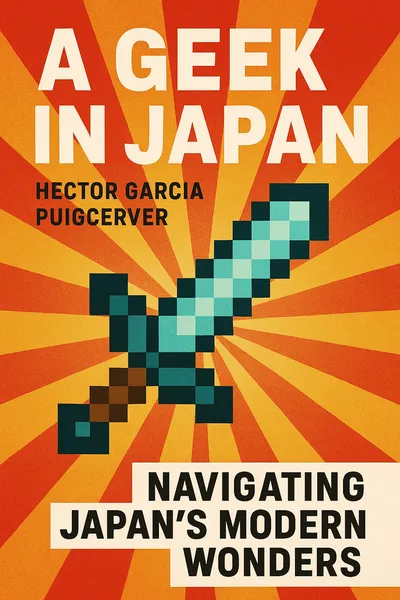
A Geek in Japan
Navigating Japan's modern wonders
Description
García Puigcerver presents himself as both insider and outsider, leveraging his position as a Western technologist embedded within Japanese society to offer a comprehensive examination of contemporary Japan. His work emerges from direct ethnographic experience rather than purely academic research, positioning the analysis within the lived reality of Japanese social structures. The author's technological background provides a distinctive lens through which to examine Japan's relationship between tradition and innovation.
The central research question driving García's analysis is: How does Japanese society maintain cultural coherence while embracing radical technological transformation? His defended thesis argues that Japan offers a viable alternative model of modernity that preserves social harmony through collective values while achieving technological supremacy. The main stake of this work is demonstrating that Western individualistic paradigms are not universal prerequisites for societal advancement and innovation.
García constructs a compelling argument that Japanese society represents a viable alternative to Western modernity, one that achieves technological advancement while preserving social cohesion and cultural identity. His analysis demonstrates that modernization need not follow universal patterns but can take culturally specific forms that reflect particular historical experiences and value systems. The work's intellectual contribution lies in challenging ethnocentric assumptions about development and progress, suggesting that Western models represent only one possible pathway among many. García's framework provides tools for understanding how societies can navigate globalization while maintaining cultural authenticity, offering lessons relevant far beyond Japan's borders.
Table of contents
01 The Architecture of Social Harmony
García's analysis reveals Japan's fundamental organizing principle: the subordination of individual desires to collective well-being. This social architecture manifests through intricate systems of mutual obligation, hierarchical respect, and shared responsibility that permeate every aspect of daily life. The author demonstrates how these mechanisms create unprecedented social cohesion, evidenced in phenomena ranging from workplace dedication to public behavioral norms.

02 Technological Integration and Cultural Preservation
The work's second analytical axis examines Japan's remarkable capacity to absorb technological innovation without cultural dissolution. García demonstrates how Japanese society selectively incorporates foreign elements while maintaining essential cultural structures, creating what might be termed 'adaptive traditionalism.' This process involves sophisticated filtration mechanisms that preserve core values while embracing beneficial innovations.
The author's analysis reveals how Japanese institutions function as cultural antibodies, neutralizing potentially disruptive foreign influences while extracting their beneficial elements. This selective permeability explains Japan's ability to achieve technological leadership while avoiding the social fragmentation that often accompanies rapid modernization elsewhere. The examination extends to workplace culture, educational systems, and social rituals, all of which demonstrate this adaptive capacity.
03 The Paradoxes of Collective Individualism
A particularly sophisticated element of García's analysis addresses the apparent contradiction between Japanese collectivism and individual creativity. The author demonstrates how Japanese social structures create space for individual expression within collective frameworks, producing what might be called 'orchestrated diversity.' This paradox manifests in phenomena ranging from corporate innovation teams to artistic subcultures.
04 Sustainability and Social Responsibility
The final analytical dimension examines Japan's approach to long-term thinking and environmental stewardship. García demonstrates how traditional Japanese concepts of intergenerational responsibility create natural frameworks for sustainable development and corporate accountability. This perspective contrasts sharply with short-term profit maximization models prevalent in Western capitalism.
05 Critical Assessment and Future Directions
The work would benefit from deeper engagement with Japanese scholarly perspectives and more critical examination of social costs accompanying the benefits García identifies. The analysis opens productive avenues for comparative cultural studies and alternative development models. García's framework invites examination of how other societies balance tradition and innovation, suggesting research directions for understanding cultural resilience in an era of rapid globalization.
Related books