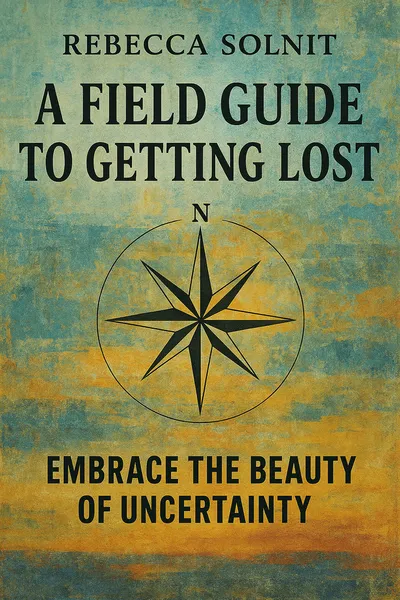
A Field Guide to Getting Lost
Embrace the beauty of uncertainty
Description
Rebecca Solnit, drawing upon her expertise in cultural geography and feminist theory, presents a meditation on the productive potential of uncertainty and spatial disorientation. This work emerges from contemporary anxieties about navigation, control, and the increasingly mapped and surveilled nature of modern existence. Positioning herself against dominant cultural narratives that pathologize confusion and celebrate certainty, Solnit constructs an alternative epistemology that valorizes the unknown as a site of creative possibility.
The central research question driving the work asks: How might experiences of being lost—physically, emotionally, or intellectually—serve as catalysts for personal transformation and creative discovery? Solnit's defended thesis argues that rather than representing failure or danger, states of lostness constitute fundamental conditions for authentic encounter with otherness and self-discovery. The main stake is to recuperate uncertainty and disorientation as valuable experiential modes against contemporary culture's obsession with GPS-mediated navigation and predetermined outcomes.
Solnit constructs a sophisticated argument for embracing uncertainty as a fundamental condition for creative, ethical, and political transformation. Her interdisciplinary approach successfully integrates phenomenological analysis, feminist epistemology, environmental philosophy, and aesthetic theory to demonstrate how experiences of lostness enable authentic encounter with otherness and self-discovery. The work's theoretical contribution lies in its systematic challenge to Enlightenment rationality and technological modernity's promise of complete knowledge and control. By recuperating uncertainty as a positive value, Solnit offers resources for resisting contemporary surveillance cultures and algorithmic prediction systems that threaten to eliminate spontaneity and surprise from human experience.
Table of contents
01 The Phenomenology of Spatial Disorientation
Solnit establishes a phenomenological framework that reframes spatial confusion as an active mode of engagement rather than passive victimization. Her theoretical approach draws heavily from existentialist philosophy, particularly the notion that anxiety and uncertainty reveal authentic possibilities for being. The author constructs a dialectical relationship between knowing and unknowing, suggesting that excessive familiarity breeds a kind of experiential death.
The work's engagement with feminist epistemology becomes apparent through its critique of masculine cartographic traditions that reduce complex territories to abstract representations. Solnit posits that conventional mapping practices reflect broader patriarchal desires for mastery and control over unpredictable environments. Her alternative cartography privileges embodied experience and affective encounter over geometric precision, suggesting that true knowledge emerges through vulnerable engagement with unfamiliar terrain rather than distant observation.

02 Temporal Displacement and Memory's Labyrinth
The analysis extends beyond spatial confusion to encompass temporal disorientation, particularly the ways personal and collective memory resist linear chronological organization. Solnit demonstrates how experiences of temporal lostness—through nostalgia, trauma, or historical disconnection—create productive spaces for reimagining identity and community.
Her examination of historical amnesia reveals how dominant cultural narratives systematically obscure alternative possibilities and marginalized experiences. The author suggests that deliberate engagement with temporal confusion allows for the recovery of suppressed histories and alternative futures. This temporal politics becomes particularly significant in her treatment of environmental and indigenous histories that resist incorporation into progressive narratological frameworks.
03 Aesthetic Encounters and Creative Uncertainty
Solnit's investigation of artistic practice reveals how creative work depends fundamentally upon cultivating productive relationships with uncertainty and failure. Her analysis suggests that genuine aesthetic innovation emerges not from technical mastery but from willingness to relinquish control over outcomes and embrace experimental risk.
The author's treatment of landscape painting and environmental art demonstrates how aesthetic engagement with natural environments requires surrendering anthropocentric perspectives and accepting nonhuman temporalities. This aesthetic philosophy connects to broader critiques of instrumental rationality and utilitarian approaches to natural resource management.
04 Ethical Implications of Embracing Uncertainty
The work's ethical dimension emerges through its critique of security cultures and risk-management paradigms that seek to eliminate uncertainty from social life. Solnit argues that excessive safety consciousness paradoxically creates new forms of vulnerability while foreclosing possibilities for meaningful encounter with otherness.
Her analysis of contemporary urban planning and architecture reveals how design practices increasingly eliminate spaces for unstructured encounter and serendipitous social interaction. This spatial politics connects to broader concerns about the privatization of public space and the securitization of everyday life in neoliberal societies.
05 Critical Assessment and Future Directions
Despite its theoretical sophistication, the work suffers from a romanticization of uncertainty that inadequately addresses the material consequences of disorientation for economically precarious populations. Solnit's celebration of getting lost reflects privileges of mobility and security unavailable to migrants, refugees, and other vulnerable populations for whom spatial disorientation represents genuine threat rather than creative opportunity.
Related books