
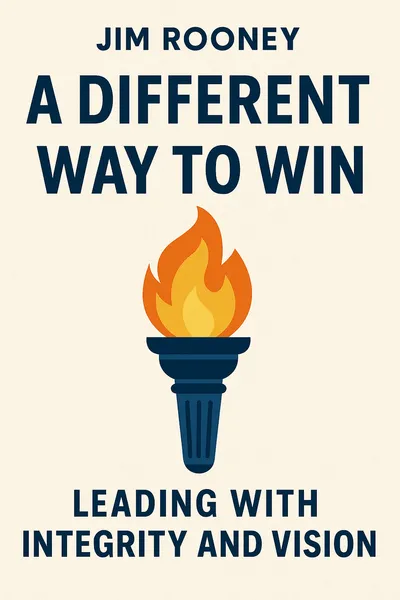
A Different Way to Win
Leading with integrity and vision
Description
Dan Rooney's autobiographical reflection emerges within a contemporary context where professional sports increasingly grapple with questions of diversity, organizational ethics, and social responsibility. The author, leveraging his unique position as both inheritor and transformer of an NFL dynasty, offers a distinctive perspective on leadership that challenges conventional metrics of success in competitive environments. This work situates itself at the intersection of sports management literature and broader organizational theory, proposing alternative frameworks for understanding effective governance in high-stakes institutional settings.
The central research question that drives this work is: How can organizational leaders achieve sustainable success while simultaneously advancing social justice and institutional reform? Rooney's defended thesis argues that authentic leadership requires integrating competitive excellence with moral imperatives, demonstrating that ethical governance enhances rather than compromises organizational performance. The main stake is to establish that transformational leadership in sports can serve as a model for broader societal change, particularly regarding racial equity and inclusive practices.
Rooney's conceptual framework fundamentally challenges the prevailing paradigm that positions winning and ethical behavior as competing priorities. The author constructs a theoretical model where organizational excellence emerges precisely from the integration of competitive drive with principled decision-making processes. The theoretical contribution lies in demonstrating how moral leadership generates measurable competitive benefits, contradicting assumptions that ethical constraints limit organizational effectiveness. Rooney's comprehensive analysis establishes a compelling case for reconceptualizing organizational success to encompass both competitive achievement and social responsibility, with the intellectual coherence of this approach lying in demonstrating that these traditionally opposing objectives actually reinforce each other when properly integrated within institutional cultures.
Table of contents
01 Institutional Leadership Beyond Performance Metrics
Rooney's conceptual framework fundamentally challenges the prevailing paradigm that positions winning and ethical behavior as competing priorities. The author constructs a theoretical model where organizational excellence emerges precisely from the integration of competitive drive with principled decision-making processes. This approach draws implicitly from transformational leadership theory, though Rooney grounds his analysis in concrete institutional experiences rather than abstract theoretical constructs.
The analytical framework reveals how traditional sports management prioritizes short-term performance indicators while neglecting the systemic factors that generate sustainable competitive advantages. Rooney's alternative methodology emphasizes organizational culture as the primary determinant of long-term success, arguing that authentic leadership cultivates environments where individual talent flourishes within collective purpose. This perspective aligns with contemporary organizational psychology while offering practical applications specific to high-performance competitive contexts.

02 Systemic Reform and the Rooney Rule Implementation
The examination of diversity initiatives within professional sports reveals broader patterns of institutional resistance to structural change. Rooney's analysis of the implementation process illuminates how entrenched organizational cultures perpetuate exclusionary practices despite stated commitments to equality. The author demonstrates that meaningful reform requires systematic intervention rather than incremental adjustments, positioning the Rooney Rule as a case study in forced institutional evolution.
The sociological implications extend beyond sports management to encompass broader questions of how privileged institutions can be compelled to embrace inclusive practices. Rooney's approach acknowledges that voluntary compliance proves insufficient to overcome historical patterns of discrimination, necessitating regulatory frameworks that mandate behavioral changes. This analysis contributes to understanding how policy interventions can reshape organizational cultures resistant to voluntary transformation.
03 Diplomatic Leadership and Cross-Cultural Bridge-Building
The transition from sports executive to diplomatic representative illuminates transferable principles of leadership across vastly different institutional contexts. Rooney's analysis of his ambassadorial role demonstrates how skills developed in competitive sports environments can be adapted to complex international relations, particularly in contexts requiring reconciliation between conflicting parties. This cross-pollination of leadership approaches challenges traditional boundaries between different professional domains.
04 Ethical Imperatives in Competitive Environments
The philosophical foundations of Rooney's leadership approach raise fundamental questions about the relationship between moral principles and competitive success. The author's framework suggests that ethical behavior enhances rather than constrains organizational effectiveness, though this position requires careful examination of how moral imperatives are defined and implemented within competitive contexts. This analysis contributes to broader debates about corporate social responsibility and stakeholder capitalism.
05 Critical Analysis and Future Directions
Despite its compelling narrative, Rooney's analysis suffers from several theoretical limitations. The work lacks systematic examination of contexts where ethical imperatives might genuinely conflict with competitive objectives, presenting an overly optimistic view of moral leadership's universal applicability. Additionally, the author's privileged position as heir to an established franchise limits the generalizability of his insights to leaders operating without comparable institutional advantages or financial resources.
Future research might explore how Rooney's leadership principles could be adapted to organizations facing genuine existential threats, where short-term survival might require compromising long-term ethical commitments. Contemporary discussions about stakeholder capitalism and environmental, social, and governance criteria in investment decisions suggest growing relevance for leadership models that integrate competitive success with social responsibility, though implementation challenges remain significant across different institutional contexts.
Related books