

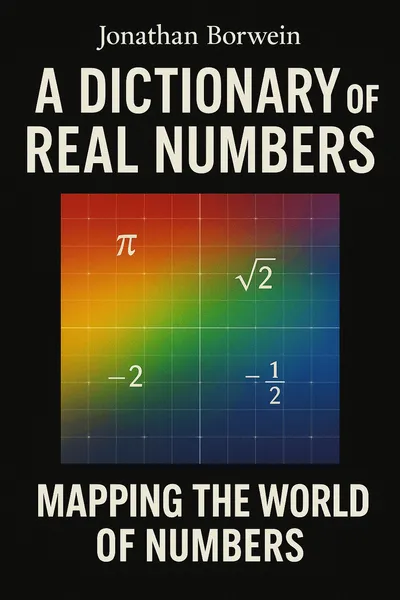
A Dictionary Of Real Numbers
Mapping the world of numbers
Description
A Dictionary of Real Numbers represents a comprehensive taxonomic enterprise that seeks to establish computational and theoretical foundations for understanding the landscape of mathematically significant real numbers. This lexicographic undertaking emerges within the contemporary mathematical landscape where computational power intersects with theoretical inquiry. The comprehensive reference work positions itself as both practical tool and theoretical statement about the nature of mathematical knowledge organization. The author leverages his extensive background in computational mathematics to create what constitutes essentially a cartographic project of numerical space, reflecting broader epistemological questions about mathematical classification and discovery.
The central research question driving this work asks: How can mathematically significant real numbers be systematically catalogued and characterized through computational and theoretical frameworks? The defended thesis argues that the systematic organization of real numbers according to their mathematical properties and computational accessibility reveals fundamental patterns in mathematical structure and enables new forms of mathematical investigation. The main stake of this enterprise is to demonstrate that comprehensive numerical cataloguing transcends mere reference compilation, constituting instead a methodological approach to mathematical knowledge that bridges computational practice with theoretical understanding.
Table of contents
01Taxonomic Epistemology and Mathematical Classification
Borwein's methodological framework reveals profound assumptions about mathematical knowledge organization. The dictionary format itself represents an epistemological choice that privileges accessibility and cross-referencing over hierarchical theoretical development. This organizational principle reflects broader tensions within contemporary mathematics between computational approaches and traditional proof-based methodologies.
The work's taxonomic ambitions echo historical attempts to systematize mathematical knowledge, from Euclid's axiomatic approach to Bourbaki's structural formalism. However, Borwein's computational emphasis introduces novel criteria for mathematical significance, where algorithmic tractability and numerical properties assume equal importance with theoretical elegance. This methodological shift suggests a democratization of mathematical importance, where computational accessibility challenges traditional hierarchies of mathematical value.

02Computational Mathematics and Cultural Authority
The dictionary's emphasis on computational aspects reflects broader transformations in mathematical practice. Borwein's approach legitimizes computer-assisted mathematical investigation, challenging traditional boundaries between pure and applied mathematics. This methodological stance carries significant cultural implications for mathematical authority and validation.
The work's computational orientation demonstrates how technological capabilities reshape mathematical inquiry. Numbers previously considered esoteric or purely theoretical gain practical significance through computational accessibility. This transformation reflects broader societal shifts where computational power democratizes access to mathematical investigation while simultaneously creating new forms of technical expertise.
03Mathematical Aesthetics and Cultural Transmission
Borwein's selection criteria reveal implicit aesthetic judgments that reflect broader mathematical culture. The inclusion of numbers based on elegance, surprise, or historical significance demonstrates how mathematical practice involves subjective evaluations alongside objective criteria. This aesthetic dimension challenges purely rationalist accounts of mathematical development.
04Digital Humanities and Mathematical Knowledge
The dictionary represents an early example of digital humanities applied to mathematical knowledge. Its computational emphasis and systematic organization prefigure contemporary developments in mathematical databases and computer-assisted research. This methodological innovation raises questions about how digital technologies transform mathematical practice and knowledge organization.
05Critical Assessment and Future Implications
Borwein's lexicographic enterprise transcends mere reference compilation to constitute a methodological statement about contemporary mathematical practice. The work demonstrates how computational approaches can enhance traditional mathematical investigation while raising fundamental questions about knowledge organization, mathematical aesthetics, and disciplinary authority. The dictionary format enables novel forms of mathematical exploration while challenging traditional hierarchies of mathematical importance.
The work's significance lies in its integration of computational methodology with comprehensive scope, creating a resource that serves both practical and theoretical purposes. This dual functionality reflects broader transformations in mathematical practice where computational power enables new forms of systematic investigation.