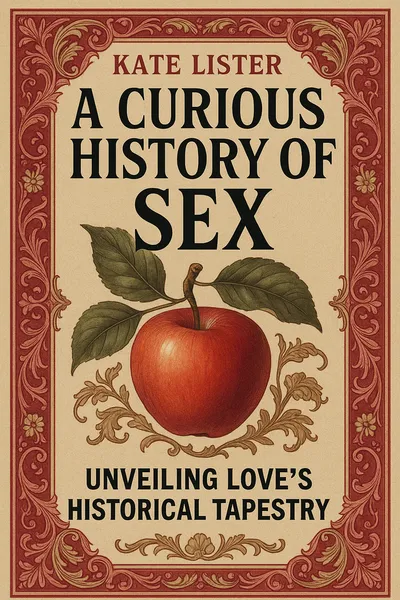
A Curious History of Sex
Unveiling love's historical tapestry
Description
Kate Lister's work emerges within the contemporary landscape of new sexual history, building upon decades of scholarship initiated by Michel Foucault's revolutionary approach to sexuality as a historical construct. This contribution positions itself at the intersection of social history, gender studies, and cultural analysis, offering a comprehensive examination of sexual practices across civilizations. The author leverages her expertise in digital humanities to synthesize extensive archival research with accessible narrative techniques, addressing both academic and general audiences interested in understanding sexuality as a lens through which to examine broader social transformations.
The central research question explores how sexual practices, norms, and taboos evolved across different historical periods and cultures, and what these transformations reveal about underlying power structures and social organization. The defended thesis demonstrates that sexual behaviors and attitudes are not biologically determined constants but rather historically contingent constructions that reflect and reinforce the political, economic, and religious frameworks of their respective societies. The main stake is to demonstrate that contemporary sexual norms are neither natural nor universal, thereby challenging essentialist assumptions and revealing the constructed nature of sexual morality and practice.
Lister's comprehensive historical survey successfully demonstrates that sexuality functions as a privileged site for examining broader social transformations and power dynamics. The work establishes that sexual practices cannot be understood independently from their political, economic, and cultural contexts, challenging essentialist assumptions about human sexual nature. The synthesis reveals how regulatory mechanisms adapt to changing social conditions while maintaining fundamental controlling functions across different historical periods. The intellectual contribution lies in synthesizing extensive historical evidence with contemporary theoretical frameworks, creating a accessible yet rigorous analysis that bridges academic specialization with public engagement. The coherence emerges through consistent attention to power dynamics and social construction processes, revealing underlying patterns across seemingly disparate historical phenomena.
Table of contents
01 The Archaeological Foundations of Sexual Normativity
Lister's archaeological approach to sexuality reveals how ancient civilizations established foundational paradigms that continue to influence contemporary sexual discourse. The analysis demonstrates that what modern societies consider deviant or normal often contradicts historical precedents, exposing the arbitrary nature of sexual classification systems. The theoretical framework employed draws heavily from anthropological structuralism and postcolonial critique, examining how Western interpretations of ancient sexual practices have been filtered through Christian moral frameworks and Victorian sensibilities.

02 Religious Hegemonies and Sexual Control
The examination of religious influences on sexual regulation reveals sexuality as a primary site of institutional control and social organization. Lister's analysis demonstrates how religious authorities systematically transformed sexual practices into moral categories, establishing surveillance mechanisms that extended ecclesiastical power into the most intimate spheres of human experience. The theoretical foundations draw from Foucauldian concepts of biopower and disciplinary mechanisms, showing how sexual regulation became central to broader projects of social control.
03 Medicalization and the Scientific Construction of Sexuality
The medicalization of sexuality represents a crucial epistemological shift wherein scientific discourse replaced religious authority as the primary legitimating force for sexual regulation. Lister's analysis reveals how medical professionals constructed pathological categories that reinforced existing social hierarchies while claiming objective neutrality. The theoretical approach integrates history of science perspectives with feminist critiques of medical authority, exposing how supposedly empirical classifications served ideological functions.
04 Contemporary Reconfigurations and Persistent Continuities
The examination of contemporary sexual transformations reveals both revolutionary changes and persistent structural continuities within sexual regulation systems. Lister's analysis demonstrates how digital technologies and global connectivity have created new possibilities for sexual expression while simultaneously enabling unprecedented forms of surveillance and control. The theoretical framework incorporates digital sociology perspectives alongside traditional historical analysis, revealing how technological mediation transforms intimate relationships and sexual practices.
05 Critical Assessment and Future Directions
Despite its comprehensive scope, the work exhibits certain theoretical limitations that constrain its analytical depth. The emphasis on accessibility occasionally sacrifices theoretical sophistication, particularly regarding the complex relationship between material conditions and ideological formations. The analysis tends toward descriptive historical survey rather than sustained theoretical intervention, limiting its contribution to existing scholarly debates within sexuality studies.
The treatment of non-Western sexual practices risks reproducing orientalist assumptions despite attempts at cultural sensitivity. The framework remains fundamentally Eurocentric, with other civilizations primarily serving as comparative examples rather than autonomous theoretical sources. Additionally, the relationship between individual agency and structural determination requires more sophisticated theoretical elaboration.
Related books