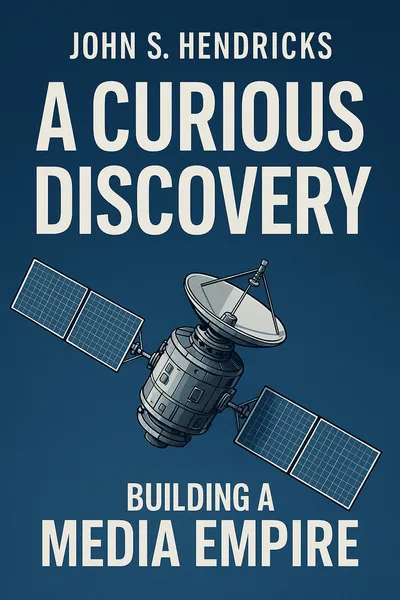
A Curious Discovery
Building a media empire
Description
"A Curious Discovery" by John S. Hendricks presents a comprehensive exploration of how entrepreneurial vision can successfully reconcile commercial imperatives with educational missions in the modern media landscape. The work's central thesis argues that the democratization of knowledge through mass media requires entrepreneurial vision that balances commercial viability with educational integrity. Hendricks positions himself as both media architect and cultural democratizer, crafting a narrative that transcends conventional business memoir boundaries while examining how knowledge dissemination evolved in late twentieth-century America.
The book addresses the fundamental research question of how entrepreneurial media ventures can reconcile profit imperatives with educational mission while transforming public knowledge consumption patterns. Hendricks defends the thesis that successful media democratization requires strategic balancing of commercial sustainability with authentic educational content delivery, demonstrating that entertainment and education can coexist productively within capitalist media structures without compromising intellectual integrity.
Throughout the work, Hendricks illustrates how Discovery Channel's programming strategy challenged traditional broadcasting paradigms by treating audiences as intellectually curious rather than passively consumptive. He demonstrates how knowledge commodification need not necessarily compromise intellectual rigor when properly structured, showing how Discovery's business model created economic incentives for high-quality documentary production while expanding public access to specialized knowledge domains. The analysis reveals how accessible documentary programming created informal learning networks that complemented traditional educational institutions while reaching demographics typically excluded from higher education, ultimately arguing that properly structured media enterprises can serve public educational interests while generating profits.
Table of contents
01 Media Entrepreneurship as Cultural Intervention
Hendricks articulates a theoretical framework positioning media entrepreneurship as cultural intervention rather than mere commercial enterprise. His conceptual approach draws from educational philosophy while embracing market-driven content distribution mechanisms. The author demonstrates how Discovery Channel's programming strategy challenged traditional broadcasting paradigms by treating audiences as intellectually curious rather than passively consumptive.
This analytical axis reveals tensions between accessibility and authenticity in knowledge presentation. Hendricks navigates the delicate balance between simplifying complex subjects for mass consumption while maintaining scientific and historical accuracy. His entrepreneurial methodology suggests that educational content requires sophisticated packaging to compete with conventional entertainment programming, thereby transforming how society conceptualizes learning beyond formal institutional boundaries.

02 Economic Structures and Knowledge Commodification
The work examines how Discovery Communications transformed documentary content into sustainable economic models, revealing complex relationships between information value and market mechanisms. Hendricks explores how advertising-supported programming created new revenue streams for educational content while maintaining editorial independence from commercial pressures.
His analysis demonstrates how knowledge commodification need not necessarily compromise intellectual rigor when properly structured. The author illustrates how Discovery's business model created economic incentives for high-quality documentary production, generating employment for researchers, filmmakers, and educators while expanding public access to specialized knowledge domains. This economic framework challenges traditional assumptions about profit-driven media inevitably degrading educational content quality.
03 Technological Disruption and Content Evolution
Hendricks addresses how technological advances fundamentally altered documentary production and distribution paradigms. His examination of cable television's emergence reveals how infrastructure changes created opportunities for niche programming that traditional broadcast networks could not economically justify.
The author demonstrates how Discovery Channel capitalized on technological shifts to reach previously underserved audiences interested in science, nature, and historical programming. This analysis exposes tensions between technological capability and content creativity, showing how distribution innovations enabled more sophisticated documentary narratives while simultaneously creating pressure for more sensationalized presentation styles to maintain audience engagement across expanded programming schedules.
04 Cultural Impact and Educational Transformation
The work's final analytical dimension examines Discovery Communications' broader cultural influence on American educational paradigms and public intellectual engagement. Hendricks argues that accessible documentary programming created informal learning networks that complemented traditional educational institutions while reaching demographics typically excluded from higher education.
His analysis reveals how Discovery's programming influenced public discourse around scientific literacy, environmental awareness, and historical understanding. The author demonstrates how entertainment-formatted educational content shaped cultural conversations about complex topics, potentially democratizing intellectual engagement across socioeconomic boundaries while raising questions about oversimplification risks in complex subject matter presentation.
05 Critical Analysis and Future Implications
Hendricks' analysis suffers from entrepreneurial bias that potentially overstates Discovery's cultural impact while understating negative consequences of knowledge commodification. The work lacks critical examination of how commercial pressures might have influenced editorial decisions or contributed to sensationalized content presentation. His perspective minimizes concerns about educational authority and expertise being displaced by entertainment-oriented programming approaches.
The analysis also overlooks potential demographic limitations in Discovery's audience reach and the persistence of educational inequalities despite expanded media access. Hendricks fails to adequately address criticism regarding the oversimplification of complex subjects or the potential for documentary programming to promote superficial rather than deep learning engagement.
Related books