
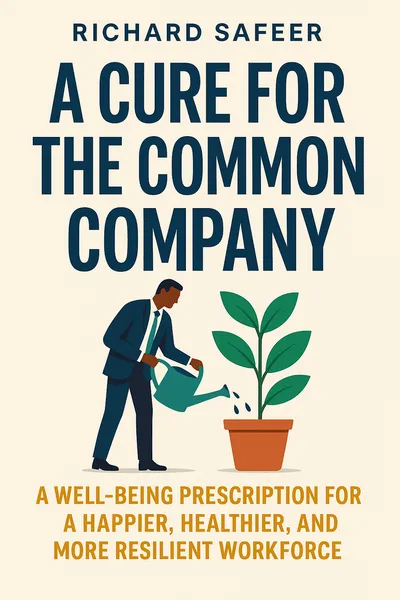
A Cure for the Common Company
When dysfunction becomes treatable
Description
Richard Safeer's 'A Cure for the Common Company' presents a systematic approach to organizational transformation that draws heavily from his medical background and healthcare leadership experience. The central thesis argues that organizations suffering from cultural stagnation can be systematically revitalized through targeted interventions that prioritize employee engagement and sustainable innovation practices.
Safeer conceptualizes corporate dysfunction as a chronic condition requiring clinical-style diagnosis and treatment. His framework treats organizational culture as an ecosystem needing careful cultivation rather than dramatic intervention, challenging prevalent disruption narratives in contemporary business literature. The work advocates for measured, evidence-based approaches to change management, emphasizing preventive measures over crisis management.
The book's treatment of employee engagement transcends superficial motivational strategies, positioning engagement as a fundamental organizational capability. Safeer argues that engaged employees serve as primary agents of transformation, creating multiplier effects that extend beyond individual productivity to systemic innovation capacity. This perspective challenges traditional command-and-control structures by suggesting sustainable transformation emerges from distributed leadership rather than top-down directives.
Innovation is conceptualized as an organizational immune system protecting against market disruption and competitive threats. Safeer emphasizes incremental innovation over breakthrough thinking, arguing that sustainable transformation results from continuous improvement rather than dramatic reinvention. This conservative approach challenges Silicon Valley's disruptive innovation ethos.
The work's ethical dimension emerges through treating transformation as a collective endeavor balancing organizational needs with individual well-being. Safeer's medical background informs his commitment to 'first, do no harm' principles in organizational change, positioning organizational health as inseparable from employee welfare and challenging business models prioritizing short-term profits over long-term sustainability.
Table of contents
01 The Pathology of Corporate Stagnation
Safeer's diagnostic approach to organizational dysfunction reveals his medical training's influence on business analysis. He conceptualizes corporate stagnation as a chronic condition characterized by systemic symptoms: declining employee morale, resistance to innovation, and rigid adherence to obsolete practices. This medicalization of business problems represents both the work's strength and potential limitation.
The author's framework treats organizational culture as an ecosystem requiring careful cultivation rather than dramatic intervention. This perspective challenges the prevalent disruption narratives that dominate contemporary business literature, advocating instead for measured, evidence-based approaches to change management. Safeer's emphasis on preventive measures over crisis management reflects his healthcare background, suggesting that organizational health requires ongoing maintenance rather than periodic revolutionary overhauls.

02 The Prescription for Engagement
The work's treatment of employee engagement transcends superficial motivational strategies, positioning engagement as a fundamental organizational capability rather than a human resources concern. Safeer argues that engaged employees serve as the primary agents of transformation, creating a multiplier effect that extends beyond individual productivity to systemic innovation capacity.
This perspective challenges traditional command-and-control management structures by suggesting that sustainable transformation emerges from distributed leadership rather than top-down directives. The author's emphasis on creating conditions for employee-driven innovation reflects contemporary theories of organizational learning and adaptive capacity.
03 Innovation as Organizational Immunity
Safeer's conceptualization of innovation extends beyond technological advancement to encompass cultural and procedural transformation. He presents innovation capacity as an organizational immune system that protects against market disruption and competitive threats. This biological metaphor suggests that healthy organizations possess natural defense mechanisms that enable adaptation to changing environments.
The author's framework emphasizes incremental innovation over breakthrough thinking, arguing that sustainable transformation results from continuous improvement rather than dramatic reinvention. This perspective challenges the Silicon Valley ethos of disruptive innovation, suggesting that most organizations benefit more from steady adaptation than revolutionary change.
04 The Ethics of Organizational Transformation
The work's ethical dimension emerges through its treatment of transformation as a collective endeavor that must balance organizational needs with individual well-being. Safeer's medical background informs his commitment to 'first, do no harm' principles in organizational change, advocating for transformation processes that enhance rather than exploit employee capabilities.
This ethical framework positions organizational health as inseparable from employee welfare, challenging business models that prioritize short-term profits over long-term sustainability. Safeer's approach suggests that truly effective transformation must address both performance metrics and human flourishing, creating value for multiple stakeholders rather than shareholders alone.
05 Critical Analysis and Future Directions
Safeer's contribution lies in his systematic approach to organizational transformation, one that applies clinical rigor to business problems while maintaining sensitivity to human factors. His work synthesizes insights from healthcare, management theory, and organizational psychology to create a comprehensive framework for sustainable change. The author's emphasis on employee engagement and incremental innovation provides a pragmatic alternative to more radical transformation narratives. The work's coherence stems from its consistent application of health metaphors to organizational challenges, creating a unified theoretical framework that guides practical interventions.
Related books