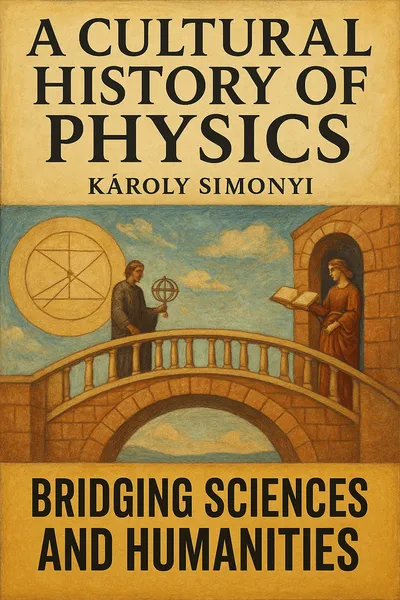
A Cultural History of Physics
Bridging sciences and humanities
Description
Károl Simonyi's "A Cultural History of Physics" presents a groundbreaking approach to understanding physics as a cultural phenomenon deeply intertwined with the intellectual, social, and philosophical currents of each historical epoch. Writing from the perspective of a distinguished Hungarian physicist and science historian, Simonyi challenges the conventional view of physics as merely a collection of technical discoveries isolated from broader cultural contexts. His central thesis argues that scientific discoveries in physics are inseparable from the cultural, philosophical, and social contexts in which they emerge, making cultural-historical understanding essential for bridging the gap between scientific and humanistic knowledge.
The work emerges from growing concerns about the increasing specialization of scientific disciplines and their progressive disconnection from humanistic culture. Positioning himself as a mediator between technical scientific knowledge and broader cultural literacy, Simonyi reflects the Central European tradition of polymathic scholarship. He demonstrates that physical theories emerge from and respond to the intellectual preoccupations of their time, revealing how concepts like space, time, and matter are culturally mediated constructions rather than purely objective discoveries.
Simonyi traces the historical development of physics through various cultural lenses, showing how Aristotelian physics reflected medieval cosmological concerns while Newtonian mechanics embodied Enlightenment rationalism and mechanical philosophy. He extends his analysis beyond individual discoveries to examine physics as a social institution embedded within broader power structures and cultural practices, analyzing how scientific communities, educational systems, and patronage networks shape both research directions and knowledge dissemination.
The work also addresses epistemological transformations, examining how shifts from classical to modern physics involved fundamental reorientations of thought that resonated throughout culture. The transition to relativity and quantum mechanics challenged common-sense notions of reality, influencing philosophy, literature, and art while contributing to broader cultural transformations. Finally, Simonyi explores the ethical implications of scientific development and the responsibility of physicists as cultural actors, arguing that cultural literacy in physics is essential for democratic participation in decisions about science and technology.
Table of contents
01 The Cultural Embeddedness of Scientific Thought
Simonyi's fundamental contribution lies in demonstrating how physical theories emerge from and respond to the intellectual preoccupations of their time. Rather than presenting physics as a linear accumulation of objective discoveries, he reveals how concepts like space, time, and matter are culturally mediated constructions. The author traces how Aristotelian physics reflected medieval cosmological concerns, while Newtonian mechanics embodied Enlightenment rationalism and mechanical philosophy.

02 Science as Social Institution
The work extends beyond individual discoveries to examine physics as a social institution embedded within broader power structures and cultural practices. Simonyi analyzes how scientific communities, educational systems, and patronage networks shape both the direction of research and the dissemination of knowledge. He demonstrates how the emergence of modern physics coincided with new forms of social organization, from the Royal Society to the modern research university.
03 Epistemological Transformations and Cultural Ruptures
A particularly sophisticated aspect of Simonyi's analysis concerns the epistemological ruptures that mark transitions between different physical paradigms. He examines how shifts from classical to modern physics involved not merely technical adjustments but fundamental reorientations of thought that resonated throughout culture. The transition to relativity and quantum mechanics represented challenges to common-sense notions of reality that extended far beyond physics proper, influencing philosophy, literature, and art.
04 The Ethics of Scientific Knowledge and Cultural Responsibility
The final dimension of Simonyi's analysis addresses the ethical implications of scientific development and the responsibility of physicists as cultural actors. He examines how the practical applications of physical theories—from industrial technology to nuclear weapons—raise fundamental questions about the relationship between knowledge and power. The author argues that physicists cannot retreat into technical specialization but must engage with the broader cultural implications of their work.
05 Critical Assessment and Contemporary Relevance
Simonyi's cultural history successfully demonstrates that physics and humanistic culture are not separate domains but interconnected aspects of human intellectual development. His work reveals how scientific concepts emerge from cultural contexts, shape social institutions, and influence broader patterns of thought and practice. By historicizing physics within cultural frameworks, the author provides a model for overcoming the artificial separation between scientific and humanistic knowledge. The work's coherence lies in its consistent demonstration that technical competence in physics requires cultural understanding, while cultural literacy demands engagement with scientific concepts. This synthesis offers a compelling alternative to both scientistic reductionism and humanistic anti-intellectualism.
Related books