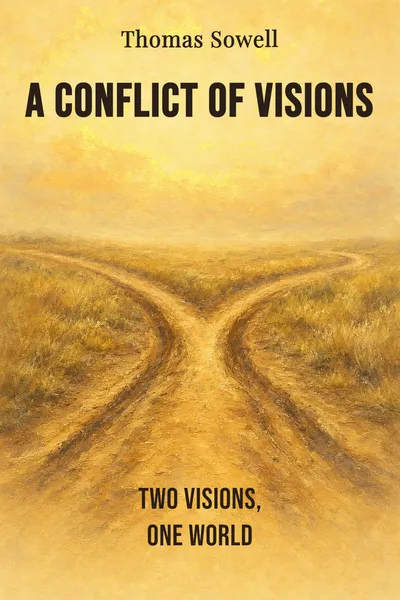
A Conflict of Visions
Two visions, one world
Description
In 1987, an economist at the Hoover Institution named Thomas Sowell published a book with an odd premise for a work of political theory. It did not argue for a side. It argued that most of us have been fighting the wrong fight — not over facts, but over something buried underneath the facts. Sowell called that buried thing a vision: a gut-level sense of how the world works and what human beings are capable of, formed long before we ever reach for evidence. The book was A Conflict of Visions, and its claim was that the great political battles of the last three centuries are, at bottom, a clash between two of them.
What makes the idea stick is how little it maps onto the labels we use. Sowell was not describing left versus right, or liberal versus conservative, or any of the tribal markers we wear. He was describing something closer to a temperament — the way certain people instinctively trust human reason to remake the world, while others instinctively distrust it and lean on the accumulated habits of the past. Adam Smith and William Godwin sat on opposite sides of this line in the eighteenth century. So did their intellectual descendants, right down to the arguments we are still having about crime, war, taxes, and justice today.
It is a strange feeling, reading the book, to watch positions you thought were random preferences click into a pattern. The person who wants to abolish something and the person who wants to reform it are not just disagreeing about a policy. They are running on different assumptions about what a person even is. Sowell spends the whole book pulling that assumption into the light.
The question we’re asking : Why do intelligent, well-meaning people keep landing on opposite sides of nearly every issue — and what are they actually disagreeing about?What we’ll see : How a single split in what we believe about human nature quietly organizes centuries of argument, and what it costs us to ignore it.
Table of contents
01 Chapter 1 — The argument beneath every argument
Sowell's starting observation is deceptively simple. When two people argue about a specific policy — say, whether to be tough or lenient on crime — they rarely stay on the policy for long. Push a little, and the disagreement slides downward, toward questions neither side raised out loud. What causes crime? Can people be changed? Is a harsh institution a failure of imagination or a hard-won defense against something worse? The surface fight, Sowell argues, is fed by an underground one, and the underground one almost never gets spoken aloud because both sides assume their own answer is just obvious.
He gives this underground layer a name: a vision. A vision is not a theory, and it is not an ideology. It comes earlier than both. Sowell describes it as a pre-analytic sense of how things work — the intuition you already have before you sit down to reason. Theories are built on top of visions; ideologies are visions dressed for public life. But the vision itself is the silent premise, the thing you feel in your gut is true about people and society before anyone shows you a single statistic.

02 Chapter 2 — Human nature as the fork in the road
The fork, for Sowell, is a single question: how much can human nature actually change? One vision answers, in effect, not much. He calls it the constrained vision, and its defining figure is Adam Smith. The constrained vision starts from the assumption that people are limited — limited in knowledge, limited in virtue, driven far more by self-interest than by reason, and largely stuck that way. You do not fix human nature; you work around it. Given that people will not reliably act well, the trick is to build arrangements — markets, laws, inherited customs — that channel flawed individuals toward decent collective outcomes without requiring anyone to become a saint.
The other vision Sowell calls unconstrained, and its purest early voice is the English radical William Godwin. Here the assumption runs the other way. Human beings are not fixed. Reason and moral understanding can genuinely improve them, and the selfishness we observe is not built in — it is a symptom of bad institutions, ignorance, or circumstance. If people behave badly, that is a problem to be solved, not a permanent fact to be managed. Where the constrained vision sees inherent limits, the unconstrained vision sees obstacles that better ideas and better arrangements can clear away.
03 Chapter 3 — Knowledge, wisdom, and who gets to decide
One of the sharpest divides Sowell draws runs through the question of knowledge — specifically, where it lives and who is entitled to act on it. The unconstrained vision tends to trust articulated reason: the knowledge that can be spelled out, defended in words, and concentrated in the hands of the people best equipped to think it through. If a bright, informed person can reason her way to a better arrangement, why defer to the messy status quo? Expertise, on this view, is not a threat to democracy but its rightful engine.
The constrained vision distrusts exactly this. It leans on what Sowell calls systemic knowledge — the diffuse, unspoken wisdom scattered across millions of ordinary people and encoded in prices, customs, and long-standing practices that no single mind ever designed. From this angle, the confident expert is dangerous precisely because she overrates what any one intellect can grasp. Edmund Burke's defense of inherited institutions runs on this logic: a practice that has survived for generations may carry knowledge its critics cannot articulate, and tearing it down because you cannot see the reason for it is a good way to discover the reason the hard way.
04 Chapter 4 — The trade-off nobody quite forgives
Step back from the specific debates and Sowell's framework becomes a lens on political disagreement itself. Its most uncomfortable implication is that our opponents are usually not the fools or villains we take them for. When someone reaches a conclusion that seems monstrous or absurd to us, the natural explanation is that they are stupid, corrupt, or cruel. Sowell's argument is that far more often they are simply reasoning consistently from a different premise about human limits — and if you granted them that premise, their conclusion would look as inevitable to you as yours does now.
This reframes the moral heat that surrounds politics. The constrained thinker looks at the unconstrained thinker and sees someone playing with fire, unleashing untested schemes on real people. The unconstrained thinker looks back and sees someone defending indefensible suffering by hiding behind the word tradition. Each reads the other's caution or ambition as a character flaw. Sowell's point is that it is not a flaw at all — it is the honest downstream consequence of a vision, and calling it wickedness only guarantees that neither side ever hears the other.
05 Conclusion
The book closes where it opened, with the strange discovery that so much of what looks like chaos in political life is actually pattern. The scattered positions people hold on crime and war and justice and money turn out to be held together by an invisible thread — a prior conviction about what human beings are and what they might become. Sowell traced that thread through Smith and Godwin, Burke and Condorcet, and found it running unbroken into arguments we are still having, often without noticing that we inherited them.
Related books