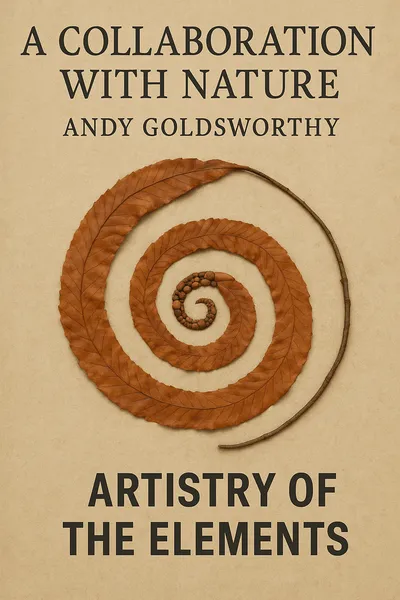
A Collaboration with Nature
Artistry of the elements
Description
Goldsworthy's work emerges from the intersection of contemporary sculpture and environmental consciousness, positioning itself within the broader land art movement while distinctly emphasizing temporality and process. His practice challenges conventional notions of permanence in art, instead embracing the ephemeral qualities that characterize natural phenomena. This book documents a methodology that treats natural materials not as passive media but as active collaborators in artistic creation.
The central research question driving this work asks: How can artistic practice authentically engage with natural processes without imposing human dominance over environmental materials? Goldsworthy defends the thesis that genuine artistic collaboration with nature requires abandoning anthropocentric control in favor of responsive dialogue with material properties and seasonal rhythms. The main stake involves redefining the artist's role from creator-manipulator to facilitator-participant within ecological systems.
Goldsworthy's "A Collaboration with Nature" presents a coherent philosophy of artistic practice grounded in respect for natural processes and material agency. His methodology offers alternatives to anthropocentric approaches that treat nature as mere resource or backdrop for human creativity. The work demonstrates how genuine collaboration requires artists to surrender control while maintaining creative intentionality. The book's documentation reveals the intellectual sophistication underlying apparently simple natural arrangements. Goldsworthy's practice emerges as a form of applied philosophy, testing abstract concepts about temporality, agency, and collaboration through concrete material engagement with specific environments and seasonal conditions.
Table of contents
01 Temporal Aesthetics and Ephemeral Practice
Goldsworthy's methodology fundamentally challenges Western art's obsession with permanence, establishing temporality as both medium and message. His ice sculptures, leaf arrangements, and stone configurations embrace decay, melting, and dispersal as integral aspects of the creative process. This temporal dimension reflects broader philosophical questions about duration, memory, and artistic legacy in an age of environmental crisis.

02 Material Agency and Collaborative Methodology
The book reveals Goldsworthy's sophisticated understanding of material properties as active forces rather than passive substances. His work with snow, clay, and stone demonstrates intimate knowledge of how different materials behave under varying conditions, requiring the artist to adapt his intentions to natural constraints and possibilities.
03 Environmental Knowledge and Ecological Literacy
Goldsworthy's practice demonstrates how artistic engagement can generate sophisticated environmental knowledge. His seasonal observations, understanding of weather patterns, and familiarity with geological processes reflect years of embodied learning through direct material engagement. This knowledge differs qualitatively from scientific or academic approaches, offering experiential insights into natural systems.
04 Photographic Documentation and Temporal Paradox
The book's photographic documentation raises complex questions about representation, permanence, and mediation. While Goldsworthy's sculptures dissolve back into their environments, photographs preserve visual traces of these temporary interventions. This creates a productive tension between the ephemeral philosophy underlying the work and the documentary impulse to record and preserve.
05 Critical Perspectives and Future Directions
Goldsworthy's practice, while innovative, potentially romanticizes rural environments while remaining relatively disconnected from urban ecological challenges. His emphasis on pristine natural settings may inadvertently reinforce nature-culture divisions rather than addressing the hybrid environments where most contemporary life unfolds. Additionally, the work's reliance on photographic documentation for dissemination creates dependencies on technological systems that contradict its apparent anti-modern philosophy.
Related books