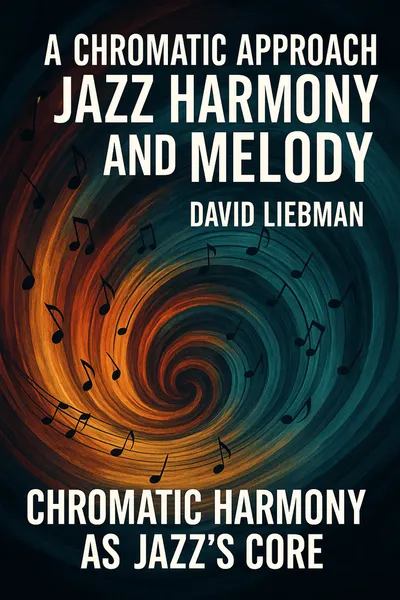
A Chromatic Approach to Jazz Harmony and Melody
Chromatic harmony as jazz's core
Description
David Liebman presents a comprehensive theoretical framework that challenges conventional jazz pedagogy by prioritizing chromatic movement over traditional scalar approaches. His expertise as both performer and educator enables a unique synthesis of practical application and theoretical rigor, positioning this work within contemporary debates about jazz education methodology.
The central research question explores how chromatic harmony can serve as the primary organizing principle for jazz improvisation and composition. Liebman defends the thesis that chromatic approaches supersede traditional diatonic methods in generating sophisticated harmonic content. The main stake involves transforming jazz education by establishing chromatic thinking as foundational rather than supplementary.
Liebman's fundamental contribution lies in repositioning chromaticism from ornamental device to structural foundation. This theoretical reorientation challenges the pedagogical dominance of modal approaches that have characterized jazz education since the 1960s. By emphasizing chromatic voice-leading over scalar frameworks, he proposes a harmonic language that privileges linear motion and intervallic relationships.
This paradigmatic shift reflects broader tensions within jazz pedagogy between systematic approaches and intuitive development. Liebman's framework suggests that traditional chord-scale relationships, while historically significant, limit harmonic possibilities by constraining improvisational thinking within predetermined patterns. His chromatic methodology advocates for a more flexible relationship between harmony and melody, where linear movement generates harmonic content rather than conforming to predetermined structures.
Liebman's work represents a significant intellectual contribution to jazz pedagogy by providing systematic approaches to advanced harmonic concepts. His theoretical framework successfully bridges the gap between abstract harmonic theory and practical application, offering musicians concrete tools for developing sophisticated improvisational vocabularies. The emphasis on chromatic movement provides a unifying principle that encompasses diverse harmonic possibilities while maintaining pedagogical coherence.
Table of contents
01Pedagogical Implementation and Social Effects
The educational implications of Liebman's approach extend beyond technical instruction to encompass broader questions of cultural transmission within jazz communities. By advocating for chromatic primacy, he challenges established hierarchies within jazz education that privilege certain theoretical frameworks over others. This methodological shift potentially democratizes advanced harmonic concepts by making sophisticated techniques more accessible to developing musicians.

02Performance Practice and Cultural Tensions
Liebman's theoretical framework generates significant tensions within established performance practices. The emphasis on chromatic movement challenges conventional notions of harmonic resolution and melodic development that have characterized mainstream jazz performance. This creates potential conflicts between traditional aesthetic values and contemporary harmonic possibilities.
03Aesthetic and Ethical Implications
The privileging of chromatic harmony raises fundamental questions about aesthetic values within jazz culture. Liebman's approach implies that harmonic sophistication represents musical progress, potentially devaluing simpler approaches that emphasize other musical elements. This creates ethical tensions regarding the evaluation of musical worth and the definition of artistic advancement.
04Critical Analysis and Future Directions
Despite its pedagogical value, Liebman's framework exhibits certain limitations that constrain its universal applicability. The emphasis on chromatic approaches may inadvertently devalue other important musical elements such as rhythmic complexity, timbral exploration, or cultural expression. This theoretical bias toward harmonic sophistication reflects broader tendencies within jazz education that privilege technical complexity over holistic musical development.
Additionally, the systematic nature of chromatic approaches risks mechanizing improvisational processes that traditionally emphasized spontaneous creativity. The tension between analytical knowledge and intuitive expression requires careful balance to avoid reducing improvisation to predetermined patterns.
Related books