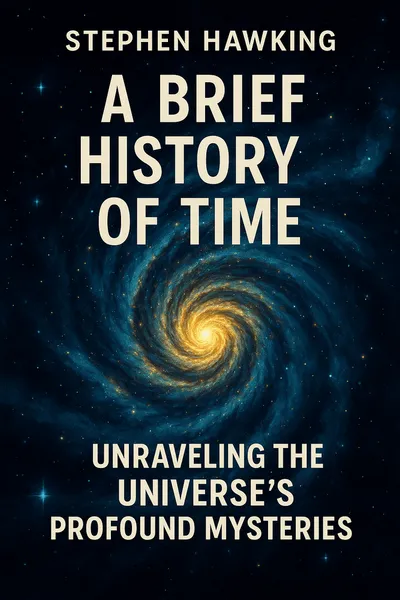
A Brief History of Time
Unraveling the universe's profound mysteries
Description
Stephen Hawking's *A Brief History of Time* emerged in 1988 as an ambitious attempt to democratize cosmological knowledge. Writing as both theoretical physicist and public intellectual, Hawking sought to bridge the gap between cutting-edge physics and popular understanding. The work situates itself within the broader project of twentieth-century physics to achieve a unified theory, while simultaneously challenging traditional boundaries between scientific discourse and public engagement.
The central research question asks: Can the fundamental laws governing the universe be understood and unified into a complete theory accessible to general audiences? Hawking defends the thesis that the universe operates according to discoverable physical laws that ultimately converge toward a comprehensive "theory of everything." The main stake involves demonstrating that cosmological complexity can be rendered comprehensible without sacrificing scientific rigor.
Hawking's work represents a landmark synthesis of cosmological knowledge that successfully demonstrates the possibility of rendering complex physical theories accessible to general audiences. His achievement lies not merely in simplification but in revealing the profound implications of contemporary physics for human understanding. The work establishes that cosmological insights necessarily transform conventional frameworks for comprehending reality, temporality, and human significance. The intellectual coherence of Hawking's enterprise emerges through his consistent emphasis on mathematical beauty and theoretical unification as guiding principles. His vision of a comprehensible universe reflects deep confidence in human rational capacity while simultaneously revealing the contingency of everyday assumptions about space, time, and causality.
Table of contents
01 The Democratization of Cosmological Knowledge
Hawking's enterprise fundamentally challenges the traditional hermetic nature of theoretical physics. His approach reveals a tension between scientific specialization and democratic access to knowledge. By translating concepts like spacetime curvature and quantum mechanics into accessible language, the work performs a radical epistemological gesture: asserting that the most abstract theoretical constructs can be communicated without mathematical formalism.

02 Temporality and the Architecture of Reality
The work's treatment of time reveals profound implications for human experience and meaning-making. Hawking's exploration of temporal directionality, thermodynamic arrows, and the possibility of time's beginning challenges conventional linear narratives that structure social and cultural understanding. His discussion of time's relationship to consciousness suggests that temporal experience itself may be contingent rather than fundamental.
03 The Boundaries of Existence
Hawking's investigation of cosmic boundaries—spatial edges, temporal beginnings, dimensional limitations—confronts fundamental assumptions about finitude and infinity. His treatment of these questions reveals deep tensions between mathematical description and intuitive understanding, highlighting how cosmological insights can destabilize common-sense notions of containment and limitation.
04 Scientific Authority and Existential Meaning
The work's pursuit of a complete theoretical framework raises profound questions about the relationship between scientific knowledge and human significance. Hawking's vision of a universe fully explicable through physical laws potentially reduces human experience to mechanistic processes, challenging traditional sources of meaning and value.
05 Critical Assessment and Future Directions
The work's accessibility paradoxically creates new forms of exclusion. While eliminating mathematical barriers, Hawking's approach privileges particular forms of rationality and cultural capital, potentially marginalizing alternative ways of knowing. His emphasis on theoretical elegance may reflect aesthetic preferences rather than objective criteria, raising questions about the universality of scientific values.
Related books