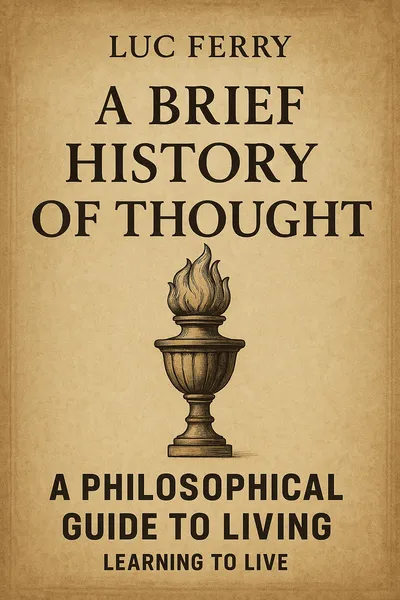
A Brief History of Thought
A Philosophical Guide to Living (Learning to Live)
Description
Ferry's ambitious synthesis emerges within contemporary debates over philosophy's relevance and accessibility. Drawing upon his expertise in political philosophy and educational reform, Ferry constructs a panoramic view of Western thought spanning from ancient Greece to postmodernity. The work positions itself against both academic obscurantism and philosophical relativism, advocating for philosophy's continued vitality as humanity's fundamental response to mortality and meaninglessness.
The central research question driving this work asks: How has philosophy evolved across history to address humanity's fundamental confrontation with finitude and the search for salvation without transcendent guarantees? Ferry's defended thesis proposes that philosophy constitutes humanity's secular quest for wisdom, progressing through distinct epochs that each offer different responses to existential anxiety and the desire for meaningful existence. The main stake is to demonstrate philosophy's enduring relevance by showing its historical continuity as humanity's rational alternative to religious consolation.
Ferry's historical synthesis demonstrates philosophy's remarkable adaptability across epochal transitions while maintaining essential continuity in its therapeutic mission. The work successfully shows how philosophical paradigms respond to changing cultural contexts while addressing perennial human concerns about mortality, meaning, and moral orientation. Each historical moment generates both insights and limitations, creating dialectical progression rather than simple replacement. The intellectual contribution lies in Ferry's ability to present philosophical history as neither progressive development nor arbitrary succession, but as humanity's ongoing creative response to existential challenges. This perspective rehabilitates philosophy's public role while acknowledging the complexity of contemporary intellectual landscapes.
Table of contents
01 Ancient Philosophy: The Cosmological Foundation
Ferry's analysis reveals how ancient philosophy established itself through the revolutionary transition from mythological to rational explanations of existence. The Stoic framework emerges as paradigmatic, proposing harmony with cosmic order as philosophy's original therapeutic function. This cosmological orientation represents more than intellectual curiosity; it constitutes humanity's first systematic attempt to achieve serenity through understanding rather than faith.

02 Modern Philosophy: Humanistic Revolts and Subjectivity
The medieval-to-modern transition reveals philosophy's dramatic reorientation toward human autonomy and individual dignity. Ferry examines how thinkers from Pico della Mirandola to Kant constructed new foundations for meaning-making centered on human freedom rather than cosmic determinism. This humanistic revolution transforms philosophy from passive acceptance of natural order to active construction of moral and political frameworks.
03 Contemporary Philosophy: Deconstructive Challenges and Fragmentation
Contemporary philosophy's deconstructive turn represents both culmination and crisis of the humanistic project. Ferry's analysis of figures like Nietzsche, Heidegger, and contemporary French theorists reveals how postmodern thought simultaneously extends and undermines Enlightenment rationality. The critique of metaphysical foundations leads to radical questioning of truth, subjectivity, and moral universals.
04 Ferry's Constructive Vision: Post-Metaphysical Wisdom
Ferry's constructive proposal envisions philosophy's renewal through integration of historical insights without metaphysical dogmatism. This post-metaphysical approach maintains philosophy's therapeutic vocation while acknowledging the impossibility of absolute foundations. Love, beauty, and finite transcendence emerge as contemporary sources of meaning that neither require cosmic guarantees nor collapse into pure relativism.
05 Critical Assessment and Future Directions
Ferry's synthesis suffers from several theoretical limitations that constrain its analytical scope. The exclusive focus on Western philosophical traditions ignores rich non-European wisdom traditions that might complicate or enrich his developmental narrative. Additionally, the work's pedagogical clarity sometimes oversimplifies complex philosophical positions, potentially distorting their original sophistication. The emphasis on philosophy's therapeutic function, while historically grounded, may underestimate other legitimate philosophical pursuits such as purely theoretical inquiry or critical social analysis.
Related books