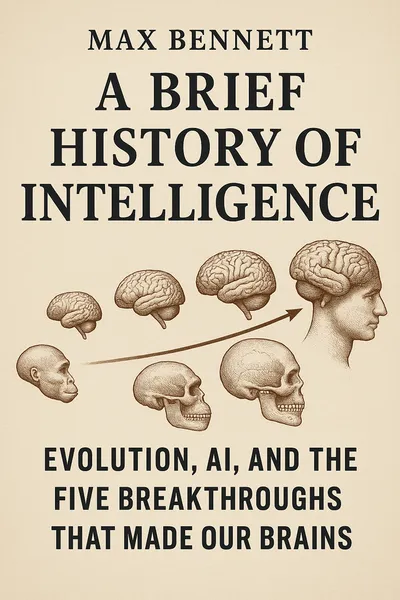
A Brief History of Intelligence
Power disguised as objectivity
Description
Bennett's work emerges within a contemporary intellectual landscape marked by unprecedented developments in artificial intelligence and renewed debates about human cognitive capabilities. The author leverages his interdisciplinary expertise to examine intelligence as both a scientific object and a social construct, challenging essentialist perspectives that treat intelligence as an immutable biological property. This historical investigation arrives at a moment when traditional boundaries between human and machine intelligence are increasingly questioned, making Bennett's genealogical approach particularly relevant for understanding current controversies surrounding cognitive assessment, educational policy, and technological advancement.
The central research question asks: How has the concept of intelligence been constructed, reconstructed, and contested throughout human history, and what does this evolution reveal about the relationship between knowledge, power, and social organization? Bennett's defended thesis posits that intelligence represents a historically contingent concept whose definitions and applications have consistently reflected the dominant cultural, political, and technological paradigms of each historical period. The main stake is to demonstrate that contemporary debates about intelligence cannot be understood without recognizing the ideological dimensions embedded within seemingly objective scientific discourse.
Bennett's historical investigation successfully demonstrates that intelligence represents a contested terrain where scientific claims intersect with social interests and political projects. The author's genealogical approach reveals persistent patterns of exclusion and hierarchy that persist across different historical periods and theoretical frameworks. This analysis challenges both naive scientism that treats intelligence as a natural property and simple relativism that dismisses all cognitive differences as purely constructed. The work's intellectual contribution lies in providing a framework for understanding contemporary intelligence debates as continuous with historical patterns while recognizing genuine innovations introduced by technological development. Bennett's synthesis suggests that future progress requires acknowledging both the social dimensions of intelligence discourse and the legitimate scientific questions it addresses.
Table of contents
01 The Archaeological Construction of Intelligence
Bennett's historical excavation reveals intelligence as fundamentally tied to power structures and social hierarchies rather than emerging from neutral scientific inquiry. The author demonstrates how ancient civilizations developed proto-theories of cognitive capability primarily to justify existing social stratifications and legitimize educational exclusions. This archaeological approach exposes the persistent entanglement between intelligence discourse and mechanisms of social reproduction, challenging narratives that present modern psychometrics as representing genuine scientific progress over earlier, supposedly more primitive, conceptualizations.

02 The Psychometric Revolution and Its Discontents
The emergence of standardized intelligence testing represents, in Bennett's analysis, a crucial transformation in how societies organize access to opportunities and resources. The author examines how psychometric instruments became powerful sorting mechanisms that simultaneously claimed scientific objectivity while reproducing existing inequalities. This contradiction between egalitarian rhetoric and stratifying practice reveals the complex relationship between democratic ideologies and meritocratic technologies.
03 Multiplicity and Fragmentation in Intelligence Theories
The proliferation of alternative intelligence theories—emotional, multiple, practical—signals both the democratization of cognitive discourse and its potential fragmentation into competing paradigms. Bennett analyzes how these expansionist approaches challenge traditional hierarchies while potentially creating new forms of exclusion and categorization. The multiplication of intelligence types reflects broader cultural shifts toward diversity recognition while raising questions about conceptual coherence and empirical validity.
04 Artificial Intelligence and Human Identity
Bennett's examination of artificial intelligence development reveals how technological capabilities force fundamental reconsiderations of human cognitive uniqueness. The author analyzes contemporary anxieties about machine intelligence as reflecting deeper uncertainties about human identity and social organization in post-industrial contexts. These concerns extend beyond technical questions about algorithmic capability to encompass existential issues about human purpose and social value.
05 Critical Assessment and Future Directions
Bennett's analysis occasionally suffers from an overly deterministic reading of scientific development that underestimates the genuine empirical insights generated by intelligence research. The author's critical stance toward psychometrics, while valuable for exposing ideological dimensions, sometimes obscures legitimate questions about cognitive assessment and individual differences. Additionally, the work's focus on Western intellectual traditions limits its global perspective on intelligence conceptualization across different cultural contexts.
The historical narrative presented tends toward presentist interpretations that judge past theories primarily through contemporary ethical standards rather than understanding them within their original contexts. This approach risks missing important continuities and innovations that might inform current debates.
Related books