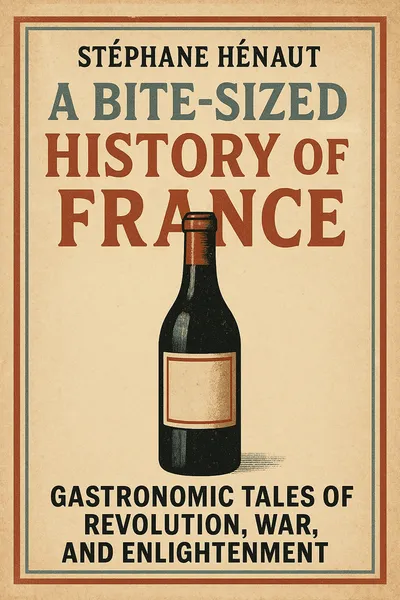
A Bite-Sized History of France
Identity forged, not inherited
Description
Stéphane Hénaut presents a synthetic approach to French historiography that challenges traditional chronological narratives by emphasizing cultural continuities and transformations. This work emerges within contemporary debates about national identity construction and the democratization of historical knowledge. The author positions himself within the tradition of cultural historians who seek to bridge academic scholarship with public understanding, offering an alternative to both nationalist mythologies and deconstructionist critiques of French exceptionalism.
The central research question explores how cultural practices, linguistic evolution, and material traditions contribute to the formation of French national identity across different historical periods. Hénaut defends the thesis that French national identity results from a dynamic process of cultural synthesis that transforms diverse regional and temporal elements into a coherent civilizational narrative. The main stake involves demonstrating that French cultural unity emerges not from homogenization but from the creative integration of heterogeneous historical experiences.
Hénaut's theoretical framework draws upon Benedict Anderson's concept of imagined communities while incorporating Pierre Nora's notion of lieux de mémoire. The author argues that French identity formation operates through what he terms 'cultural metabolism,' a process by which diverse influences are absorbed and transformed rather than merely accumulated. This approach challenges essentialist interpretations of Frenchness by revealing how Celtic, Roman, Germanic, and Mediterranean elements undergo continuous reconfiguration. The work's theoretical sophistication emerges through its integration of anthropological insights with historical analysis, successfully demonstrating how material practices carry symbolic meaning while avoiding reductive interpretations that ignore power relations and social conflicts.
Table of contents
01 Linguistic Evolution as Cultural Synthesis
The analysis of linguistic evolution serves as a primary case study for this cultural synthesis. Hénaut demonstrates how the emergence of French from Latin involves not mere linguistic drift but active cultural negotiation between competing traditions. The author's examination of medieval linguistic practices reveals how political unification required cultural translation mechanisms that preserved local specificities while creating common reference points.

02 Gastronomic Practices as Civilizational Markers
The second analytical axis explores how culinary traditions function as vehicles for cultural transmission and identity consolidation. Hénaut's treatment of French gastronomy transcends folkloric description to examine how food practices encode social hierarchies, regional affiliations, and temporal continuities. The author reveals how culinary techniques and preferences migrate across social boundaries while maintaining distinctive characteristics.
03 Artistic Expression and Cultural Legitimation
The third thematic development examines how artistic production participates in identity construction through the creation of shared aesthetic vocabularies. Hénaut's analysis of French artistic traditions reveals tensions between innovation and conservation, between regional expression and national representation. The author explores how artistic movements negotiate between local roots and cosmopolitan aspirations, creating distinctive French contributions to European culture.
04 Political Integration and Cultural Resistance
The final analytical axis addresses the relationship between state formation and cultural transformation. Hénaut examines how political centralization interacts with cultural diversity to produce new forms of unity that preserve rather than eliminate difference. The author's treatment of regional resistance movements reveals how opposition to political integration often strengthens rather than weakens cultural synthesis by forcing creative adaptations.
05 Critical Assessment and Contemporary Implications
The work's primary limitation lies in its insufficient attention to power dynamics within cultural synthesis processes. While Hénaut acknowledges regional diversity, his analysis understates how cultural integration often involves domination and marginalization of subordinated groups. The emphasis on creative synthesis risks obscuring violent aspects of national consolidation.
Additionally, the author's focus on successful integration may overlook persistent cultural tensions and unsuccessful synthesis attempts. The work would benefit from examining cases where cultural differences resist integration or produce ongoing conflicts rather than harmonious combination.
Related books