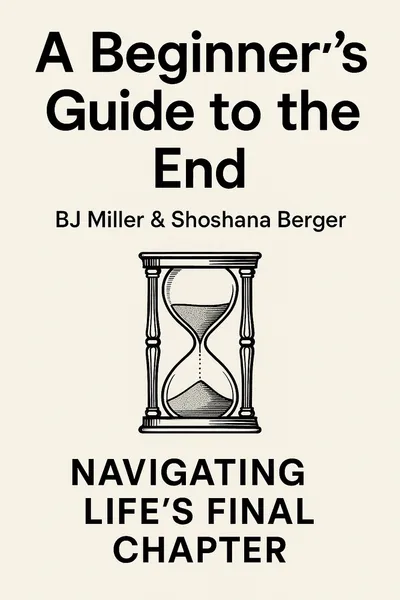
A Beginner’s Guide to the End
Navigating life's final chapter
Description
Miller and Berger position their collaborative work within the contemporary death literacy movement, challenging Western society's medicalization and denial of mortality. Drawing upon Miller's clinical expertise in palliative medicine and Berger's journalistic accessibility, the authors address the profound disconnect between modern healthcare systems and meaningful end-of-life experiences. Their intervention responds to increasing recognition that technological medicine, while extending life, often compromises the quality of dying processes and creates institutional barriers to dignified death.
The work's central research question asks: How can individuals and families reclaim agency over dying processes within systems that prioritize medical intervention over human dignity? The authors defend the thesis that death constitutes a natural life stage requiring intentional preparation, informed decision-making, and cultural reframing from medical failure to meaningful transition. The main stake involves transforming societal attitudes toward mortality while providing practical frameworks for navigating end-of-life decisions with autonomy and grace.
Miller and Berger construct a comprehensive argument for cultural transformation regarding mortality, combining practical guidance with systemic critique. Their central contribution lies in demonstrating how individual death anxiety intersects with institutional failures to create unnecessarily traumatic end-of-life experiences. By repositioning death as natural transition rather than medical failure, they provide theoretical foundation for both personal preparation and healthcare reform advocacy. The authors successfully integrate multiple analytical levels, from psychological frameworks addressing death anxiety to policy critiques examining healthcare financing structures. Their work contributes to emerging death studies scholarship while maintaining accessibility for general audiences facing end-of-life decisions. The synthesis of clinical expertise with journalistic clarity creates a distinctive voice within contemporary mortality discourse, offering both theoretical depth and practical applicability.
Table of contents
01 Reframing Mortality as Life Practice
The authors fundamentally challenge the contemporary Western construction of death as medical defeat, proposing instead a paradigmatic shift toward understanding mortality as integral to human experience. This reframing operates through what might be termed 'death normalization,' positioning end-of-life preparation alongside other major life transitions requiring planning and intentionality. Miller and Berger deploy philosophical frameworks drawn from both Eastern contemplative traditions and contemporary bioethics to argue that death anxiety stems largely from cultural avoidance rather than inherent human nature.

02 Institutional Critique and Healthcare Reform
The work develops a sustained critique of healthcare systems that prioritize curative interventions over palliative approaches, examining how institutional structures create barriers to dignified dying. Miller and Berger analyze the economic incentives driving aggressive end-of-life care, demonstrating how fee-for-service models reward intervention while financially penalizing comfort-focused approaches. Their analysis reveals how medical education inadequately prepares practitioners for death conversations, creating professional discomfort that translates into patient abandonment during crucial transition periods.
03 Family Systems and Social Networks
Miller and Berger explore how contemporary family structures and social fragmentation complicate traditional death-supporting networks, examining the breakdown of intergenerational knowledge transmission regarding mortality practices. They analyze how geographic mobility and nuclear family isolation create what they term 'death inexperience,' wherein individuals face end-of-life decisions without cultural scaffolding or inherited wisdom. This social atomization intersects with medical specialization to create profound communication gaps between healthcare providers and family systems.
04 Ethical Framework and Death Justice
The work addresses broader ethical implications of death literacy, examining how improved end-of-life education might transform healthcare resource allocation and social policy priorities. Miller and Berger explore the tension between extending life and ensuring meaningful death, questioning utilitarian frameworks that measure healthcare success through longevity metrics alone. They argue for incorporating quality-of-dying measures into healthcare evaluation, challenging purely quantitative approaches to medical outcomes assessment.
05 Critical Analysis and Future Directions
Despite its valuable contributions, the work exhibits certain theoretical limitations and cultural blind spots. The authors' emphasis on individual agency and autonomous decision-making reflects dominant Western liberal philosophical traditions while potentially undervaluing communitarian approaches to mortality found in non-Western cultures. Their critique of medical intervention, while necessary, occasionally oversimplifies the genuine benefits of life-extending technologies for individuals who genuinely desire additional time with loved ones.
The work's focus on middle-class American healthcare experiences limits its applicability to populations lacking basic medical access or facing structural violence. Their practical recommendations assume resource availability and family stability that may not exist for marginalized communities. Additionally, the authors insufficiently address how their proposed cultural transformation might encounter resistance from religious traditions that provide alternative frameworks for understanding mortality and afterlife beliefs.
Related books