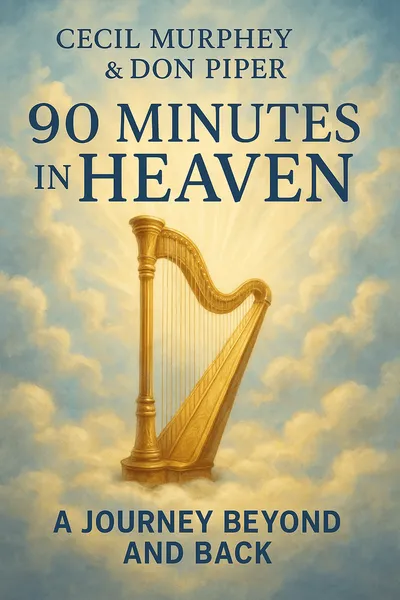
90 Minutes in Heaven
A journey beyond and back
Description
This testimonial narrative emerges from the contemporary American evangelical movement's emphasis on experiential faith validation. Piper, a Baptist minister, collaborates with established Christian author Murphey to document an alleged supernatural encounter following a fatal automobile accident. The work positions itself within the broader cultural phenomenon of near-death experience literature, seeking to bridge personal testimony with theological certainty. The narrative claims to provide firsthand evidence of heavenly existence through direct experiential account.
The central research question explores whether personal near-death experiences can provide empirical evidence for Christian theological claims about afterlife existence. The authors defend the thesis that individual testimony of supernatural encounter constitutes valid proof of divine reality and Christian doctrinal truth. The main stake involves legitimizing religious faith through claimed direct experiential evidence rather than doctrinal belief alone.
The work attempts to resolve fundamental tensions between religious faith and empirical knowledge through testimonial validation of supernatural claims. The authors construct a narrative framework that positions personal experience as authoritative evidence for theological truth, thereby challenging traditional epistemological boundaries between subjective experience and objective reality. The intellectual contribution lies in its articulation of contemporary evangelical approaches to faith validation, though this contribution remains limited by its reliance on unverifiable claims and circular reasoning patterns.
Table of contents
01 Testimonial Authority and Religious Epistemology
The work establishes its argumentative foundation through the privileging of personal experience as a legitimate source of theological knowledge. This epistemological framework challenges traditional Christian reliance on scriptural authority by proposing that individual supernatural encounters can serve as primary evidence for divine truth. The authors construct a narrative structure that positions subjective experience as objectively verifiable reality, thereby attempting to resolve the tension between faith and empirical knowledge.

02 Cultural Commodification of Transcendent Experience
The commercialization of near-death experiences within contemporary Christian publishing reveals significant sociological patterns regarding the marketability of spiritual encounters. The narrative transforms private mystical experience into public commodity, reflecting broader cultural trends toward the commercialization of transcendence. This commodification process necessarily shapes the testimonial account, as market demands influence narrative construction and theological interpretation.
03 Theological Implications and Doctrinal Tensions
The claimed heavenly encounter generates substantial theological complications within traditional Christian frameworks. The specificity of the described celestial experience contradicts established doctrinal positions regarding post-mortem existence and resurrection theology. The narrative inadvertently challenges core Christian teachings about judgment, resurrection timing, and the nature of intermediate states between death and final resurrection.
04 Social Construction of Afterlife Discourse
The societal reception and validation of near-death testimonies reflects contemporary cultural anxieties regarding mortality and religious uncertainty. The work functions as a social phenomenon that provides psychological comfort through claimed empirical evidence of post-mortem survival. This cultural function transcends its theological claims, serving broader social needs for mortality management and existential reassurance.
05 Critical Analysis and Limitations
The work's primary limitation involves its fundamental epistemological confusion between subjective experience and objective evidence. The authors fail to address the psychological and neurological factors that can produce vivid experiences during trauma and clinical death. Additionally, the narrative lacks critical engagement with theological scholarship regarding afterlife doctrine and resurrection theology.
Related books