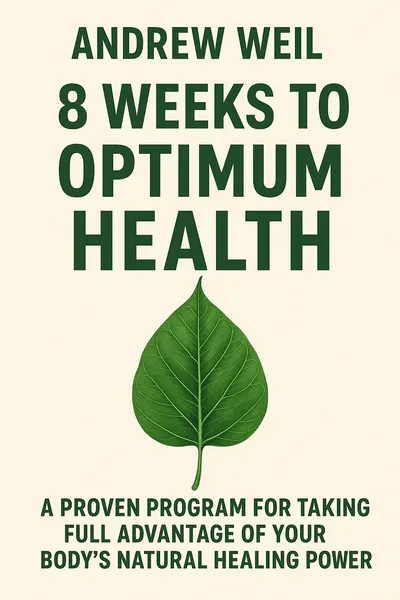
8 Weeks to Optimum Health
Medicine meets self-transformation
Description
Weil's work emerges within the context of late twentieth-century American healthcare discourse, where growing dissatisfaction with purely biomedical approaches created space for integrative medicine paradigms. The author leverages his medical credentials to legitimize alternative health practices, positioning himself as a bridge between conventional medicine and holistic wellness philosophies. This work represents a systematization of integrative health principles into a practical, time-bound framework designed for mainstream consumption.
The research framework centers on the question: How can individuals systematically optimize their health through structured integration of conventional and alternative practices? Weil's defended thesis proposes that an eight-week progressive program combining dietary reform, exercise, stress management, and environmental consciousness can fundamentally transform individual health outcomes. The main stake involves demonstrating that optimal health requires active participation in a holistic lifestyle transformation rather than passive reliance on medical interventions.
Weil's work represents a significant attempt to systematize integrative health principles within a framework accessible to mainstream consumers. The eight-week program functions as both practical guide and cultural intervention, challenging conventional medicine's authority while creating new forms of therapeutic legitimacy. The work's coherence lies in its successful integration of diverse health practices within a structured, time-bound framework that satisfies contemporary consumer expectations for measurable results. However, this systematization potentially reduces complex, long-term lifestyle transformations to simplified program components, risking commodification of holistic health principles.
Table of contents
01 The Medicalization of Wellness and Its Alternative
Weil's approach fundamentally challenges the dominant biomedical paradigm by proposing wellness as an active, self-directed process rather than the mere absence of disease. His framework operates within what could be termed "therapeutic individualism," wherein personal responsibility becomes the primary mechanism for health optimization. This perspective reflects broader neoliberal tendencies in healthcare, where individual lifestyle choices are privileged over structural determinants of health.

02 Disciplinary Integration and Professional Authority
The work represents a strategic attempt to legitimize alternative health practices through medical authority, creating what might be called "credentialed holism." Weil's medical degree functions as cultural capital that allows him to advocate for practices traditionally marginalized within conventional healthcare systems. This integration process reveals tensions between evidence-based medicine's empirical demands and holistic medicine's more intuitive, experiential approaches.
03 Temporality, Transformation, and Consumer Expectations
The eight-week timeframe reveals significant assumptions about personal transformation and consumer patience within contemporary wellness culture. This temporal structure reflects what could be termed "accelerated self-optimization," wherein profound lifestyle changes are promised within commercially viable timeframes. The program's progressive structure mirrors therapeutic intervention models, suggesting that optimal health can be achieved through systematic behavioral modification rather than gradual, organic lifestyle evolution.
04 Environmental Health and Individual Responsibility
Weil's integration of environmental awareness into personal health optimization raises complex questions about the relationship between individual wellness and collective ecological responsibility. The work acknowledges environmental factors in health outcomes while maintaining focus on individual-level interventions, creating a tension between personal optimization and structural environmental challenges. This approach reflects what might be called "privatized environmentalism," where ecological consciousness becomes primarily a matter of personal consumer choices rather than collective political action.
05 Critique and Future Directions
The work's primary limitation lies in its inadequate engagement with structural determinants of health, including socioeconomic factors, healthcare access, and environmental justice concerns. The program's emphasis on individual responsibility, while empowering for those with necessary resources, may inadvertently reinforce health disparities by focusing on personal choices rather than systemic barriers to optimal health. Additionally, the integration of alternative practices lacks sufficient critical analysis of their cultural origins and potential appropriation concerns.
Related books