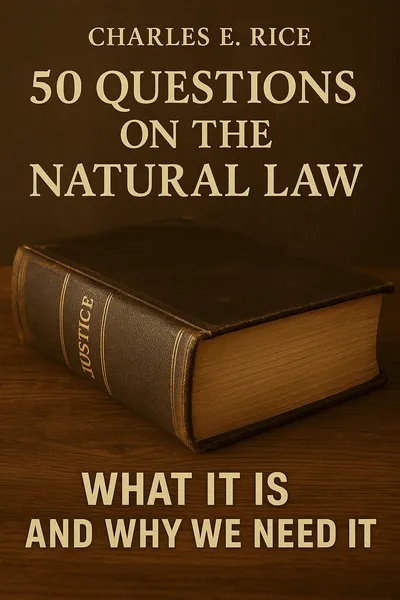
50 Questions on the Natural Law
Reclaiming moral ground
Description
Charles Rice's pedagogical treatise emerges within contemporary debates surrounding moral relativism and legal positivism that have dominated Western intellectual discourse since the Enlightenment. Writing as both jurist and philosopher, Rice addresses the perceived crisis of objective moral foundations in modern society through a systematic exposition of natural law theory. The work represents an ambitious attempt to rehabilitate Thomistic natural law philosophy for contemporary audiences grappling with bioethical dilemmas, constitutional interpretation, and cultural pluralism. Rice positions his intervention against the backdrop of secular humanism's ascendancy and what he perceives as the resulting moral confusion in legal and political institutions.
The central research question driving Rice's work asks: Can natural law theory provide objective moral guidance in an increasingly pluralistic and secular society? Rice defends the thesis that natural law, grounded in human reason and divine providence, offers universal moral principles accessible to all rational beings regardless of religious belief. The main stake of his argument involves demonstrating that objective moral truth exists and can be rationally apprehended, thereby challenging relativistic and positivistic legal philosophies.
Rice's systematic exposition of natural law theory represents a sophisticated attempt to rehabilitate classical moral philosophy for contemporary audiences. His work demonstrates impressive internal coherence and provides substantive responses to major objections against natural law reasoning. The author successfully articulates natural law's rational foundations while showing its practical relevance to contemporary moral and legal questions. The work's pedagogical structure effectively introduces complex philosophical concepts to general audiences without sacrificing intellectual rigor. Rice's question-and-answer format facilitates engagement with common objections and misconceptions regarding natural law theory. This accessibility serves the author's broader apologetic goals while maintaining scholarly respectability. Rice's integration of philosophical analysis with practical application demonstrates natural law theory's continued vitality within contemporary moral discourse. His work challenges prevalent assumptions regarding moral knowledge and legal authority while providing alternative framework for addressing persistent ethical questions.
Table of contents
01 The Metaphysical Architecture of Moral Objectivity
Rice constructs his argument upon classical metaphysical foundations, drawing heavily from Aristotelian-Thomistic philosophy to establish the rational basis for natural law. His theoretical framework presupposes an ordered cosmos wherein human nature possesses inherent teleological orientation toward specific goods. This metaphysical commitment distinguishes Rice's approach from contemporary legal philosophy's predominantly empirical and pragmatic methodologies.
The author's conceptual apparatus relies fundamentally upon the principle of non-contradiction and the convertibility of being and goodness. Rice argues that human reason, properly exercised, necessarily apprehends certain moral truths through contemplation of human nature's essential characteristics. This epistemological confidence reflects broader tensions within contemporary philosophy between realist and anti-realist metaphysical commitments.

02 Legal Positivism and Its Discontents
Rice's critique of legal positivism reveals profound concerns regarding modern jurisprudence's separation of law from morality. He argues that positivistic legal theory, exemplified by Hart and Kelsen, inevitably leads to moral relativism and potentially tyrannical governance. This analytical framework positions natural law as necessary corrective to positivism's alleged deficiencies.
The author demonstrates particular concern with positivism's inability to provide substantive criteria for evaluating legal systems' moral legitimacy. Rice contends that purely procedural approaches to legal validity cannot account for fundamental human rights or constrain governmental power effectively. His analysis suggests that positivistic jurisprudence ultimately serves authoritarian interests by divorcing legal obligation from moral consideration.
03 Cultural Relativism and Universal Moral Truth
The work's treatment of cultural diversity and moral disagreement reveals fundamental tensions between Rice's universalist commitments and contemporary pluralism. Rice acknowledges cross-cultural variation in moral practices while maintaining that such diversity reflects incomplete or distorted apprehension of natural law principles rather than genuine moral disagreement about fundamental values.
This analytical strategy allows Rice to preserve natural law's universal claims while accounting for empirical diversity in moral beliefs and practices. However, his approach risks appearing culturally imperialistic or insufficiently sensitive to legitimate cultural differences. Rice's framework struggles to distinguish between culturally relative customs and universally binding moral principles without appearing to privilege particular cultural traditions.
04 Bioethics and Contemporary Moral Challenges
Rice's application of natural law principles to contemporary bioethical issues demonstrates both the theory's explanatory power and its potential limitations. His analysis of abortion, euthanasia, and reproductive technologies reflects confident application of natural law reasoning to complex moral questions. Rice argues that natural law provides clear guidance on these issues where secular bioethics remains conflicted and uncertain.
05 Critical Assessment and Future Directions
Rice's exposition suffers from several significant limitations that constrain its persuasive power within contemporary intellectual contexts. His metaphysical realism appears insufficiently defended against post-modern critiques of objectivity and universality. The work's epistemological confidence regarding rational access to moral truth seems naive given widespread philosophical skepticism about such claims. Additionally, Rice's treatment of cultural diversity and religious pluralism risks appearing dogmatic or culturally insensitive to readers committed to democratic pluralism.
Related books