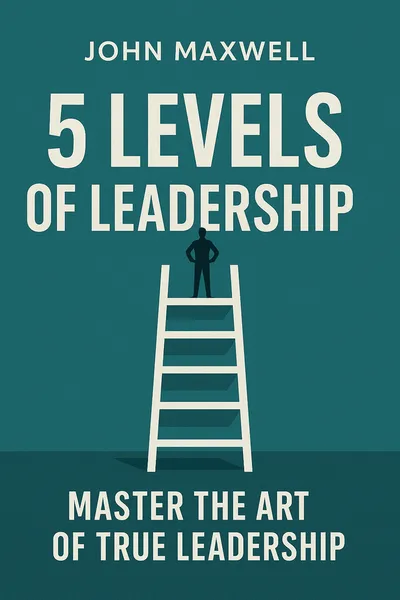
5 Levels of Leadership
Master the art of true leadership
Description
Maxwell's work emerges from contemporary organizational psychology and leadership studies, positioning itself within the humanistic management paradigm that emphasizes relational dynamics over hierarchical authority. The author leverages his extensive experience in pastoral leadership and corporate consulting to construct a developmental framework that challenges traditional command-and-control leadership models. This contribution arrives amid growing recognition that sustainable organizational effectiveness requires leaders who can navigate complex human dynamics rather than merely exercise positional power.
The central research question driving Maxwell's analysis is: How does authentic leadership develop beyond formal authority to create lasting influence and organizational transformation? His defended thesis argues that leadership effectiveness progresses through five hierarchical levels, each requiring distinct competencies and relational investments that compound to create exponential influence. The main stake is to demonstrate that positional leadership represents merely the foundation for authentic influence, which must be cultivated through systematic relationship-building and personal development.
Maxwell's thesis posits that leadership is not a position but a progressive journey through five distinct levels of influence that transforms both leader and follower through deepening relationships and expanding impact. This framework fundamentally challenges position-based leadership paradigms by revealing how formal authority represents the most fragile form of influence, dependent entirely on organizational structures rather than personal competency or relational capital. The progression through his five levels demonstrates sophisticated understanding of organizational psychology and social capital theory, emphasizing that leaders must earn the right to challenge and develop others through demonstrated competence and genuine care.
Table of contents
01 The Deconstruction of Positional Authority
Maxwell's fundamental contribution lies in his systematic dismantling of position-based leadership paradigms. His framework reveals how formal authority represents the most fragile form of influence, dependent entirely on organizational structures rather than personal competency or relational capital. This analysis exposes the inherent limitations of bureaucratic leadership models that dominated twentieth-century organizational theory.
The author's conceptualization of positional leadership as merely the entry point rather than the destination challenges deeply embedded assumptions about power and influence. His framework suggests that leaders who remain at this foundational level operate within a compliance-based system that generates minimal engagement and innovation. This perspective aligns with contemporary motivational theories that emphasize intrinsic rather than extrinsic drivers of human behavior.

02 The Economics of Relational Leadership
The progression through Maxwell's middle levels reveals sophisticated understanding of organizational psychology and social capital theory. His emphasis on productivity and people development reflects recognition that effective leadership must balance task accomplishment with human development. This dual focus addresses persistent tensions in management literature between results-oriented and people-centered approaches.
Maxwell's framework suggests that leaders must earn the right to challenge and develop others through demonstrated competence and genuine care. This perspective aligns with research on psychological safety and trust-building in organizational contexts. His model implicitly acknowledges that authority without relationship breeds resistance, while relationship without results undermines credibility.
03 The Paradox of Pinnacle Leadership
Maxwell's conception of pinnacle leadership introduces fascinating tensions between individual achievement and systemic impact. His highest level suggests that exceptional leaders transcend immediate organizational boundaries to influence broader societal change. This vision reflects both the aspirational nature of his framework and potential limitations in its practical application.
The author's treatment of legacy and transcendent influence reveals implicit engagement with questions of power, responsibility, and social change. His framework suggests that ultimate leadership effectiveness involves developing others who surpass one's own capabilities and impact. This perspective challenges ego-driven leadership models while raising questions about how such selfless development occurs in competitive organizational environments.
04 Ethical Implications and Social Responsibility
The ethical dimensions of Maxwell's framework merit careful examination, particularly regarding power dynamics and social responsibility. His progressive model implicitly assumes that increased influence should serve collective rather than individual interests. This perspective aligns with servant leadership theories while raising questions about accountability and oversight mechanisms.
Maxwell's emphasis on character development and relational integrity addresses persistent concerns about leadership ethics and corporate responsibility. His framework suggests that sustainable influence requires moral authority alongside technical competence. This integration of ethical and practical considerations reflects growing recognition that leadership effectiveness cannot be separated from character issues.
05 Critical Analysis and Future Directions
Maxwell constructs a compelling developmental framework that reconceptualizes leadership as progressive influence rather than positional authority. His five-level model provides practical guidance while challenging conventional assumptions about power and effectiveness. The work successfully integrates relational, productive, and ethical dimensions of leadership within a coherent developmental sequence.
The author's contribution lies not in revolutionary theoretical insights but in synthesizing established leadership principles within an accessible, actionable framework. His emphasis on relationship-building, character development, and legacy creation addresses persistent challenges in leadership development while providing clear pathways for growth. The work demonstrates particular strength in connecting individual development with organizational effectiveness and societal impact.
Related books