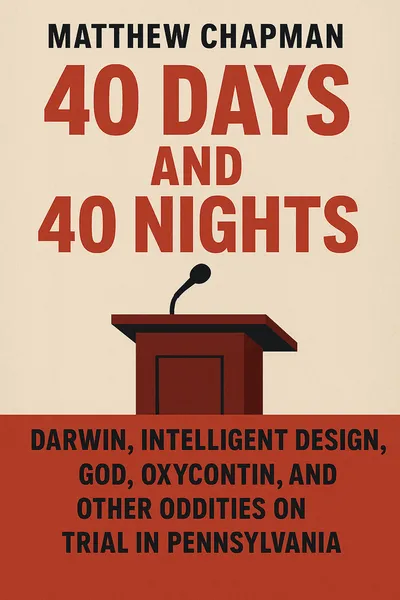
40 Days and 40 Nights
Science as proxy for deeper fears
Description
Matthew Chapman's "40 Days and 40 Nights" presents a nuanced examination of contemporary American culture wars through the lens of evolution education debates. Chapman argues that the persistent conflict between science and religion in American society reveals deeper anxieties about authority, knowledge, and national identity in a pluralistic democracy. The work demonstrates how evolution controversies function as elaborate cultural performances rather than genuine intellectual exchanges, serving as proxy battles for broader concerns about democratic legitimacy, social change, and cultural ownership.
The central thesis posits that the science-religion divide transcends mere epistemological disagreements to reveal fundamental tensions about American identity and values. Chapman's analysis reveals multiple intersecting dimensions of this conflict: the theatrical nature of cultural combat where scientific discourse becomes spectacle; geographic and social stratifications that map onto educational and economic disparities; religious pluralism creating constitutional tensions in democratic governance; and epistemological authority struggles between expert knowledge and democratic participation.
Through meticulous analysis, Chapman shows how evolution serves as a condensed symbol for broader fears about social transformation, cultural imperialism from educated elites, and the displacement of traditional authority structures. The work synthesizes these dimensions to reveal evolution controversies as symptoms of deeper structural tensions within American democracy, demonstrating how symbolic politics around evolution education intersects with material concerns about social mobility, economic opportunity, and cultural recognition. Chapman's contribution lies in illuminating the performative and symbolic dimensions of these debates while pointing toward more productive approaches to managing democratic pluralism in technologically complex societies.
Table of contents
01 Cultural Performance and the Theater of Scientific Discourse
Chapman's analysis reveals how contemporary evolution debates function as elaborate cultural performances rather than genuine intellectual exchanges. The ritualistic nature of these confrontations suggests that participants engage not primarily to resolve epistemological questions but to assert tribal loyalties and cultural boundaries. This theatrical dimension transforms scientific discourse into spectacle, where the actual content of evolutionary theory becomes secondary to its symbolic value as a marker of worldview allegiance.
The author demonstrates how both scientific and religious communities participate in this dramatization, creating simplified narratives that serve political rather than pedagogical purposes. The complexity of evolutionary science becomes flattened into talking points, while religious objections are reduced to caricatures that obscure more nuanced theological positions. This mutual simplification serves the needs of cultural warfare while impoverishing genuine dialogue about the relationship between scientific and spiritual understanding.

02 Geographic Divisions and Social Stratification
The geographic distribution of evolution controversies reveals deeper patterns of social and economic stratification that Chapman meticulously analyzes. Rural and urban divides map onto educational and economic disparities, creating complex intersections between scientific literacy, religious commitment, and class positioning. These geographic fault lines reflect broader anxieties about globalization, technological change, and the displacement of traditional authority structures.
Chapman demonstrates how evolution serves as a condensed symbol for broader fears about social transformation. Communities experiencing economic decline or cultural marginalization often view scientific authority as threatening to remaining sources of local autonomy and identity. The rejection of evolutionary theory thus functions as resistance to perceived cultural imperialism from educated elites.
03 Democratic Pluralism and Religious Expression
Chapman explores the paradox whereby democratic pluralism both enables and constrains religious expression in public education. The constitutional framework that protects religious liberty simultaneously limits its public manifestation, creating ongoing tensions about the boundaries between private faith and public knowledge. These constitutional contradictions generate perpetual litigation and political mobilization around education policy.
The author examines how different religious traditions navigate these constraints, revealing internal diversity within both Christian and secular communities regarding appropriate responses to scientific challenges. Mainline Protestant acceptance of evolutionary theory contrasts sharply with fundamentalist rejection, while secular communities debate how extensively to accommodate religious sensibilities in educational settings.
04 Epistemological Authority and Expert Knowledge in Democracy
The final analytical axis addresses how evolution controversies reveal deeper anxieties about the role of expertise and scientific authority within democratic governance. Chapman examines the tension between democratic equality and epistemic hierarchy, showing how scientific claims to objective truth challenge populist assertions of equal validity among competing perspectives.
This epistemological dimension extends beyond education policy to encompass broader questions about technocratic governance, public understanding of science, and the relationship between democratic participation and expert knowledge. The evolution debate becomes emblematic of wider struggles over climate science, medical expertise, and other domains where scientific consensus conflicts with popular opinion or economic interests.
05 Critical Assessment and Future Directions
Chapman's analysis, while illuminating, occasionally overstates the uniquely American character of these tensions, underexploring parallel developments in other democratic societies facing similar challenges. The focus on geographic and religious divisions, while valuable, could benefit from more sustained attention to economic factors driving cultural resentment and political mobilization.
The work's emphasis on symbolic dimensions risks minimizing the genuine epistemic differences at stake in these debates. Some religious objections to evolutionary theory reflect serious philosophical concerns about materialism, reductionism, and human dignity that deserve more charitable interpretation than Chapman provides.
Related books