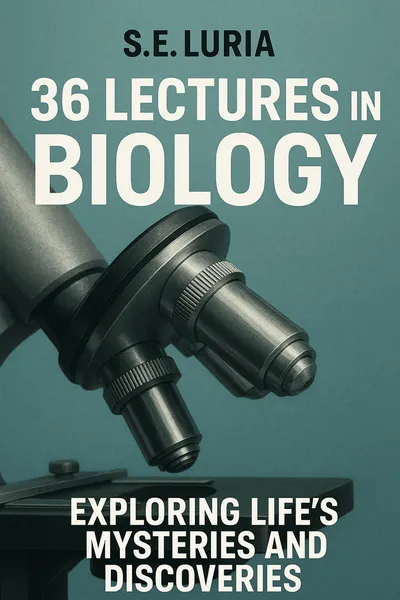
36 Lectures in Biology
Exploring life's mysteries and discoveries
Description
Salvador Luria's "36 Lectures in Biology" emerges from the pedagogical vision of a Nobel laureate seeking to synthesize the explosive developments in mid-twentieth century biological sciences. Written during a period when molecular biology was revolutionizing our understanding of life processes, this work represents Luria's attempt to provide a comprehensive framework for biological education. The author leverages his expertise in microbiology and genetics to construct a systematic approach to biological knowledge, addressing the fragmentation that had begun to characterize the life sciences as specialized fields proliferated.
The central research question driving this work asks: How can the diverse branches of biological science be unified into a coherent educational framework that reveals the fundamental principles governing all living systems? Luria's defended thesis maintains that biology achieves its greatest explanatory power when molecular mechanisms are integrated with evolutionary theory and ecological understanding to demonstrate the essential unity underlying life's diversity. The main stake involves establishing biology as a unified science capable of explaining life phenomena across all scales of organization, from molecular to ecological levels.
Luria's "36 Lectures in Biology" represents a masterful synthesis of mid-twentieth century biological knowledge organized around the central insight that molecular mechanisms, evolutionary processes, and ecological relationships must be understood as mutually illuminating aspects of a unified science. His pedagogical framework successfully demonstrates how apparent complexity in biological phenomena emerges from relatively simple underlying principles operating across multiple organizational levels and temporal scales. The work's intellectual contribution lies not merely in its comprehensive coverage but in its demonstration of conceptual unity underlying biological diversity. Luria shows how molecular biology, rather than fragmenting biological understanding, actually provides the mechanistic foundation for understanding evolutionary change and ecological interaction. This integration represents a sophisticated response to the challenge of maintaining coherent biological education amid rapid specialization within the life sciences.
Table of contents
01 The Molecular Foundation of Biological Unity
Luria's pedagogical architecture rests upon the revolutionary insight that molecular mechanisms provide the foundational language for understanding all biological phenomena. His approach transcends traditional descriptive biology by grounding observations in biochemical and genetic principles. The author demonstrates how DNA replication, protein synthesis, and cellular metabolism represent universal processes that unite all living organisms despite their apparent diversity.

02 Evolutionary Integration and Temporal Perspective
The second major axis of Luria's work involves the systematic integration of evolutionary thinking throughout biological education. Rather than treating evolution as a separate topic, he demonstrates how evolutionary principles illuminate every aspect of biological study. This approach reflects the modern synthesis of evolutionary theory with genetics and molecular biology, showing how Darwinian selection operates at molecular, cellular, and organismal levels.
03 Ecological Context and Systemic Thinking
The third analytical dimension addresses Luria's insistence on situating biological organisms within their environmental contexts. His approach challenges the isolation of laboratory-based molecular biology from ecological reality, demonstrating how environmental factors shape evolutionary trajectories and molecular adaptations. This ecological integration prevents reductionist thinking from losing sight of the complex interactions that characterize living systems in nature.
04 Critical Assessment and Contemporary Relevance
Despite its synthetic ambitions, Luria's framework reflects certain limitations characteristic of its historical moment. The emphasis on molecular mechanisms, while illuminating, occasionally risks overshadowing emergent properties that cannot be reduced to molecular interactions. Additionally, the work's focus on fundamental principles sometimes underemphasizes the role of historical contingency and environmental variability in shaping biological phenomena.
The pedagogical structure, while systematic, may not adequately prepare students for the interdisciplinary collaborations increasingly necessary in contemporary biological research. The boundaries between molecular, evolutionary, and ecological thinking appear more fluid in current practice than Luria's organized presentation suggests.
Related books