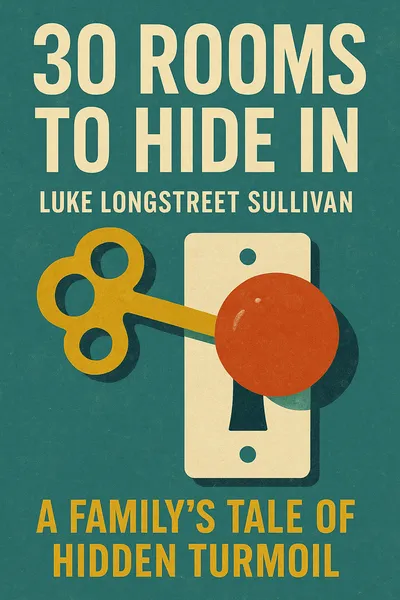
30 Rooms to Hide In
A family's tale of hidden turmoil
Description
Luke Longstreet Sullivan's memoir "30 Rooms to Hide In" examines the disintegration of patriarchal authority within the American family structure, revealing the profound psychological trauma that traditional masculine ideals inflict upon both fathers and their children. Set against the backdrop of 1950s and 1960s suburban respectability, the work interrogates the psychological costs of maintaining social facades while confronting domestic chaos through the lens of Sullivan's own childhood experience with a father whose professional success as a Mayo Clinic surgeon masked profound mental illness. The author's perspective as both witness and victim provides a unique vantage point for analyzing how institutional authority—embodied by medical profession prestige—can simultaneously protect and destroy family structures.
The central research question explores how the gradual mental deterioration of a patriarchal figure exposes the fundamental contradictions within American family mythology and masculine identity construction. Sullivan defends the thesis that the idealized nuclear family structure of post-war America functioned as a prison that concealed rather than addressed psychological dysfunction, creating generational trauma through enforced silence and social conformity. The main stake demonstrates that traditional masculine authority, when coupled with mental illness, transforms the domestic sphere into a battleground where children develop survival strategies that shape their entire emotional architecture.
Sullivan constructs a compelling argument that mid-century American family structures contained inherent contradictions that amplified rather than contained psychological dysfunction. The work demonstrates that social respectability, spatial isolation, and patriarchal authority combined to create environments where mental illness could flourish unchecked while children developed complex adaptive strategies for survival. The author's analysis reveals that the idealized nuclear family model functioned more as social performance than functional reality, creating conditions where abuse could persist under the protection of institutional authority and cultural mythology. The memoir ultimately argues that understanding family trauma requires recognition of how broader social structures—professional hierarchies, gender roles, and community expectations—shape and enable individual dysfunction.
Table of contents
01 The Performance of Normalcy and Institutional Protection
Sullivan's analysis reveals how social respectability functions as a complex masking mechanism that enables dysfunction while preventing intervention. The Mayo Clinic surgeon's professional reputation creates an impenetrable shield around the family's private suffering, illustrating how institutional authority can become complicit in domestic violence through willful blindness. The author demonstrates that respectability politics within medical communities prioritize professional image over family welfare, creating environments where abuse flourishes under the protection of social status.

02 Spatial Dynamics of Fear: The Geography of Childhood Trauma
The titular rooms function as metaphorical and literal spaces of concealment, representing the geography of childhood trauma where safety becomes a matter of strategic positioning rather than unconditional security. Sullivan's architectural metaphor reveals how domestic space transforms under the influence of unpredictable violence, creating a topology of terror where children must constantly assess threat levels and escape routes. The author demonstrates that the American suburban home—symbol of post-war prosperity and family stability—becomes inverted into a labyrinth of potential danger when patriarchal authority becomes unhinged.
03 Fraternal Survival Networks and Alternative Family Structures
The six brothers develop intricate systems of mutual protection and emotional regulation that demonstrate children's remarkable capacity for adaptation under extreme circumstances. Sullivan's examination of sibling dynamics reveals how horizontal relationships within families can provide alternative structures of care when vertical authority becomes destructive. The author illustrates that children create their own moral universes when adult guidance proves unreliable, developing ethical frameworks based on loyalty, protection, and shared survival rather than traditional authority structures.
04 Intergenerational Transmission of Trauma and Long-term Consequences
Sullivan's narrative exposes how mental illness and family dysfunction perpetuate across generations through learned patterns of emotional regulation and relationship formation. The author demonstrates that children of mentally ill parents internalize survival strategies that later manifest as adult relationship difficulties, professional anxieties, and parenting challenges. This analysis reveals the subtle ways trauma reproduces itself through seemingly adaptive behaviors, suggesting that hypervigilance, emotional suppression, and conflict avoidance become embedded psychological reflexes that persist long after the original threat disappears.
05 Critical Assessment and Contemporary Implications
While Sullivan's personal testimony provides powerful emotional authenticity, the work occasionally risks conflating individual family pathology with broader social critique without sufficient analytical framework. The author's focus on his specific experience, while compelling, may limit the work's capacity for broader sociological analysis of mental health and family structure. Additionally, the memoir's temporal specificity to mid-century America may obscure how similar dynamics persist in contemporary family configurations under different social conditions.
Related books