30 Lessons for Living
What the old already know
Description
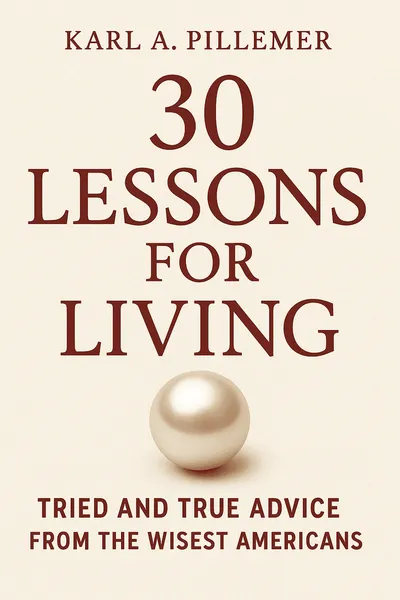
Pillemer's investigation emerges from a profound recognition that contemporary American society systematically undervalues the experiential knowledge of its eldest members. Drawing upon his expertise in gerontological research, the author constructs an ambitious project that positions elderly wisdom as a corrective to the accelerated pace and uncertainty characterizing modern existence. The work represents a deliberate departure from traditional gerontological scholarship, moving beyond clinical or demographic analyses toward a more humanistic exploration of aging as a repository of cultural capital.
The accumulated life experience of America's eldest generation constitutes a largely untapped reservoir of practical wisdom that can guide younger generations in navigating contemporary social, professional, and personal challenges. This thesis emerges from a central research question: What practical wisdom can America's oldest generation offer to address contemporary life challenges? The defended thesis maintains that elderly Americans possess empirically valuable insights that transcend generational specificity and retain relevance for navigating universal human dilemmas. The main stake demonstrates that intergenerational knowledge transfer represents an underutilized resource for individual and collective social navigation.
Pillemer's systematic collection of testimonies from over one thousand elderly Americans establishes what might be termed an "archive of lived experience," positioning personal narratives as legitimate sources of sociological knowledge. His categorization of life domains—career satisfaction, relationship maintenance, child-rearing, personal fulfillment—reflects a pragmatic understanding of human existence that transcends theoretical sophistication. The work's emphasis on practical applicability distinguishes it from purely academic treatments of aging and positions elderly knowledge as actionable rather than merely descriptive.
Table of contents
01 Intergenerational Communication and Social Capital
The work's treatment of intergenerational relationships reveals broader sociological implications regarding social cohesion and cultural transmission. Pillemer identifies a communication breakdown between generations that extends beyond mere technological gaps to encompass fundamental differences in values, expectations, and life experiences. His analysis suggests that American society has developed what might be characterized as "generational segregation," where age cohorts exist in relative isolation from one another.

02 The Commodification of Wisdom and Therapeutic Culture
Pillemer's presentation of elderly wisdom reveals tensions inherent in contemporary therapeutic culture and the commodification of personal experience. By packaging complex life experiences into digestible "lessons," the work participates in broader cultural tendencies toward self-help discourse and the marketization of wisdom. This transformation of nuanced human experience into consumable advice reflects deeper patterns in late capitalist society where even personal growth becomes a product for consumption.
03 Mortality, Meaning, and the Question of Authority
The proximity of Pillemer's subjects to mortality generates unique insights about meaning-making and value prioritization that distinguish their perspective from younger generations. Their temporal positioning—looking backward rather than forward—provides a distinctive vantage point for evaluating life choices and social priorities. This retrospective wisdom carries particular weight in a youth-obsessed culture that often avoids confronting aging and death.
However, the work's treatment of mortality raises ethical questions about the authority granted to proximity to death. Does approaching the end of life necessarily generate superior wisdom, or does it simply provide different perspectives? Pillemer's implicit assumption that elderly viewpoints carry special validity because of their temporal position requires more critical examination.
04 Critical Assessment and Future Directions
The work's primary limitation lies in its insufficient attention to structural factors shaping both elderly experiences and contemporary challenges. By focusing on individual wisdom and personal adjustment, Pillemer obscures how broader economic, political, and social systems influence life outcomes. His respondents' advice, while personally meaningful, may prove inadequate for addressing systemic inequalities, environmental crises, and technological disruptions characterizing contemporary existence.
The methodological approach, while innovative, raises questions about representativeness and generalizability. The elderly Americans interviewed may not reflect the full diversity of aging experiences, particularly those of marginalized communities whose wisdom might offer different insights. Additionally, the temporal gap between their formative experiences and current conditions limits the direct applicability of their counsel. The epistemological foundation rests upon an assumption that accumulated experience generates transferable insights, yet Pillemer inadequately addresses how historical specificity might limit such transferability.
Related books