
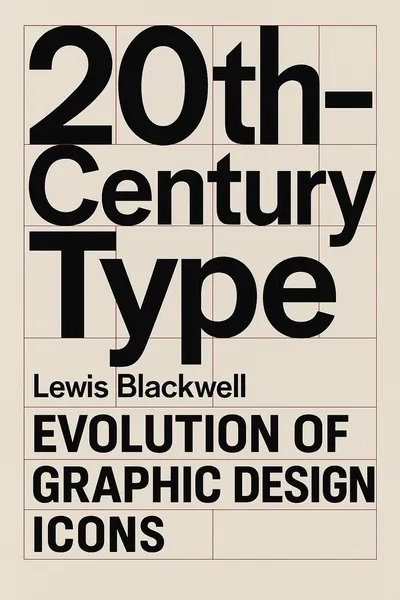
20th-Century Type
Evolution of graphic design icons
Description
Lewis Blackwell presents in "20th-Century Type" an ambitious examination of typography's role as cultural protagonist throughout the twentieth century. Situating his analysis within broader contexts of modernization, technological advancement, and social upheaval, the author positions typographic design not merely as aesthetic choice but as ideological instrument reflecting and shaping collective consciousness.
The research framework centers on the question: How did typography evolve as both reflection and catalyst of twentieth-century cultural transformations? Blackwell's defended thesis positions type design as a privileged lens through which to understand modernity's contradictions and aspirations. The main stake lies in establishing typography as legitimate object of cultural and sociological analysis beyond purely technical considerations.
Blackwell's thesis argues that typography functions as both mirror and agent of cultural transformation, with twentieth-century type design embodying the century's ideological, technological, and aesthetic revolutions. The work successfully establishes typography as legitimate object of cultural analysis, demonstrating its capacity to illuminate broader social transformations through its multi-dimensional approach, examining technological, ideological, and economic factors simultaneously rather than privileging single explanatory frameworks.
The analysis reveals typography's dual nature as both conservative force maintaining established hierarchies and revolutionary tool enabling cultural transformation. This dialectical understanding avoids simplistic narratives of either technological determinism or cultural resistance, instead revealing complex negotiations between structural constraints and human agency. The work's empirical richness supports theoretical arguments through detailed case studies spanning the century's major design movements, enabling identification of longer-term patterns while acknowledging significant discontinuities and ruptures within typographic development.
Table of contents
01 Typography as Ideological Apparatus
Blackwell's fundamental contribution lies in his conceptualization of typography as ideological apparatus, borrowing implicitly from Althusserian frameworks while adapting them to visual culture. The author demonstrates how typographic choices embody political positions, from the geometric rationality of Bauhaus design reflecting modernist utopian aspirations to the expressive distortions of postmodern typography challenging established hierarchies.
This analysis reveals typography's capacity to naturalize dominant worldviews through seemingly neutral formal decisions. The standardization of sans-serif typefaces in corporate communications, for instance, becomes readable as visual manifestation of bureaucratic rationalization processes described by Weber. Blackwell's examination of fascist typography particularly illuminates how authoritarian regimes manipulated typographic codes to construct national mythologies, while democratic societies employed similar techniques for commercial persuasion.

02 Technological Mediation and Social Transformation
The author's second analytical axis explores typography's relationship to technological revolution, examining how mechanical and digital innovations restructured not only production methods but social relations of design itself. Blackwell traces the democratization of typographic production from exclusive craft guild to widespread desktop publishing, analyzing accompanying transformations in professional hierarchies and cultural authority.
This technological determinism, however, reveals certain limitations. While acknowledging technology's transformative power, the analysis occasionally underestimates human agency and cultural resistance. The persistence of calligraphic traditions within digital environments, for example, suggests more complex negotiations between innovation and continuity than purely progressive narratives allow.
03 National Identity and Global Circulation
Blackwell's third analytical dimension addresses typography's role in constructing and circulating national identities within increasingly globalized contexts. The tension between local typographic traditions and international modernist standardization produces complex negotiations between cultural specificity and universal accessibility.
The analysis of vernacular typography reveals how marginalized communities appropriate and subvert dominant typographic codes, creating counter-hegemonic visual languages. Hip-hop typography, for instance, emerges as resistance practice transforming mainstream commercial design through systematic rule violation and cultural signification.
04 Consumer Culture and Aesthetic Standardization
The final analytical axis examines typography's central role in constructing consumer subjectivity and facilitating capitalist accumulation. Blackwell analyzes how typographic design shapes desire, constructs brand identities, and naturalizes consumption as social practice. The evolution from craft-based to mass-produced typography parallels broader transitions from production-based to consumption-based economies.
The analysis of corporate typography reveals sophisticated psychological manipulation techniques embedded within apparently neutral design decisions. Font choices communicate values, establish trust, and position products within complex symbolic hierarchies. This instrumental use of typography transforms cultural signs into commercial tools, raising ethical questions about design's social responsibility.
05 Critical Assessment and Future Directions
Despite its considerable strengths, Blackwell's analysis reveals certain limitations requiring critical examination. The predominantly Western focus obscures non-European typographic traditions and their contributions to global design culture. This Eurocentric bias reproduces cultural hierarchies the author elsewhere critiques.
The economic analysis remains underdeveloped, particularly regarding typography's role within broader capitalist accumulation processes. While acknowledging commercial applications, Blackwell insufficiently examines how typographic design contributes to surplus value creation and capital circulation.
Related books