1870/71
War seen through lives
Description
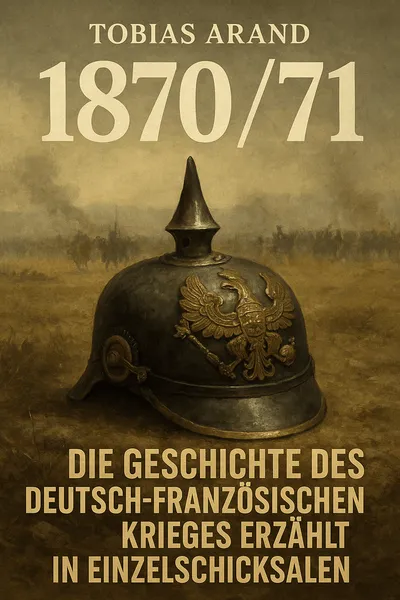
Tobias Arand's "1870/71" represents a significant contribution to the historiography of the Franco-Prussian War, approaching this foundational conflict of modern European history through an innovative microhistorical methodology. Rather than following traditional diplomatic or military-strategic narratives, Arand constructs his analysis around individual destinies, positioning personal experiences as essential keys to understanding the broader historical transformation. The work emerges within contemporary historical scholarship's turn toward social history and the recovery of subaltern voices in major historical events.
The central research question guiding Arand's work asks: How do individual experiences and personal trajectories illuminate the deeper social, cultural, and political transformations triggered by the Franco-Prussian War? His defended thesis maintains that the 1870-71 conflict can only be comprehensively understood through the examination of individual destinies that reveal the human dimension and social consequences of this pivotal European war. The main stake is to demonstrate that microhistorical analysis provides superior insight into the mechanisms of historical change than traditional macro-political approaches.
Arand's work represents a successful synthesis between methodological innovation and historical rigor. His demonstration that individual experiences provide privileged access to understanding major historical transformations constitutes a significant contribution to contemporary historiography. The author succeeds in showing how the Franco-Prussian War, examined through personal destinies, reveals broader patterns of European modernization and the formation of contemporary political culture. The intellectual coherence of the work lies in its systematic application of microhistorical methodology to reveal macro-historical processes. Arand demonstrates that the apparent opposition between individual and structure dissolves when properly analyzed, revealing instead complex dialectical relationships that constitute the very fabric of historical change.
Table of contents
01 The Methodological Revolution of Microhistory
Arand's fundamental contribution lies in his methodological approach, which represents a decisive break from conventional military historiography. By privileging individual narratives over strategic analyses, the author inscribes himself within the microhistorical tradition inaugurated by Carlo Ginzberg and Giovanni Levi. This methodological choice reveals profound theoretical implications: the individual becomes not merely an illustration of broader trends, but rather a privileged site of historical intelligibility.

02 Social Recomposition and Identity Transformation
The second major axis of Arand's analysis concerns the profound social recompositions triggered by the conflict. Through individual trajectories, the author reveals how the war operated as a catalyst for identity transformations that transcended simple national antagonisms. The examined personal destinies illustrate the complex negotiations between inherited social positions and new possibilities opened by wartime circumstances.
Arand demonstrates how the conflict disrupted traditional social hierarchies while simultaneously creating new forms of stratification. Military mobilization, territorial occupation, and economic disruption generated unprecedented social mobility, both ascendant and descendant. The author's analysis reveals how individuals navigated these transformations, developing new survival strategies and redefining their social identities.
03 The Construction of National Memory
Arand's third analytical axis addresses the complex processes through which individual experiences were transformed into collective memory. The author demonstrates how personal narratives of the conflict were progressively integrated into competing national mythologies, revealing the political uses of war memory in the construction of modern European identities.
The analysis reveals significant tensions between lived experience and official commemoration. Many individual trajectories presented by Arand resist simple integration into heroic national narratives, revealing the conflicts, ambiguities, and contradictions that official memory tends to occult. This tension illuminates the violent character of memory construction processes and their exclusionary effects.
04 Ethics and Political Responsibility
The final dimension of Arand's analysis addresses the ethical implications of individual choices during wartime and their long-term political consequences. Through detailed examination of moral dilemmas faced by historical actors, the author reveals the complex relationships between individual responsibility and structural constraints that characterize extreme historical situations.
This ethical reflection extends to contemporary implications, as Arand's analysis illuminates persistent questions about civilian responsibility during armed conflicts and the moral foundations of political obligation. The individual destinies examined reveal how ordinary people navigated impossible moral choices, contributing to a more nuanced understanding of human agency under extreme circumstances.
05 Critical Assessment and Future Directions
Despite its methodological sophistication, Arand's work presents certain limitations. The selection of individual cases, while rich and varied, remains necessarily limited and raises questions about representativeness. The author's commitment to recovering subaltern voices sometimes leads to insufficient attention to elite strategies and international diplomatic dimensions that significantly shaped the conflict's trajectory.
Furthermore, the theoretical framework, while innovative, could benefit from more systematic dialogue with contemporary sociology and political science literature on conflict transformation and memory construction. The analysis would gain depth from more sustained engagement with comparative perspectives on war and social change.
Related books