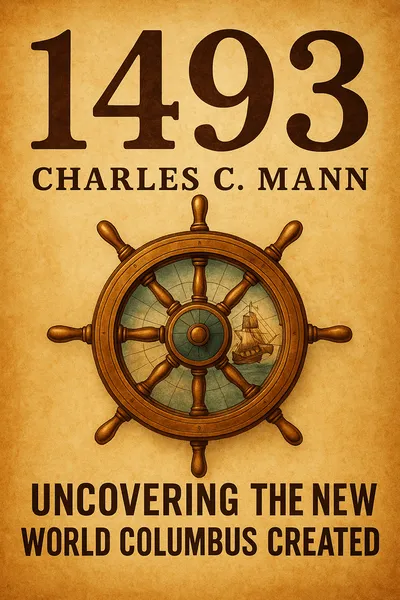
1493
The birth of the modern world
Description
Mann's work examines the profound transformations following Columbus's voyages, positioning the Columbian Exchange as the foundational moment of globalization. Drawing upon extensive archival research and contemporary scientific studies, the author challenges traditional historical periodization by arguing that the post-1492 world represents a fundamentally new ecological and economic epoch. The work synthesizes environmental history, economic analysis, and cultural studies to demonstrate how biological and commercial exchanges reshaped global civilization.
The Columbian Exchange initiated an unprecedented global ecological and economic transformation that fundamentally restructured human civilization through the creation of the first truly worldwide trade networks and biological exchanges. Mann's central research question explores how the biological and commercial exchanges initiated by Columbus's voyages created the first genuinely global economic and ecological system. The defended thesis positions the Columbian Exchange as history's most significant transformation, establishing interconnected global networks that fundamentally altered human civilization and natural environments. The main stake of this argument is to demonstrate that contemporary globalization's roots lie in the ecological and economic revolutions of the sixteenth century.
Mann's comprehensive analysis establishes the Columbian Exchange as the foundational moment of modernity, demonstrating how post-1492 biological and economic exchanges created integrated global systems that fundamentally transformed human civilization. The work successfully synthesizes ecological, economic, and social analysis to reveal the complex interconnections underlying contemporary globalization. The author's interdisciplinary approach illuminates how seemingly separate historical processes operated as components of broader systemic transformation. The work's theoretical contribution lies in its demonstration that globalization represents not a recent phenomenon but rather the continuation of processes initiated five centuries ago. Mann's analysis reveals how ecological, economic, and social transformations operated according to integrated logics that established patterns persisting in contemporary global systems.
Table of contents
01 Ecological Revolution and Biological Imperialism
Mann's analysis reveals how the Columbian Exchange constituted an unprecedented biological revolution that transcended simple species transfer. The author demonstrates that introduced organisms functioned as agents of ecological imperialism, fundamentally restructuring entire ecosystems and agricultural systems. European crops, livestock, and diseases didn't merely supplement existing American ecosystems but actively displaced indigenous flora and fauna, creating new ecological configurations that favored European settlement and economic exploitation.

02 Economic Networks and Proto-Globalization
The author's examination of emerging global trade networks reveals how the Columbian Exchange established the foundational structures of modern capitalism. Silver flows from American mines to Asian markets created the first truly global currency system, while the demand for American commodities restructured European and Asian economies around Atlantic trade. Mann demonstrates how these networks operated according to capitalist logic centuries before classical economists theorized market mechanisms.
03 Social Transformation and Cultural Hybridization
Mann's analysis of social transformation emphasizes how the Columbian Exchange generated new forms of cultural hybridization and social stratification. The mixing of European, African, and American populations created complex racial hierarchies and cultural syncretisms that challenged existing social categories. The author demonstrates how these demographic changes produced new social formations that combined elements from multiple cultural traditions while serving the interests of colonial exploitation.
04 Environmental Consequences and Sustainability Questions
The author's treatment of environmental transformation addresses the long-term ecological consequences of the Columbian Exchange, revealing how global biological mixing created both opportunities and crises. Introduced species frequently became invasive, disrupting established ecosystems and threatening biodiversity. Mann demonstrates how these ecological disruptions generated environmental problems that anticipate contemporary sustainability challenges.
05 Critical Analysis and Future Research Directions
Mann's analysis occasionally underestimates indigenous agency, presenting native peoples primarily as victims of biological and economic forces rather than active participants in exchange processes. The work's focus on macro-historical processes sometimes obscures local variations and resistance strategies that complicated colonial domination. Additionally, the author's emphasis on the revolutionary character of the Columbian Exchange may overstate discontinuities while minimizing pre-existing global connections.
Related books