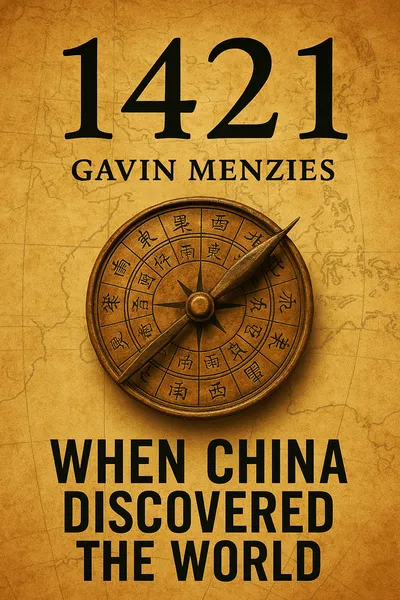
1421
Before Columbus, the Chinese
Description
Menzies presents a revolutionary reinterpretation of fifteenth-century maritime history, challenging the Eurocentric narrative of global exploration. Drawing upon his naval expertise and extensive travel research, he constructs an alternative historical framework positioning Ming China as the primary agent of early global discovery. The work emerges within contemporary debates about decolonizing historical knowledge and questioning Western-centric historical paradigms.
The central research question driving this work asks: Did Chinese fleets under the Ming Dynasty achieve global circumnavigation and continental discoveries decades before European explorers? Menzies defends the thesis that Admiral Zheng He's treasure fleets systematically mapped and explored the entire world between 1421-1423, predating Columbus by seventy years. The main stake involves demonstrating that Chinese civilization, not European powers, initiated the first truly global age of exploration and cultural exchange.
Menzies constructs a comprehensive alternative history positioning Chinese civilization as the primary agent of early global exploration and cultural exchange. His synthesis draws upon technological analysis, cartographic interpretation, biological evidence, and political explanation to support claims of systematic Chinese global discovery preceding European exploration by decades. The work challenges fundamental assumptions about the timing and agency of global exploration, proposing Chinese rather than European initiation of the modern global age. The argument's coherence depends upon accepting multiple controversial interpretations simultaneously, creating a cumulative case that transcends individual evidence limitations through breadth rather than depth. This methodology transforms historical speculation into systematic alternative history, offering readers a dramatically different framework for understanding early modern global development and cultural exchange patterns.
Table of contents
01 Maritime Technological Supremacy and Chinese Navigational Capabilities
Menzies establishes his argument through an examination of Chinese maritime technological advancement during the early fifteenth century. The treasure fleets represented unprecedented naval engineering achievements, with vessels allegedly surpassing European ships in size, sophistication, and navigational capability. These technological arguments form the foundation for claims of global reach, positioning Ming naval architecture as superior to contemporary European maritime technology.

02 Cartographic Evidence and Geographic Knowledge Transfer
Central to Menzies' argument is the analysis of medieval and Renaissance maps allegedly showing pre-Columbian knowledge of American and Australian coastlines. He traces cartographic traditions suggesting Chinese geographic knowledge filtered through Islamic and European scholarly networks, eventually informing later European exploration efforts. This cartographic archaeology attempts to demonstrate Chinese precedence through map analysis and geographic knowledge transmission.
03 Cultural and Biological Exchange Networks
Menzies extends his thesis by examining alleged biological and cultural evidence of pre-Columbian Chinese presence in the Americas and other continents. He analyzes genetic markers, linguistic similarities, agricultural transfers, and cultural practices as supporting evidence for sustained Chinese contact with previously unknown continents. This interdisciplinary approach attempts to demonstrate lasting Chinese influence on global cultural development.
04 Imperial Motivations and Historical Suppression Theory
The final analytical framework addresses why such monumental achievements allegedly disappeared from historical consciousness. Menzies argues that changing Chinese political priorities, particularly the shift toward isolationism and continental focus, led to systematic suppression of maritime exploration records. He suggests that later Chinese dynasties deliberately erased evidence of global exploration to support new political orientations emphasizing territorial consolidation over maritime expansion.
05 Critical Assessment and Scholarly Implications
The work suffers from significant methodological limitations, particularly regarding evidence interpretation standards and scholarly peer review processes. Menzies' background as a naval officer rather than trained historian shows in his approach to evidence evaluation, often privileging navigational possibility over documented historical fact. The absence of substantial Chinese documentary evidence supporting his claims remains problematic, while his dismissal of academic criticism as Western bias undermines scholarly dialogue.
Furthermore, the work relies heavily on circumstantial evidence and speculative interpretation, often transforming theoretical possibility into claimed historical fact without adequate supporting documentation. The cartographic analysis frequently involves questionable dating and provenance assumptions, while biological evidence interpretation lacks sufficient consideration of alternative explanations for observed similarities.
Related books