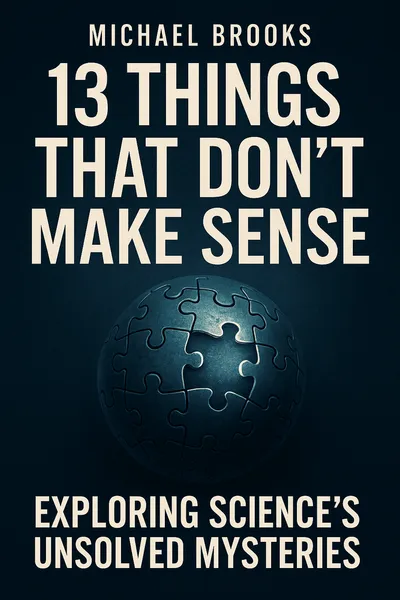
13 Things That Don't Make Sense
Exploring science's unsolved mysteries
Description
Michael Brooks presents a provocative examination of contemporary science's relationship with unexplained phenomena, positioning his work within the tradition of scientific skepticism that questions institutional complacency. Drawing upon his background in theoretical physics and science journalism, the author challenges the tendency of mainstream science to marginalize anomalous observations that resist conventional explanation. The work emerges from a growing concern about scientific dogmatism and the potential stagnation of discovery when inconvenient data is systematically ignored or rationalized away.
The central research question explores how unexplained scientific anomalies reveal the limitations of current paradigms and what they can teach us about the nature of scientific progress. Brooks defends the thesis that scientific advancement depends fundamentally on embracing rather than dismissing phenomena that contradict established theories, as these anomalies often herald revolutionary discoveries. The main stake is to demonstrate that science's greatest breakthroughs emerge from serious investigation of its most troubling inconsistencies rather than from incremental refinement of existing knowledge.
Brooks constructs a compelling argument that scientific progress depends fundamentally on institutional willingness to investigate rather than dismiss anomalous phenomena. The work demonstrates how defensive reactions to challenging data reflect deeper problems within contemporary scientific culture, including excessive professionalization, risk-averse funding mechanisms, and status hierarchies that discourage intellectual adventure. The author's analysis suggests that science's greatest discoveries emerge from serious engagement with its most troubling mysteries rather than incremental refinement of established knowledge. The intellectual contribution lies in Brooks's synthesis of epistemological, sociological, and ethical perspectives on scientific anomalies. By examining how institutional factors shape research priorities, the work illuminates structural obstacles to scientific discovery while proposing that embracing uncertainty represents science's greatest strength rather than its primary weakness.
Table of contents
01 The Epistemological Challenge of Scientific Anomalies
Brooks constructs a sophisticated critique of scientific methodology by examining how institutional science responds to data that challenges fundamental assumptions. The author reveals how peer review systems, funding mechanisms, and academic career structures create powerful incentives for researchers to avoid investigating phenomena that might undermine established theories. This analysis draws upon Thomas Kuhn's paradigm theory while extending it to contemporary contexts, demonstrating how scientific communities develop immune responses to protect dominant frameworks from existential threats.

02 The Sociology of Scientific Resistance
The author's examination of how scientific institutions manage anomalous phenomena reveals deep structural tensions within contemporary research culture. Brooks demonstrates how the professionalization of science has created bureaucratic hierarchies that prioritize consensus over investigation, leading to systematic suppression of research directions that threaten established interests. This analysis illuminates how funding bodies, journal editors, and university administrators function as gatekeepers who effectively determine which mysteries deserve serious attention.
03 Paradigmatic Disruption and Conceptual Revolution
Brooks explores how anomalous phenomena function as catalysts for fundamental conceptual transformations rather than mere additions to existing knowledge. The author demonstrates how each unexplained observation represents a potential fault line in current theoretical structures, requiring scientists to choose between accommodation and revolution. This analysis reveals the inherently conservative nature of scientific institutions, which prefer minor modifications to existing theories over radical reconceptualization of basic assumptions.
04 Ethical Implications of Scientific Orthodoxy
The ethical dimensions of Brooks's analysis center on questions of intellectual responsibility and public accountability within scientific communities. The author argues that systematic dismissal of anomalous phenomena represents a form of epistemic injustice that privileges institutional authority over empirical investigation. This framework raises profound questions about scientists' obligations to pursue truth regardless of professional consequences or theoretical convenience.
05 Critical Assessment and Future Directions
While Brooks's analysis effectively identifies institutional barriers to investigating anomalous phenomena, the work occasionally understates the practical difficulties of distinguishing legitimate mysteries from experimental error or pseudoscientific speculation. The author's critique of scientific orthodoxy sometimes approaches false equivalency, failing to acknowledge that institutional skepticism serves important quality control functions. Additionally, the work could benefit from more detailed analysis of successful cases where anomaly investigation led to genuine breakthroughs rather than dead ends.
Related books