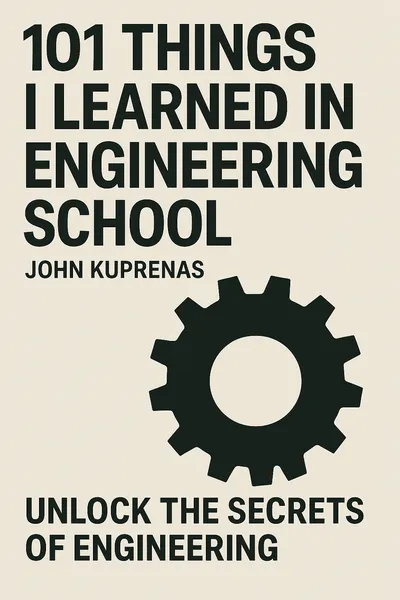
101 Things I Learned in Engineering School
Unlock the secrets of engineering
Description
Kuprenas presents a synthesis of essential engineering principles through a collection of concise observations that challenge the traditional boundaries of technical education. Writing from his dual perspective as practicing engineer and educator, he addresses the growing disconnect between academic engineering curricula and the multifaceted demands of professional practice. The work emerges within the broader context of engineering education reform debates, particularly concerning the integration of humanistic elements into predominantly technical programs.
The central research question driving this work is: How can engineering education be reconceptualized to better prepare practitioners for the ethical, social, and interdisciplinary challenges of contemporary professional practice? The defended thesis argues that engineering competence requires the integration of technical mastery with practical wisdom, ethical reasoning, and interdisciplinary collaboration. The main stake is to transform engineering pedagogy from narrow technical specialization toward holistic professional formation that recognizes engineering's social embeddedness.
Kuprenas constructs a compelling case for fundamental reform in engineering education that transcends merely updating technical content or pedagogical methods. His argument reveals the inadequacy of education models that treat engineering as applied science rather than as a distinct professional practice with its own epistemological requirements and ethical obligations. The work's coherence emerges through its consistent emphasis on integration—between theory and practice, individual and social dimensions, technical and ethical reasoning. The intellectual contribution lies in providing a comprehensive framework for understanding how engineering education might be reconceptualized to better serve both individual professional development and broader societal needs. Rather than proposing specific curricular modifications, Kuprenas offers a philosophical foundation for thinking differently about engineering knowledge and its transmission.
Table of contents
01 The Epistemological Foundations of Engineering Knowledge
Kuprenas fundamentally challenges the positivist assumptions underlying traditional engineering education by arguing for a more nuanced understanding of technical knowledge production. His approach reveals engineering not as the mere application of scientific principles, but as a distinct form of practical reasoning that involves judgment, creativity, and contextual adaptation. This epistemological shift positions engineering closer to the classical notion of techne, wherein theoretical knowledge must be synthesized with experiential wisdom.

02 The Social Construction of Engineering Solutions
The work illuminates how engineering decisions are embedded within complex social, economic, and political networks that fundamentally shape both problem definition and solution evaluation. Kuprenas demonstrates that technical choices inevitably embody value judgments about risk distribution, resource allocation, and social priorities. This analysis challenges the ideology of technical neutrality that has historically insulated engineering from critical scrutiny of its societal implications.
03 Temporal Dynamics and Professional Adaptation
Kuprenas addresses the tension between the static nature of academic knowledge and the dynamic character of professional practice. His analysis reveals how engineering education often fails to prepare students for the reality of continuous learning, adaptation, and knowledge obsolescence that characterizes contemporary technological development. This temporal mismatch creates a fundamental pedagogical challenge: how to provide stable foundational knowledge while cultivating adaptive capacity.
04 Ethical Responsibility and Professional Identity
The ethical dimensions of Kuprenas's argument extend beyond conventional discussions of professional codes to encompass fundamental questions about engineering's social responsibility. His framework positions engineers as moral agents whose technical decisions inevitably affect human welfare, environmental sustainability, and social justice. This perspective challenges the traditional separation between technical and ethical reasoning that has characterized much of engineering education.
05 Critical Assessment and Future Implications
While Kuprenas provides valuable insights into engineering education's limitations, his analysis occasionally lacks specificity about implementation mechanisms for the reforms he advocates. The work's broad scope sometimes obscures the institutional and economic constraints that shape educational practices. Additionally, the emphasis on individual professional development may underestimate the structural factors that limit engineers' capacity for autonomous ethical action within corporate and governmental organizations.
Related books