
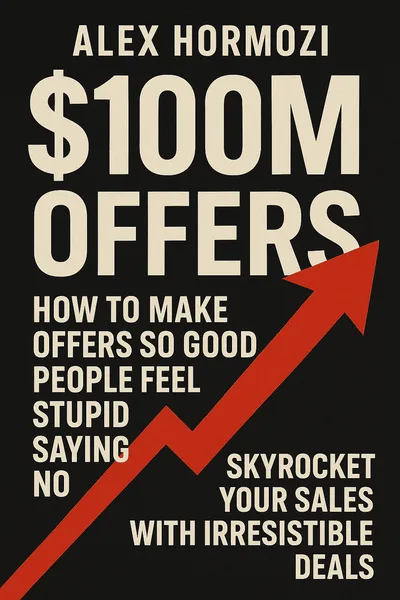
$100M Offers: How To Make Offers So Good People Feel Stupid Saying No
Skyrocket your sales with irresistible deals
Description
Hormozi's contribution emerges from the contemporary landscape of digital entrepreneurship and direct-response marketing, where traditional sales approaches have been disrupted by information abundance and consumer skepticism. The author positions himself within the lineage of business practitioners who seek to codify successful sales methodologies into replicable systems. This work reflects the broader trend of entrepreneurial literature that attempts to democratize business success through formulaic approaches, situating itself at the intersection of psychology, marketing theory, and practical business application.
The central research question driving this work asks: How can businesses construct offers that eliminate customer resistance and create overwhelming perceived value? Hormozi defends the thesis that superior business offers can be engineered through systematic manipulation of value perception, risk reversal, and strategic positioning rather than relying on traditional sales techniques. The main stake is to demonstrate that offer construction, rather than marketing execution or product quality, constitutes the primary determinant of business success.
Hormozi's contribution lies in his systematic codification of contemporary sales psychology into actionable frameworks that reflect deeper structural shifts within capitalism itself. His work reveals how modern commerce has evolved beyond simple value exchange toward sophisticated systems of psychological manipulation and desire engineering. The author successfully demonstrates that offer construction represents a crucial leverage point for business success, though his analysis remains constrained by its practical orientation and limited theoretical sophistication. The intellectual coherence of Hormozi's framework emerges from its recognition that contemporary markets operate primarily through perception management rather than objective value delivery. This insight aligns with broader trends in behavioral economics and marketing psychology while revealing the increasing sophistication of commercial manipulation techniques.
Table of contents
01 The Architecture of Perceived Value
Hormozi's theoretical framework rests upon the fundamental premise that business transactions occur within a psychological landscape where perception governs reality. His approach deconstructs the traditional notion of value as an objective measure, repositioning it as a subjective construct that can be strategically engineered. This perspective aligns with contemporary behavioral economics while departing from classical market theory that assumes rational actors operating with perfect information.

02 Risk Redistribution and Power Dynamics
The author's emphasis on risk reversal mechanisms reveals deeper power structures inherent in commercial relationships. By proposing that successful offers eliminate customer risk while concentrating it within the business entity, Hormozi exposes the fundamental asymmetries that characterize market exchanges. This approach challenges traditional risk-sharing models while reinforcing capitalist hierarchies where those with greater resources assume greater exposure.
03 Scarcity Engineering and Temporal Manipulation
Hormozi's deployment of scarcity principles reveals the sophisticated manipulation of temporal psychology within modern commerce. His framework transforms time from a neutral dimension into a strategic weapon, using urgency and exclusivity to override rational decision-making processes. This approach illuminates how contemporary capitalism has evolved to exploit cognitive biases rather than simply meeting utilitarian needs.
The systematic creation of artificial scarcity represents a fundamental departure from traditional economic models based on supply and demand equilibrium. Instead, Hormozi proposes a model where scarcity itself becomes a manufactured commodity, divorced from actual resource limitations. This approach reflects broader tensions within late-stage capitalism, where symbolic value increasingly supersedes use value.
04 The Commodification of Desire
The author's systematic approach to offer construction represents a sophisticated form of desire engineering that extends far beyond traditional marketing. Hormozi's framework reveals how contemporary business practices have evolved to shape not merely purchasing decisions but fundamental human wants and needs. This process represents a deeper form of commodification where the very capacity for desire becomes subject to commercial manipulation.
05 Critical Analysis and Future Implications
Hormozi's analysis suffers from significant theoretical limitations that constrain its broader applicability. His framework lacks engagement with critical perspectives on capitalism, consumer culture, and the ethics of persuasion, resulting in a superficial treatment of complex social phenomena. The author's exclusive focus on business efficacy ignores broader questions about social utility and ethical responsibility, reflecting the limitations of practitioner-oriented business literature.
The work demonstrates minimal awareness of existing academic literature in marketing psychology, behavioral economics, or critical business studies, resulting in the presentation of established concepts as novel innovations. This theoretical poverty limits the work's contribution to broader understanding of commercial relationships and market dynamics.
Related books