
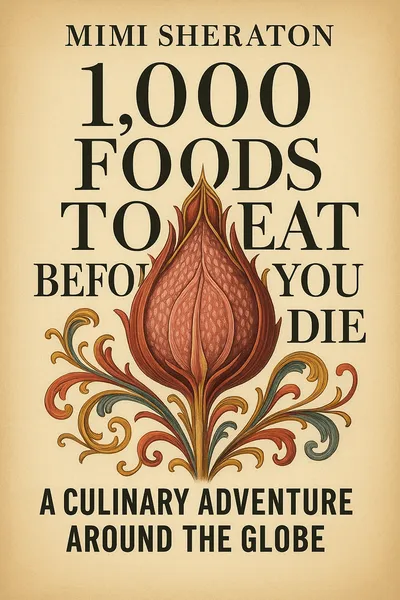
1,000 Foods To Eat Before You Die
A culinary adventure around the globe
Description
Mimi Sheraton's comprehensive culinary compendium emerges from decades of international gastronomic exploration, representing a systematic attempt to catalog humanity's most significant food experiences. Drawing upon her extensive background as a professional food critic and her travels across six continents, Sheraton constructs an ambitious taxonomy of essential culinary encounters. The work positions itself within the broader context of food studies and cultural preservation, addressing growing concerns about culinary homogenization in an increasingly globalized world.
The central research question driving this monumental work asks: What constitutes an essential culinary experience worthy of preservation and pursuit in contemporary global culture? Sheraton's defended thesis argues that authentic regional foods represent irreplaceable cultural artifacts that embody humanity's diverse heritage and deserve systematic documentation and celebration. The main stake of her endeavor is to establish criteria for culinary significance while advocating for the preservation of traditional food cultures against homogenizing forces.
Sheraton's ambitious project represents both a celebration of global culinary diversity and a response to perceived threats against traditional food cultures. Her systematic approach to cataloging essential culinary experiences creates a framework for understanding food as cultural heritage worthy of preservation and respect. The work succeeds in demonstrating the richness and complexity of global food traditions while advocating for conscious consumption as a form of cultural preservation. The intellectual contribution lies in establishing criteria for culinary significance that transcend mere pleasure to encompass cultural, historical, and social dimensions. Sheraton's framework provides tools for evaluating authenticity and cultural importance that extend beyond individual taste preferences to broader questions of heritage preservation.
Table of contents
01 Culinary Authenticity as Cultural Capital
Sheraton's conceptual framework relies heavily on Pierre Bourdieu's theory of cultural capital, positioning authentic culinary experiences as markers of sophisticated cultural knowledge. The author distinguishes between genuine regional specialties and commercialized approximations, establishing authenticity as the primary criterion for inclusion. This theoretical approach reveals underlying tensions between accessibility and exclusivity, as Sheraton's selections often privilege foods available only through specific geographic or economic access points.

02 Globalization and Culinary Homogenization
The author's selections reveal deep anxieties about cultural standardization and the loss of regional food traditions under global market pressures. Sheraton positions her catalog as resistance against what she perceives as the McDonaldization of world cuisine, advocating for the preservation of local food cultures through conscious consumption choices.
03 Class, Access, and Culinary Privilege
Despite democratic intentions, Sheraton's compilation reveals significant class-based assumptions about who constitutes the intended audience for such culinary adventures. Many selections require substantial financial resources, international travel capabilities, and cultural knowledge typically associated with educated elites. This creates tensions between the work's stated universal appeal and its practical accessibility.
04 Ethical Dimensions of Culinary Tourism
Sheraton's comprehensive catalog raises important questions about the ethics of culinary tourism and its impact on local communities. The promotion of specific regional foods as "must-try" experiences can lead to overtourism, price inflation, and the distortion of local food systems to meet external expectations.
05 Critical Assessment and Future Directions
The work's primary limitation lies in its uncritical reproduction of class and cultural hierarchies disguised as democratic accessibility. Sheraton's selections reveal implicit biases toward Western concepts of culinary sophistication and international mobility as prerequisites for meaningful food experiences. The absence of critical examination regarding the environmental and social impacts of promoted culinary tourism represents a significant blind spot.
Furthermore, the static conception of authenticity fails to account for the dynamic nature of living food cultures, potentially fossilizing traditions rather than supporting their organic evolution.
Related books